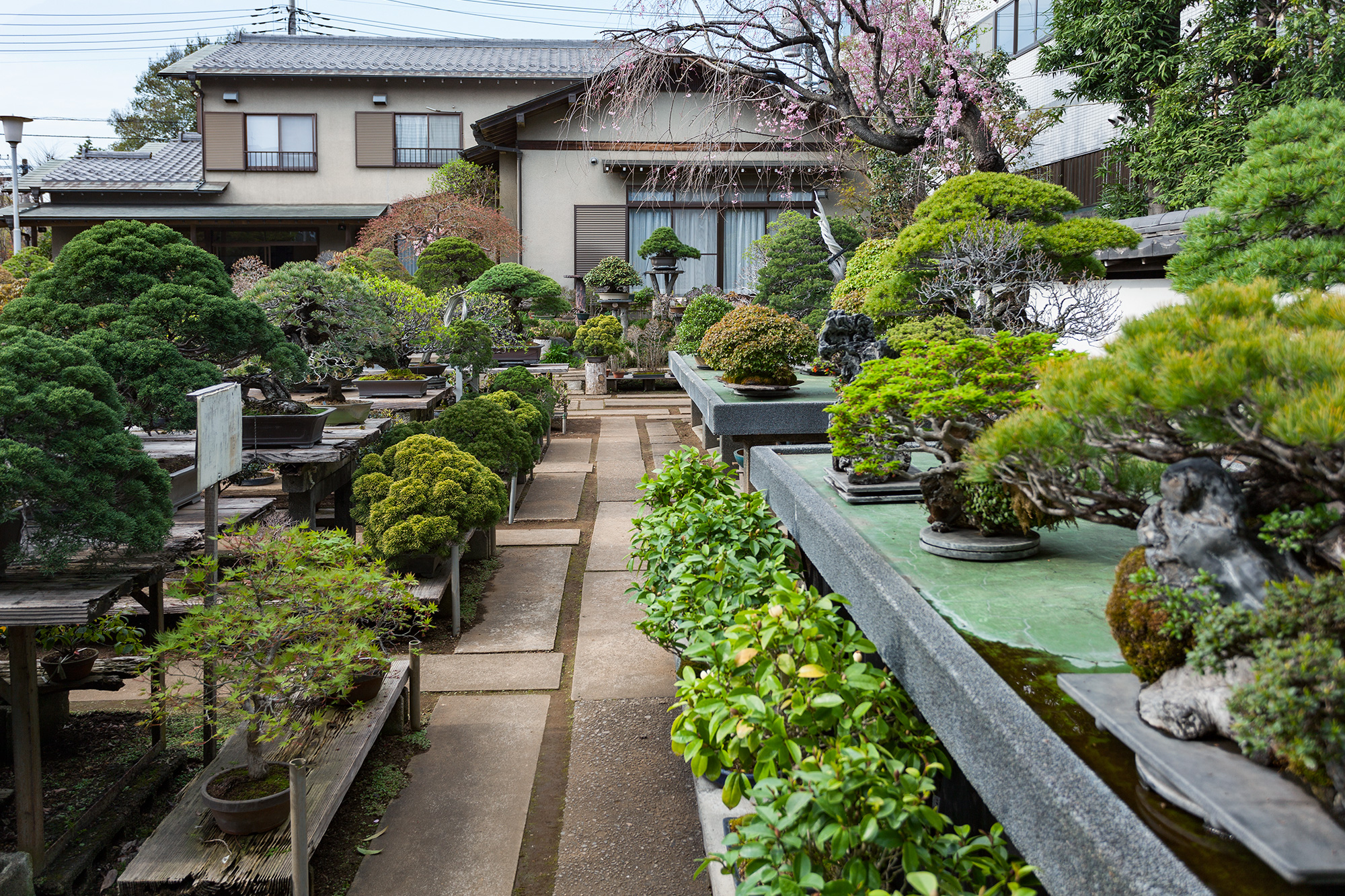
Fuyo-en, Omiya Bonsai Village. Photo by TypeZero, CC BY-SA 4.0, via Wikimedia Commons — Source

A bonsai trunk thickens by growing freely, with room for its roots to spread — in open ground or a large box, not in the shallow pot it will eventually be shown in. Almost all of a trunk's girth is built while a tree is still young and out of that pot; once it is confined and pruned back for display, thickening slows to almost nothing.
Why a pot stops a trunk from growing thicker
A tree adds girth to its trunk the same way it adds a new ring every year: by laying down wood to support whatever growth is happening above it. More leaves and more roots mean more of that wood gets laid down, and more of it gets laid down fast. A tree left alone in open soil, where its roots can spread without limit, keeps building both — and a fast-growing species can jump from a sapling's half-inch trunk to two or three inches across in as little as three years in the ground.
A tree in a shallow bonsai pot cannot do any of that. Its roots are cut back at every repotting, its container never grows larger, and its new growth is pinched back through the season rather than allowed to run. All of that is exactly what a finished bonsai needs — restraint is what keeps a tree small and holds its shape — but restraint is also what stops a trunk from getting appreciably thicker. A tree can spend decades in a bonsai pot refining its branches and its bark without its trunk's basic girth changing by much at all.
Where the thickening actually happens
That is why real trunk-building happens earlier, and outside the pot. Growers plant young stock in open ground or in a large wooden grow box for a period of unpruned, vigorous growth — commonly several years — before any bonsai styling begins. Left alone through that stretch, a young tree can put on a striking amount of wood: one often-cited field maple went from roughly one inch to fifteen inches in trunk diameter over eighteen years of ground growing, a pace no potted tree could come close to matching.
Within that same period, growers often use a technique called a sacrifice branch — a side branch or a leading shoot left to grow long and untouched for a season or several, purely to feed the section of trunk just below where it joins. A sacrifice branch thickens the trunk beneath its own base while leaving the trunk above unaffected, which lets a grower add girth to one part of a tree without over-growing the rest. Once that section is thick enough, the branch is cut away flush with the trunk, leaving a scar that closes over with time. Growers also use a related technique, the trunk chop — cutting a young trunk back hard partway through this growing stage so that a new leader shoot takes over, thickening in its turn and adding the bends and taper a straight sapling could not produce on its own.
Why this window closes
None of this happens twice. Once a young tree's basic structure is set and it moves into training as a bonsai — root-pruned, potted shallowly, and pruned back through each growing season — the conditions that made rapid thickening possible are deliberately removed, because they are the same conditions that would also make the tree too large to keep as a bonsai. A trunk's essential thickness is decided in those early years in the ground; almost everything that happens to it afterward, for the rest of its life in a pot, is about shape, bark, and branching rather than girth. We look at how long that early stretch from seed can take and at what growers actually do with the years once a tree begins that ground-growing stage in more detail elsewhere.
After the trunk is set
Once a trunk has its thickness, the years that follow measure something else entirely. We have written about mochikomi, the separate count of how long a tree has been trained inside a pot — a number that tracks refinement, not girth, and that can run for decades after a trunk's basic proportions were already decided in the ground. A finished bonsai's trunk is, in that sense, a record of one early period of the tree's life, carried forward and cared for ever since.
It is also one more reason a tree with real trunk character represents years that cannot be compressed. That patience — planting, waiting, cutting back, waiting again — is close to the same patience Azukari is built around: a tree kept in Japan, under a grower's continued hand, its work never really finished.
References
- Bonsai4Me — "Field Growing Trees for Bonsai" — growth-rate progression for field-grown stock, including the roughly 1-inch-to-15-inch trunk diameter increase over 18 years cited for one field maple.
- Bonsai Empire — "Working the Trunk of a Bonsai" — description of ground-growing, sacrifice branches, and the trunk-chop (cut-and-grow) technique.
- Evergreen Gardenworks — "Growing Thick Trunks for Bonsai" — on ground planting as the fastest route to large trunk diameters, and on growth slowing sharply once a tree is confined to a small container.
- Growing Bonsai — "Sacrifice Branches" — on how a sacrifice branch thickens only the section of trunk below its own attachment point, and how it is removed once its work is done.