
Stories
The Common Language of Hands
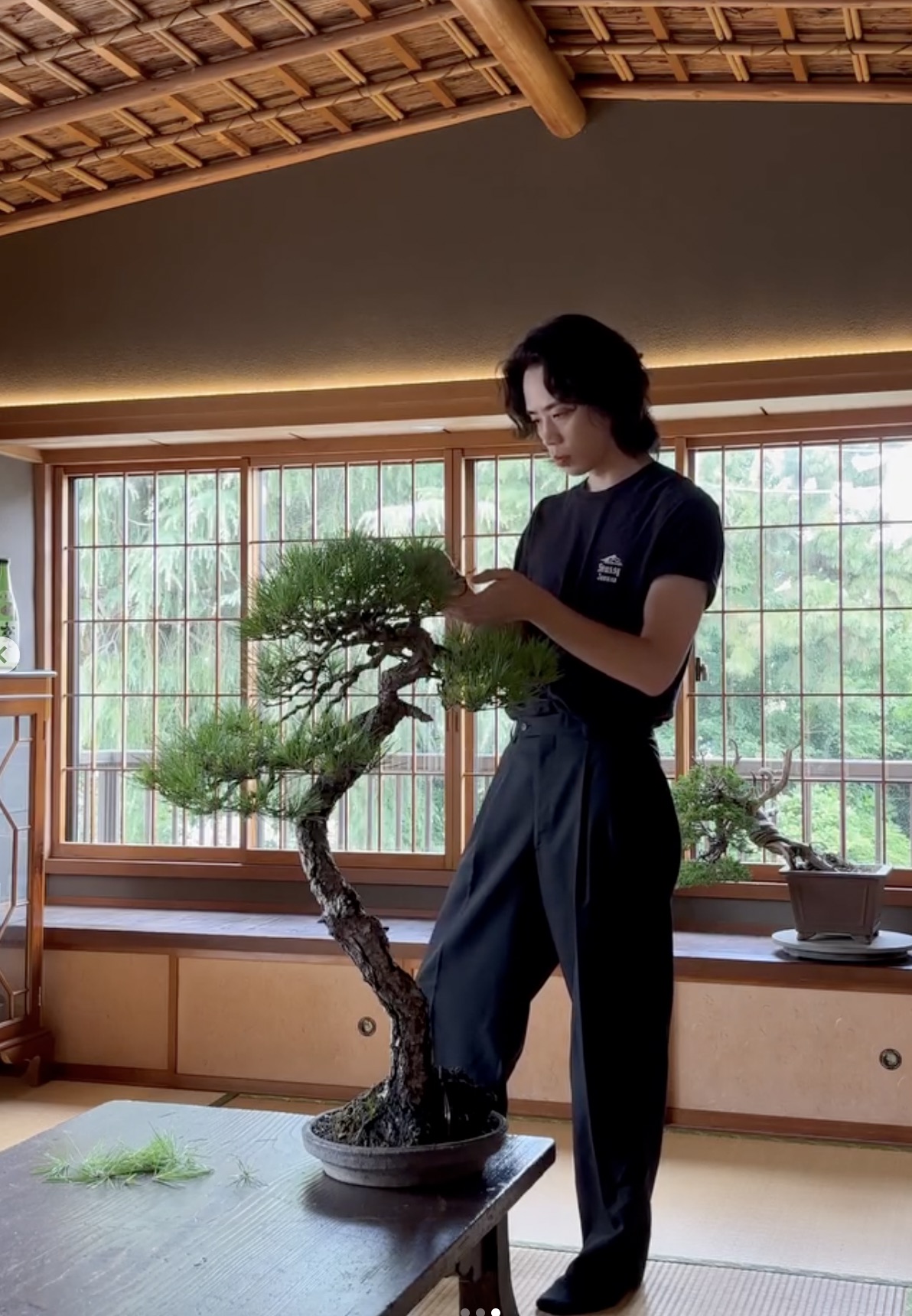
A demonstration hall in a country where the visiting artist speaks no local language, and most of the audience speaks no Japanese. An interpreter stands nearby for questions afterward, but during the work itself, nobody is translating. The artist lifts a branch, turns it, sets it down at a slightly different angle, and looks at the room. Pruning shears close. A wire is wound, evenly, without being asked to slow down. Two hundred people, most of whom could not order a coffee in the artist's language, watch the same motion and understand exactly what just happened to the tree.
Bonsai technique has always crossed borders mainly through the hands — through demonstration, observation, and imitation — with spoken language doing far less of the work than it appears to.
A craft that was never built on explanation
This is not a workaround discovered by necessity once bonsai went international. It is close to how the craft has always been taught, even inside Japan, between speakers of the same language. A nursery does not run on lectures. An apprentice is shown a form, not told a rule, and is expected to reconstruct the reasoning by watching it repeated — a habit sometimes called gijutsu wo nusumu (技術を盗む, "to steal the skill"), the old idea that a technique properly learned is one taken by close attention, not handed over pre-explained (1). The apprentice who asks "why this angle and not that one" too early is, in a sense, asking for a shortcut the craft was not designed to offer.
Once a training method already runs on watching rather than telling, exporting it across an actual language barrier changes remarkably little. The barrier was never mainly linguistic to begin with. Our companion piece on shu-ha-ri — the three-stage progression from obeying a form, to breaking it, to leaving it without forgetting where it began — describes the same structure: the first and most demanding stage, shu (守, "protect" or "obey"), asks a student to reproduce a form exactly, long before they are given, or need, a verbal account of why it works. A demonstration abroad simply compresses that same first stage into an afternoon, in front of a room that is doing more watching than a Japanese audience would, precisely because it has less to fall back on.
One artist, eleven countries, one season
Masashi Hirao offers as clear a documented case as exists. Named a Japanese Cultural Envoy by the Agency for Cultural Affairs for 2013, he spent four months that year travelling to eleven countries specifically to run bonsai demonstrations and workshops (2). The years around it show the same pattern repeated rather than a one-off tour: Spain, France, Holland, Italy, and Argentina before the envoy year; Italy, Germany, Holland, Slovakia, Lithuania, and Latvia the year after; Italy, Spain, France, Germany, Holland, Slovakia, Turkey, and the Czech Republic the year after that (3). Across those visits, the language in the room changed constantly. What Hirao brought to teach — how to read a trunk line, where to cut, how much wire is too much — did not need to change with it, because almost none of it was ever going to be delivered as a sentence.
This is not unique to one artist making an unusually long circuit. Our piece on Japanese craftsmen who travel abroad to teach covers the wider pattern of masters accepting invitations across borders. What Hirao's record adds is the range: demonstrations that worked, by every account, in rooms where he and his audience did not share a language at all, using the same tools a Japanese apprentice would recognize from a home nursery.
The tree as the shared vocabulary
None of this would work if the tree itself were not doing so much of the explaining. A branch cut too long looks wrong to a trained eye in any country. A wire pulled too tight leaves a mark that reads the same in Kyoto as it does anywhere else. Bonsai's actual vocabulary — proportion, taper, negative space, the balance of a silhouette — is visual before it is verbal, which is exactly why it survives translation this well. A demonstration communicates in that vocabulary directly, and an audience trained to look at trees can follow it without an interpreter doing much more than filling in names.
This has, in turn, given the craft an institutional shape built specifically around the demonstration rather than the lecture. The first World Bonsai Convention, held in Omiya in 1989, drew a reported 1,200 participants from 32 countries for four days centered on demonstrations and hands-on workshops rather than presentations (4) — a format choice that made sense precisely because the content travelled best that way. Video has since become the newest version of the same channel: enthusiasts now learn foundational technique from demonstration footage shot in a backyard on another continent, following the movement of a pair of hands on a screen the same way an in-person audience follows them across a demonstration table (5). The medium changed; the mechanism — watch, then repeat — did not.
What travels, and what still requires the years
None of this should be mistaken for a shortcut to mastery. A demonstration or a video can transfer a technique — how a cut is made, how a wire is wound — but not the years of judgment that tell an artist which technique a particular tree needs and when. That deeper transfer still runs almost entirely on the older, slower version of the same principle: watching one teacher, on one nursery floor, for years, which is the path our piece on foreign apprentices training inside Japan follows in full. What a single demonstration proves is narrower but still real — that the craft's basic grammar does not require a shared spoken language to move from one pair of hands to another. It only ever required a room willing to watch closely enough.
Azukari works from the same premise, on a smaller and more patient scale. An owner abroad and an artist in Japan rarely share a first language either, but the tree's condition, its seasonal record, and the work done on it are legible without one — the same hands-first vocabulary that has carried this craft across every border it has met so far.
For more, see our pieces on shu-ha-ri, foreign apprentices training in Japan, and Japanese craftsmen who travel abroad to teach.
References
- Japan Intercultural Consulting — "Gijutsu wo nusumu – Japanese workers 'stealing knowledge' to get ahead" — on the Japanese craft and workplace tradition of learning technique through observation rather than direct verbal instruction.
- Masashi Hirao — official site — record of his 2013 designation as a Japanese Cultural Envoy and his four-month, eleven-country tour of bonsai demonstrations and workshops.
- Bonsai Empire — Masashi Hirao — summary of Hirao's international demonstration and workshop appearances across Europe, the Americas, and Asia.
- Omiya Bonsai Village — History — attendance and country figures for the first World Bonsai Convention, held in Omiya in 1989.
- The Walrus — "How I Learned to Love Bonsai" — a first-person account of learning bonsai technique primarily through watching demonstration video rather than written instruction.