For most of its history, a bonsai apprenticeship was something a Japanese teenager entered, in Japanese, inside a Japanese nursery, under a master who assumed a shared language and a shared set of references. That is no longer entirely true. Over the past few decades, a small but steady number of apprentices from outside Japan have gone through the same years-long training as their Japanese counterparts — sweeping the same yards, watering the same rows of trees not yet theirs to touch, and eventually returning home to become teachers themselves.
A handful of non-Japanese artists have completed the full, years-long apprenticeship inside a Japanese bonsai nursery, and in doing so have become the first generation carrying the craft's training method — not just its techniques — beyond Japan.
Learning through the hands, before the words
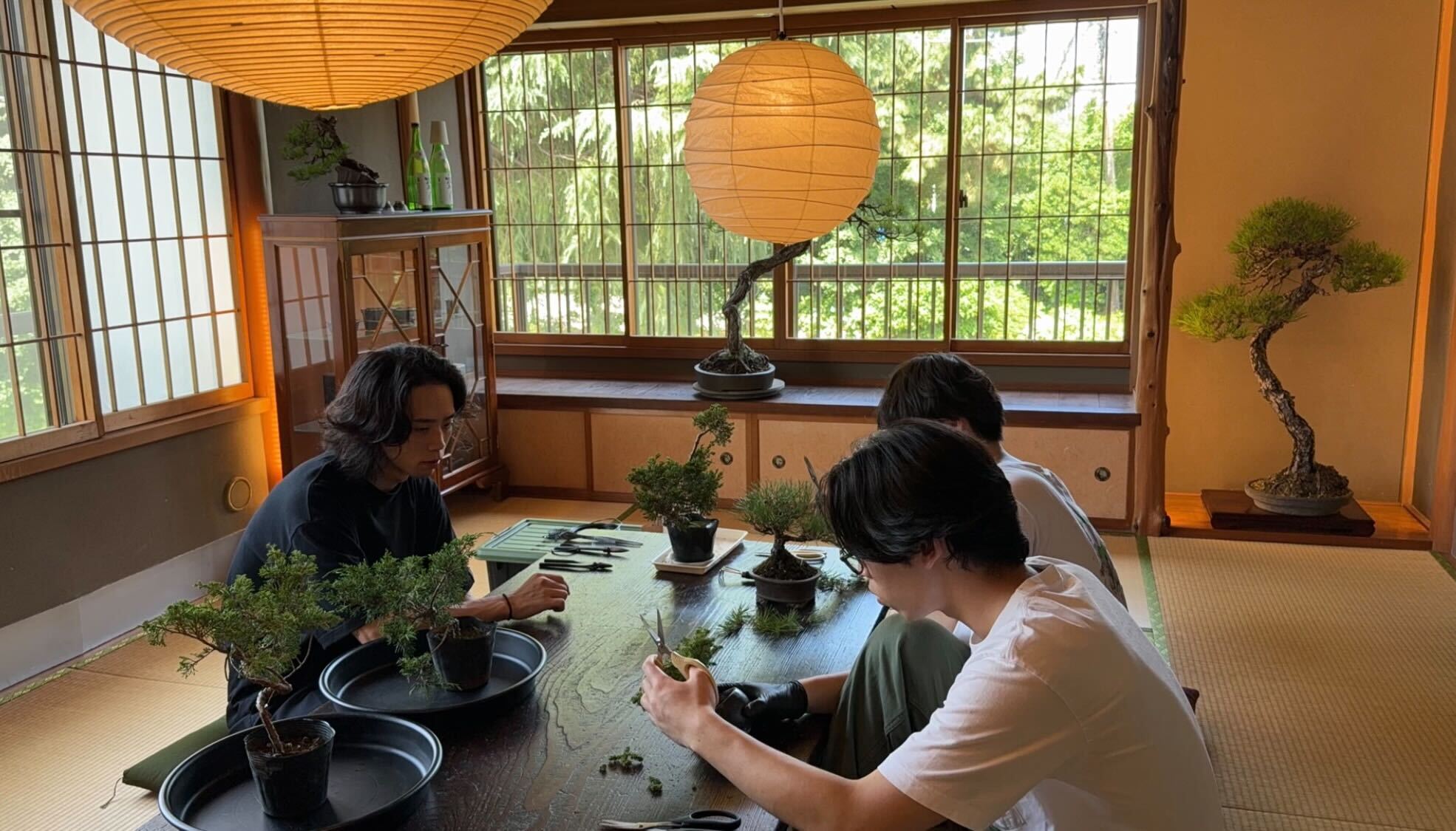
A bonsai nursery does not run on verbal instruction. As we wrote in an earlier piece on apprenticeship as time, Japanese craft training favors gijutsu wo nusumu (技術を盗む, "to steal the skill") over step-by-step explanation — an apprentice is expected to extract a technique through observation and repetition, not have it handed over in words. For a foreign apprentice, that habit compounds an already steep language barrier. Bonsai terminology is dense with vocabulary that resists easy translation, and a nursery's daily rhythm — how tea is prepared for visitors, how tools are laid out, how a senior hand is addressed — carries its own unspoken grammar. Apprentices who have gone through it often describe arriving with classroom Japanese and leaving having learned to read a tree, and a room, before they had fully learned to read the language spoken in it. The hands, in effect, become fluent before the ears do.
Years inside a workshop that is not their own
The structure itself does not bend for a foreign apprentice. Japanese craft lineages have long used the uchi-deshi (内弟子, "an apprentice who lives with the teacher") arrangement — a live-in apprenticeship found across kabuki, rakugo, and traditional workshops — and bonsai nurseries that accept foreign trainees run on close variations of the same pattern (1). Five to six years remains the term most often cited, the same span discussed in our piece on how a kata (型, "a fixed, inherited form") is put into the body over the three stages of shu-ha-ri (守破離), covered at length in our companion article.
Two documented cases illustrate what that looks like in practice. Ryan Neil, an American, is recorded as the first Western apprentice to complete a full six-year training under the celebrated bonsai master Masahiko Kimura in Saitama Prefecture (2, 3). Bjorn Bjorholm, also American, apprenticed for six years under Keiichi Fujikawa at Kouka-en nursery in Osaka, followed by three further years as an artist-in-residence — becoming, by his nursery's own account, the first foreign-born bonsai professional certified to work inside Japan (4, 5). Neither case is unique in kind; both are simply well documented. In each, the years were not a formality attached to a diploma. They were the entire mechanism by which judgment was transferred — the same mechanism a Japanese apprentice goes through, extended, without shortcut, to someone who began it in a second language.
Carrying the kata home
What distinguishes this small group of apprentices is not that they trained in Japan — visiting students and short courses have existed for decades — but that enough of them completed the full course to begin doing something new: opening nurseries and teaching programs of their own, outside Japan, built on the same training logic they had absorbed. Neil went on to found Bonsai Mirai outside Portland, Oregon, in 2010, describing its purpose as extending the dialogue between grower and tree that his own apprenticeship had opened (3). Bjorholm returned to the United States in 2017 to establish Eisei-en, a nursery and teaching garden in Tennessee, before later opening a second Eisei-en location in Japan aimed specifically at international students (4, 5). In both cases, the apprentice became the workbench the next generation gathers around — the same role a Japanese master once held for them.
This is a genuinely new development in a craft that, for most of its history, kept its training entirely inside Japan. It does not replace Japanese instruction; if anything, it depends on it, since every teacher in this new lineage still traces their own years back to a specific Japanese nursery and a specific master. What has changed is where a student can now go to begin, not where the craft's judgment originally comes from.
A craft finding a new way to pass itself on
None of this shortens the years required. If anything, the apprentices who have gone through it are among the most insistent that there is no faster route — that the judgment a nursery floor teaches cannot be taught by video or weekend workshop, only by years spent beside someone who already has it. Readers wondering whether this path is realistically open to them, and what the practical barriers look like, will find a more direct answer in our companion piece on training in Japan as a foreigner. This article has aimed instead at the larger shape of the thing: a craft that trained exclusively inside Japan for centuries is now, through a small number of long apprenticeships, learning to pass itself on beyond its own borders — without changing what "passing it on" actually requires.
Every tree still needs the same years of hands, wherever those hands were trained. Azukari works from that same premise, keeping each tree in Japan under an artist's ongoing care and turning that season-by-season work into a record its owner can follow — the craft's method, not just its trees, being the thing worth keeping intact.
For more, see our pieces on apprenticeship measured in years, on shu-ha-ri, and on the life of a bonsai artist.
References
- Wikipedia — Uchi-deshi — overview of the live-in apprentice system found across Japanese kabuki, rakugo, martial arts, and craft traditions.
- Wikipedia — Ryan Neil — biography noting his six-year apprenticeship under Masahiko Kimura in Saitama Prefecture.
- Bonsai Mirai — About — official account of Ryan Neil completing a six-year apprenticeship under Masahiko Kimura and founding Bonsai Mirai in 2010.
- Wikipedia — Bjorn Bjorholm — biography of his apprenticeship under Keiichi Fujikawa at Kouka-en nursery in Osaka.
- Bjorn Bjorholm — Staff bio — official bio detailing his six-year apprenticeship, three years as artist-in-residence, and his return to the US to found Eisei-en.