
Stories
When Japanese Masters Travel
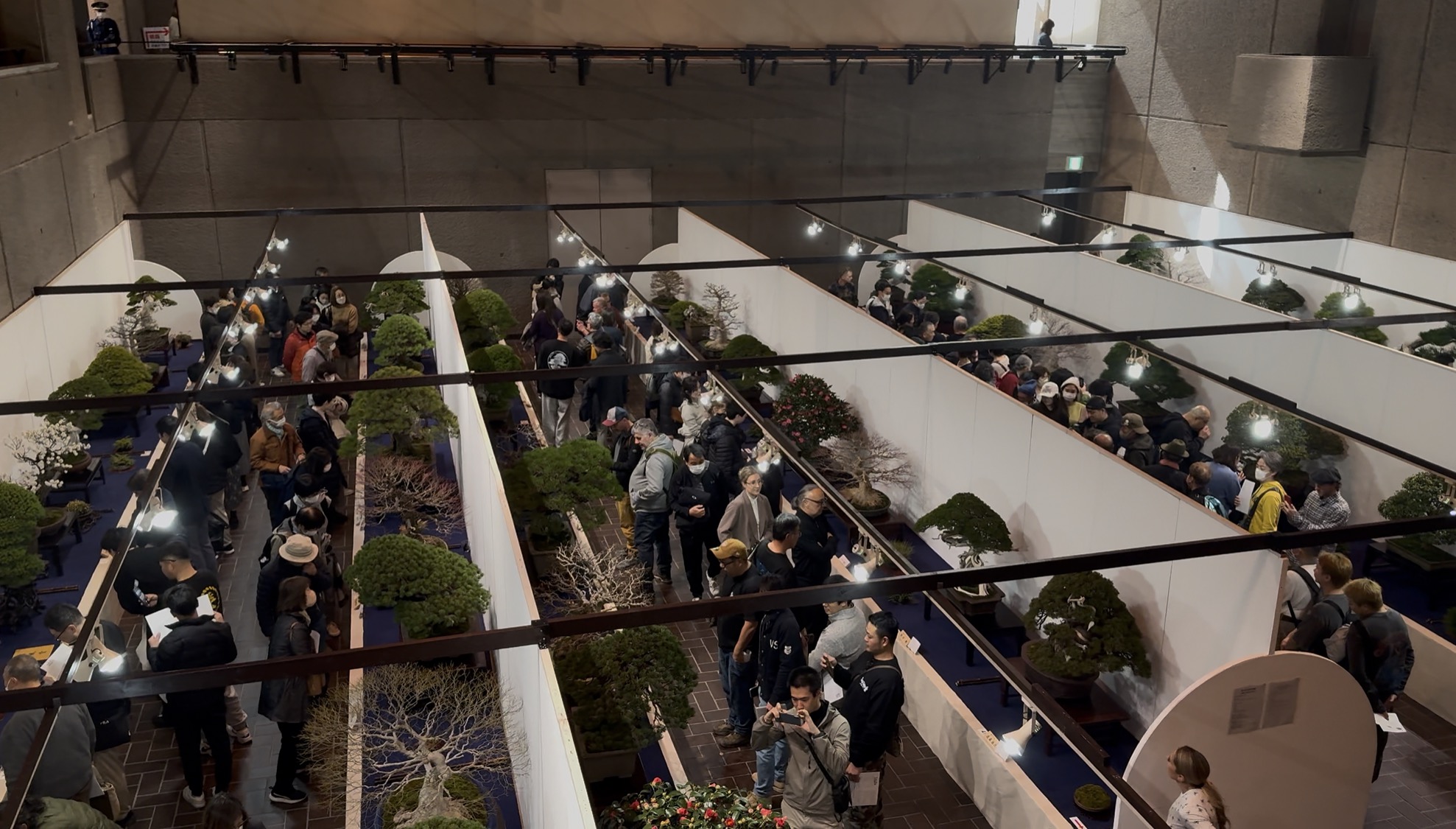
An international audience at the Kokufu Bonsai Exhibition. The same curiosity that draws visitors to Japan increasingly pulls Japan's senior artists the other way.
A small number of Japan's most senior bonsai artists now spend part of every year not at their own nurseries, but on demonstration stages, in workshops, and at conventions outside Japan.
A career that used to end at the coastline
For most of bonsai's modern history, reaching the top of the profession meant staying in Japan. Prestige was built inside a small number of institutions — the Kokufu-ten and Sakufu-ten exhibitions, the iemoto (家元, head-family) lineages of the major schools, a client list of domestic collectors who could see a tree in person before buying it. A master's reputation was made, defended, and consumed almost entirely within Japan's borders.
That pattern has not disappeared, but it is no longer the whole picture. A first generation of senior, Japan-based artists — men who built their reputations the traditional way, through decades of exhibition wins and apprentices trained at home — now also fly out several times a year to stand in front of foreign audiences and work on a tree in real time. The nursery in Saitama or Nagano stays put. Its owner increasingly does not.
Three decades of demonstration circuits
Kunio Kobayashi offers the clearest long record of this shift. A four-time Prime Minister's Award winner who opened the Shunkaen Bonsai Museum in Tokyo in 2002, Kobayashi has, by his own museum's account, given overseas demonstrations across roughly a dozen cities in Italy and Spain alone since the mid-1990s, plus further stops in Switzerland, Germany, San Marino, the United States, Taiwan, and Australia. He describes the motivation simply, as a wish "to spread the beauty of Bonsai worldwide" — pursued not instead of teaching at home, but alongside it; his own museum notes that he trains apprentices "from Japan and from the rest of the world" in the same rooms.
What Kobayashi's decades of touring show is that this is not a young artist's side hustle. It is senior, exhibition-tested masters choosing to spend part of an already full career explaining, in public and in a foreign country, decisions they could just as easily make in private at home.
When the government joins in
The clearest sign that this travel has become something larger than individual initiative is that Japan's own cultural institutions now help organize it. In 2013, the Agency for Cultural Affairs named bonsai artist Masashi Hirao a bunka koryushi (文化交流使, "Cultural Envoy"), a government-appointed role that sent him abroad for four months across eleven countries to teach bonsai. Hirao has said his own teacher, the influential Saburo Kato, was the one who first urged him to "go abroad and promote Bonsai in the world" — a rare instance of a domestic master actively pushing a student toward the door rather than keeping him close.
That same year, bonsai artist Takahiro Mori — then working as an in-house artist at the Omiya Bonsai Art Museum — travelled to Košice, Slovakia, the European Capital of Culture for 2013, as an official demonstrator, and later represented Japan's government as a bonsai expert at the EXPO 2016 Antalya International Horticultural Exposition in Turkey. Mori now also runs bonsai classes in California, a standing commitment rather than a one-off appearance. Between an artist like Kobayashi building his own touring schedule and an artist like Mori appearing as part of an official Japanese delegation, invitations for Japanese craftsmen to represent the country abroad now arrive through both private and institutional channels.
Still happening, and still rare enough to matter
This is not a settled, decades-old routine that has since become ordinary. Shinji Suzuki — holder of more Prime Minister's Awards than any other bonsai artist in Japan, and by most accounts one of the most influential living masters — travelled to the Portland Japanese Garden in July 2026 for demonstrations, a fireside talk, and a public conversation with local bonsai practitioners. The garden's own description called it "a rare visit to the United States." Even for an artist at the very top of the field, crossing the Pacific for a demonstration remains an event, not a routine stop on a circuit.
That rarity is part of what makes the invitations meaningful. A demonstration by a master of Suzuki's or Kobayashi's standing is not a marketing appearance; it is one of the only ways an audience outside Japan can watch decisions of that caliber made in real time, on a tree that will still be standing — and still be someone's responsibility — long after the artist has flown home.
Why staying home is no longer the only path to authority
None of this is quite the same story as the foreign apprentices who move to Japan to train, or the small number of Western professionals who complete a Japanese apprenticeship and then open studios of their own abroad. Those are artists moving toward Japan, or carrying a Japanese training method away from it permanently. What is described here runs the other direction: masters who remain based in Japan, whose authority was built entirely inside the Japanese exhibition system, choosing to extend that authority outward rather than defend it by staying put.
A generation ago, a bonsai career built any other way would have been a lesser one. Today, an artist's reputation can be recognized, and actively sought out, by institutions and collectors who have never set foot in Saitama. Bonsai's technical language survives translation unusually well in the first place — see The Common Language of Hands — because so much of what a demonstration teaches is shown rather than explained. A master does not need to give a lecture to be understood; the hands do most of the talking, the same way they do at home. That is one reason invitations keep arriving: the craft itself travels more easily than most.
What stays behind
For all the travel, one thing about these artists rarely changes: where their own trees live. A demonstration abroad is usually performed on material already growing in the host country, or occasionally on a tree brought along for the trip and left behind afterward — not on the decades-old stock waiting on benches back in Japan. The master returns; the bulk of the collection does not travel with him.
That distinction — a craftsman's expertise moving freely across borders while the trees themselves mostly stay rooted where they have always grown — says something quiet about what a shokunin's training is actually built to carry. What travels is judgment: years of decisions made by hand, portable in a way that a hundred-year-old pine, still under seasonal care in a Japanese nursery, is not. The tree stays home. Increasingly, the person who knows it best no longer has to.
References
- Kunio Kobayashi — Shunkaen Bonsai Museum, official biography — list of overseas demonstrations by country and year, 1996–2011, and background on the Shunkaen Bonsai Museum.
- bonsaihirao.net — Masashi Hirao — Hirao's 2013 designation as a Japanese Cultural Envoy, four months across eleven countries, and Saburo Kato's encouragement to teach abroad.
- The Japan Foundation — Wochi Kochi Web Magazine, "A Path for a Bonsai Master" — Takahiro Mori's 2013 demonstration in Košice and his role as a bonsai expert at EXPO 2016 Antalya.
- Portland Japanese Garden — "The Way of Bonsai with Master Artist Shinji Suzuki" — details of Suzuki's July 2026 visit, described as a rare U.S. appearance.