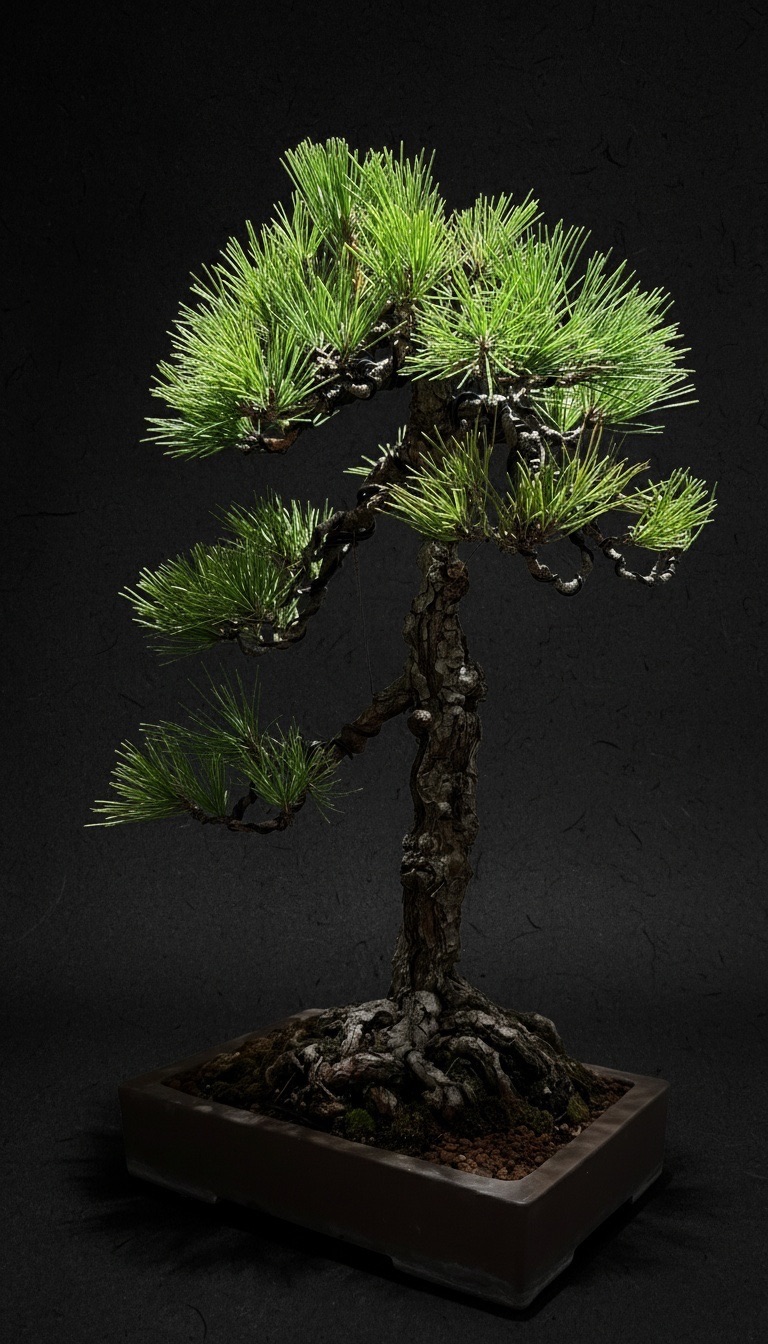
Japanese black pine, the classic rootstock onto which finer foliage is grafted / Photo: Azukari
A bonsai's most convincing branch is sometimes not one the tree grew for itself. A trunk thickens where an artist wants it to and tapers the way decades of pruning direct, but a tree does not always put out a bud in the exact spot a design calls for — a gap at the back that needs filling, a first branch that never formed low enough, foliage too coarse for the refinement the rest of the tree has reached. Tsugiki (接ぎ木, "grafting") is the technique that solves this directly: taking living material from one tree and joining it, permanently, into another.
Grafting lets an artist put a branch, or an entire style of foliage, exactly where a design calls for one, then spends years making sure no one can tell it was ever added.
A branch made to order
A trunk that has been developing for a decade can still be missing exactly the branch a design needs. Reading a bonsai's branches means recognizing the working order a tree is meant to grow in — a first branch low and to one side, a second answering it, a back branch adding depth — and a tree left to its own habits does not always oblige with wood in the right place. One grower working on an older black pine put the problem plainly: after years of development the tree still needed "a few more branches" before it could be reduced to its intended, final height. Rather than wait on the chance that a bud breaks where it is needed, or settle for whatever the tree happens to offer, an artist can graft a branch directly into the trunk at the point the design requires.
Joining a branch from another tree
The material added this way is called the scion, and the tree receiving it is the rootstock. The most traditional method is kiritsugi (切り接ぎ, "cleft grafting"): a small, healthy shoot is cut from a donor tree, its base shaped into a wedge, and set into a matching incision cut into the trunk or branch that needs it, so the thin green cambium layer just under the scion's bark meets the cambium of the rootstock precisely. For species that resist taking a severed cut cleanly — Japanese maple among them — growers instead use yobitsugi (呼び接ぎ, "approach grafting"): the donor branch is left attached and living on its own tree, its pot set beside the one being worked, and the two are bound together at the point of contact until they fuse, with the branch cut free from its parent only after the union has taken hold.
The pairing that appears again and again in pine bonsai puts kuromatsu (黒松, "Japanese black pine") to work as rootstock and grafts on scions of goyomatsu (五葉松, "Japanese white pine"): black pine's vigorous, disease-resistant roots and thick trunk carry the tree's structure, while the grafted white pine supplies the tighter, five-needle foliage the species is prized for. Juniper growers do something similar with shimpaku (真柏): foliage from the fine-scaled Itoigawa variety is commonly grafted onto sturdier rootstock — San Jose, prostrata, and related junipers — so that a trunk with dramatic curves or old, weathered deadwood ends up carrying foliage far more refined than what it originally grew.
A join that time is meant to erase
The measure of a well-made graft is not that it holds. It is that, within a few years, it becomes unreadable — no visible line, no swelling, no evidence that two separate trees were ever joined. That result depends on precision that is mostly invisible from outside: the scion is cut and set so its cambium and the rootstock's meet exactly, usually in late winter before the season's buds swell, since sap moving too freely on a warmer day can flood the cut before the tissues make contact. The union is then wrapped and covered — grafting tape, sometimes a bag of moist sphagnum moss — to hold humidity around the wound while new tissue bridges the two sides, a covering often left in place for a year or more before it is finally removed. Done correctly, growers report, the resulting scar becomes essentially invisible over time. The multi-year progressions documented with juniper grafts, in which a grower slowly removes each of the original branches only after the grafted foliage has filled in enough to replace them, show how gradual and deliberate that disappearance is meant to be.
Working backward from a tree not yet finished
None of this makes sense without a plan already in mind. An artist who reaches for a graft has usually already pictured the tree's finished silhouette — where the branches should sit, how the foliage should read, years or even decades before the tree will actually look that way — and grafting is one of the few techniques capable of adding material that a season of ordinary growth cannot supply in time. It sits alongside wiring and hard pruning as one of the tools reached for specifically when nature's own timeline does not match the artist's. Rather than accept what a tree happens to produce on its own, a grafting decision starts from the tree that does not exist yet and works backward to what needs to be added, by hand, to get there.
Closing
What makes tsugiki distinctive among bonsai techniques is how little credit it is built to receive. A wired branch still shows the bend that shaped it; a pruned trunk still shows the taper that resulted. A successful graft, by design, shows nothing at all — the years of matched timing, careful humidity, and patient waiting are visible only in the fact that a viewer cannot find them. It is a quiet kind of standard, one echoed in Azukari's own model: trees under an artist's ongoing care in Japan continue to receive exactly this kind of technical intervention, season after season, and it is kept as part of the tree's record even though, on a well-grafted tree, the work itself may never show.
For more on how a tree's structure comes together, see "How to Read the Branches," "Wiring: A Dialogue with the Branch," and "Toriki: Air-Layering."
References
- Bonsai Empire — Grafting Trees as Bonsai Cultivation Technique — scion, approach, and thread grafting methods; timing by method; the need for cambium contact; species compatibility; grafts becoming invisible over time.
- Bonsai Tonight — Trunk Grafting: Black Pine — grafting a branch onto a specific point on a black pine trunk, scion preparation, cambium alignment, and cold-weather timing.
- Bonsai Tonight — Four-Year Progression: Making a Shimpaku Juniper from Graft — grafting Itoigawa shimpaku foliage onto prostrata juniper rootstock and the multi-year removal of the original branches.
- Bonsai Kreativ — Pine Grafting (Japanese: Tsugiki) Step by Step by Josef Burschl — scion preparation, wedge cuts, cambium matching, and protecting the union with tape and parafilm.
- Bonsaimyo — 接ぎ木 (Tsugiki) — Japanese-language glossary entry on grafting types, including branch grafting, root grafting, and approach grafting, and their uses in bonsai cultivation.