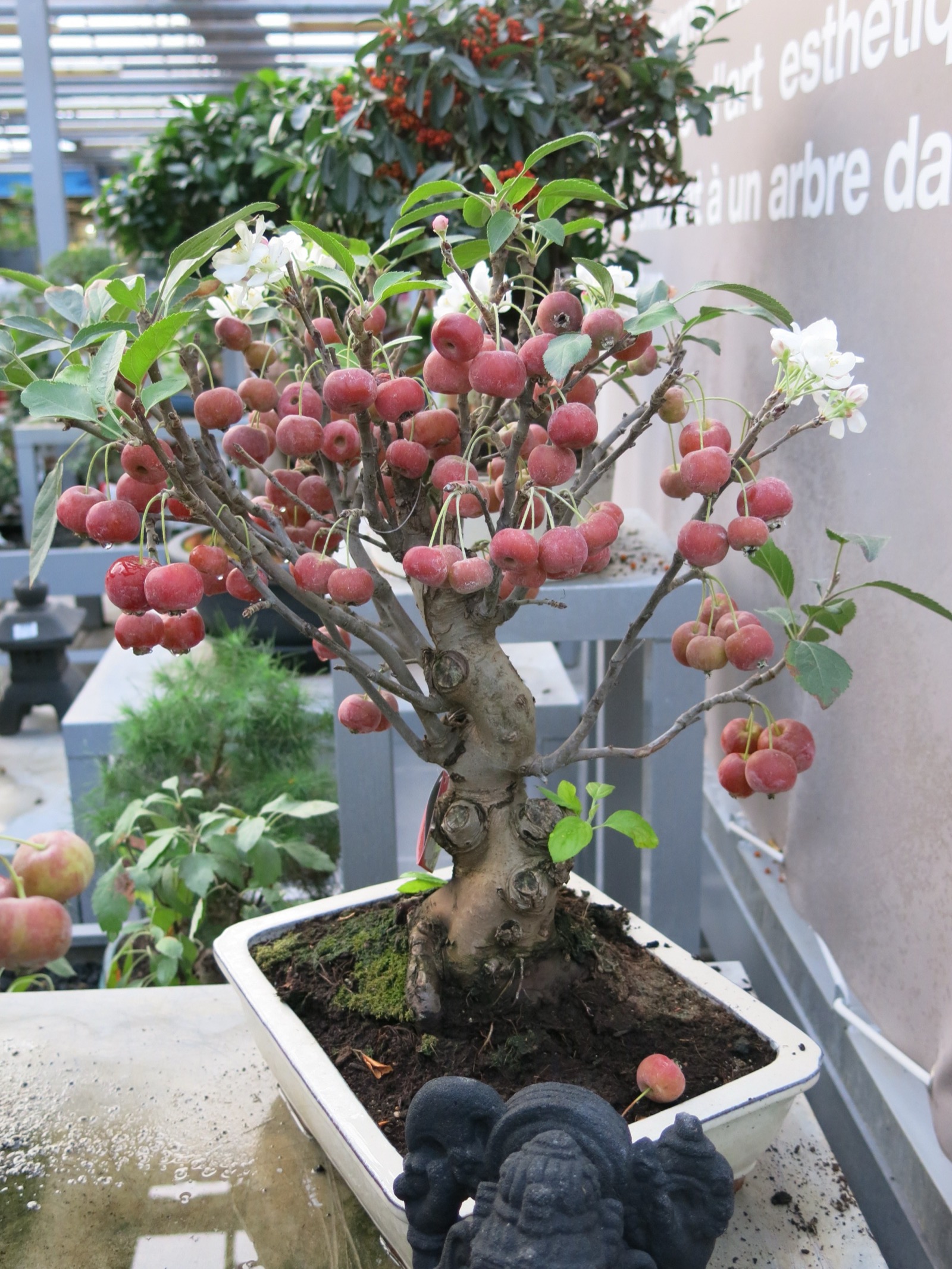
A himeringo in bloom carries two colors on the same branch at once: the flower buds open red, then pale to white as they unfurl, so for a few days in April a single twig shows both together before settling into white. Half a year later, the same branches carry something else entirely — small round fruit, one to two centimeters across, strung close enough along the twigs to look, from a few feet away, like a string of red beads. No other stretch of the bonsai calendar hands a single small tree two such different reasons to look at it.
Himeringo is a miniature crabapple bonsai whose spring flowers and autumn fruit are separated by months, not simultaneous — and it is precisely that fast, visible payoff in both seasons that leads Japanese growers to recommend it as a first fruiting bonsai.
This Apple Was Bred to Be Looked At, Not Eaten
Himeringo (姫りんご, "princess apple") is the common Japanese name for a small ornamental crabapple trained as bonsai. Sources do not fully agree on a single scientific name for it. Several Japanese nursery guides classify it as Malus prunifolia, a species also sold in Japan under the name inuringo (犬林檎, literally "dog apple," a term used for inedible, ornamental relatives of the eating apple). At least one detailed growers' account instead describes himeringo as a garden hybrid bred from ezo-no-koringo (蝦夷の小林檎, a wild crabapple native to Hokkaido) crossed with Chinese-origin inuringo stock. What both accounts agree on is the plant itself: a hardy, deciduous member of the rose family, in the same genus as the eating apple, bred and selected for its flowers and fruit rather than for anything worth eating. According to several Japanese care guides, the fruit itself is nearly dry inside and sharply sour — grown to be looked at, never tasted.
The Buds Open Red and Settle Into White
Spring is the first of himeringo's two seasons. Japanese bonsai care guides describe the flower buds opening red and turning white as they unfurl, so a tree in bloom carries both colors on the same branch for a few days before settling into white. Most sources place the bloom in mid-to-late April, and more than one description compares the effect, at this smaller scale, to a cherry tree in flower.
Like many members of the apple genus, himeringo does not set fruit reliably from its own pollen. Japanese growers typically hand-pollinate it, or keep it near a related flowering crabapple such as kaido (海棠, Malus halliana), so that cross-pollination between the two trees can set a fuller crop of fruit. A himeringo grown alone, several care guides note, tends to flower generously but fruit thinly — the flower alone is not enough; it needs a neighbor to finish what it starts.
The Fruit Takes All Summer to Turn Red
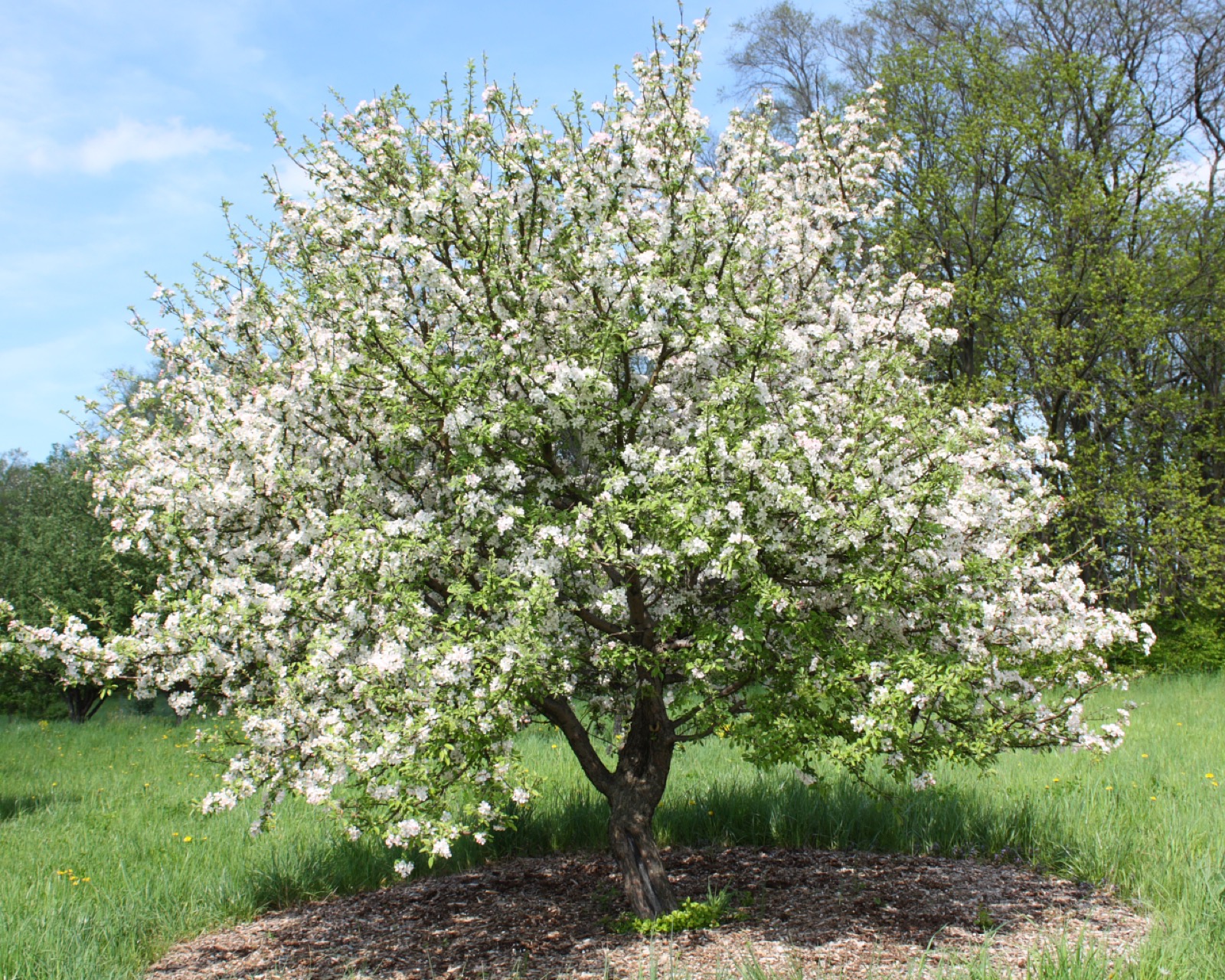
The same white blossom at full size. Himeringo is trained small, but the flower belongs to an ordinary crabapple that, left untrained, grows into a tree like this one.
By autumn, a well-pollinated himeringo carries small round fruit, commonly described as roughly one to two centimeters across, ripening from green to a deep red. Japanese guides consistently describe the fruit as hanging in clusters along the fine branches, close enough together that a well-fruited tree can look, from a short distance, as though it were strung with tiny red beads. The fruit sets in early summer and does not fully color until autumn, so between the two showiest moments there is a slower one: months of watching green fruit darken by degrees.
Bare Branches Let the Fruit Take Over
Once the leaves begin to color and drop, the red fruit is left standing largely alone against bare branches, and this is the point at which a himeringo reads most clearly as an autumn tree. Because the fruit tends to hold on the branch well after the leaves have gone, a single small tree can carry that look for weeks at a stretch, which is part of why it is a familiar presence in Japanese autumn bonsai displays and seasonal arrangements. Keep this in mind if you tend more than one bonsai on the same bench: apples and crabapples can be affected by a rust disease that alternates between Malus and juniper hosts. Several Japanese care guides recommend keeping himeringo at some distance from shimpaku or other juniper bonsai for that reason.
Mistakes Rarely Kill It
Himeringo asks for close attention to water, especially while it is flowering or carrying fruit, since a pot this size dries quickly and a dry spell at the wrong moment can cause fruit to drop before it colors. Beyond that, Japanese guides describe it as a forgiving species: it tolerates the kind of cutting-back that keeps a small bonsai small, it responds well to repotting on a fairly short cycle, and it recovers readily from the ordinary mistakes of a first year with a tree. If you are choosing a first fruiting bonsai, that combination is the thing to look for: a species that pays back attention quickly and does not punish an early mistake too harshly. It is why several Japanese bonsai guides point to himeringo specifically, in much the same spirit that mame bonsai is recommended as a first bonsai of any kind.
Two Seasons, One Small Pot
None of what makes himeringo forgiving makes it a lesser bonsai. The same watching for new growth, the same judgment about which branch to shorten, the same attentiveness to water at the moment it matters most — all of it is present here, compressed onto a tree that fits easily on a windowsill and asks for a keeper's attention twice a year instead of once. Alongside other flowering bonsai grown for a single spring window, and other fruiting species such as the princess persimmon or the pomegranate, himeringo's particular gift is refusing to pick a single season to be good at: not flower alone, not fruit alone, but a full year's cycle tight enough that neither wait feels long.
References
- Bonsai Empire — Care guide for the Apple and crabapple Bonsai tree (Malus) — general watering, pruning, repotting, and placement guidance for crabapple and apple bonsai.
- キミのミニ盆栽びより — 姫林檎(ヒメリンゴ)の魅力 — classification as a hybrid of ezo-no-koringo and inuringo, red-to-white flower color change, April–May bloom, and October–November fruit ripening.
- キミのミニ盆栽びより — ヒメリンゴの育て方 — seasonal watering schedule, pruning and pinching timing, repotting cycle, and the rust disease that requires separating himeringo from juniper bonsai.
- 趣味盆栽のブログ — 姫林檎(ヒメリンゴ)盆栽の育て方 — recommendation of himeringo as a beginner-friendly first fruiting-and-flowering bonsai, fruit size of roughly 1–2cm, and flower color compared to cherry blossom.
- e-bonsai.org — ヒメリンゴ盆栽(ひめりんご・姫林檎)実もの盆栽の「販売と育て方・作り方」 — self-incompatibility within the apple genus requiring cross-pollination, native distribution from Hokkaido to Kyushu, and repotting soil mix.