
Culture
Bonsai in Pop Culture
— many doors, one tree
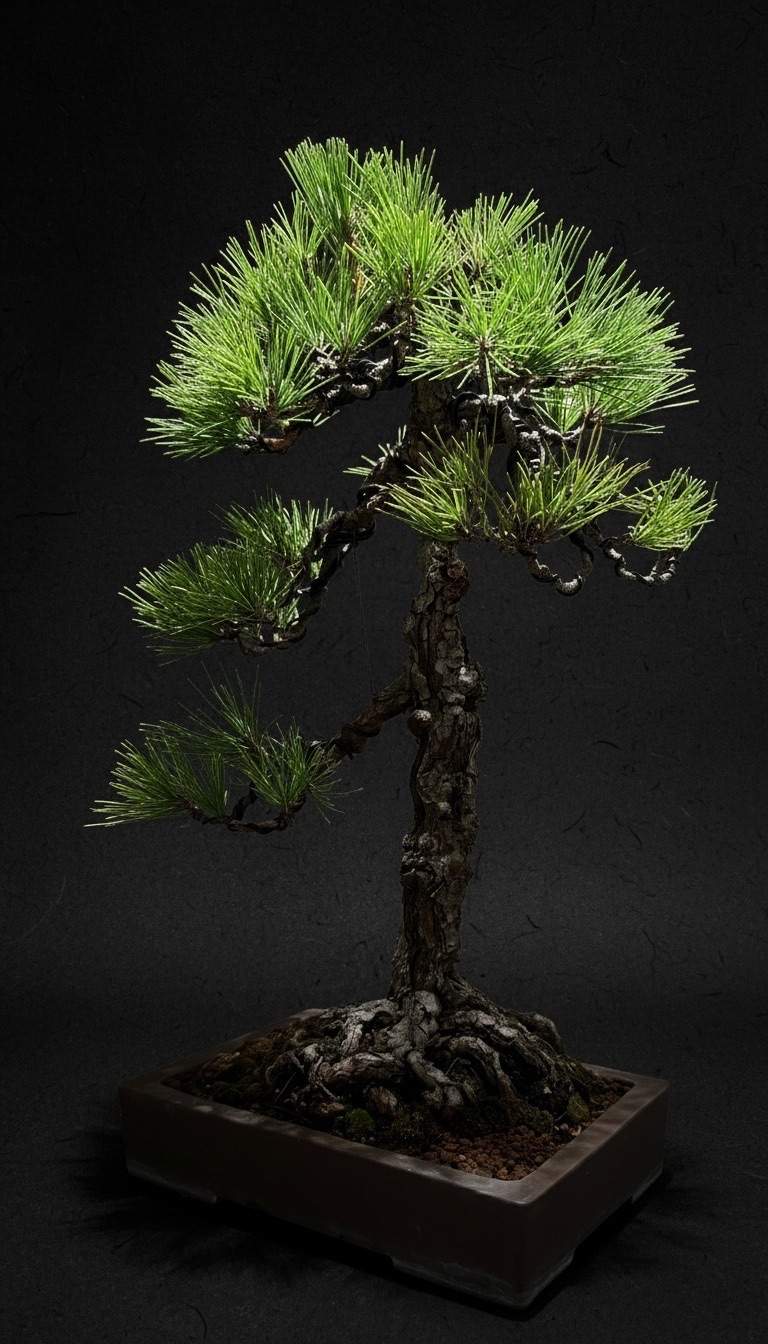
Ask someone outside Japan how they first heard the word bonsai (盆栽, "a planting in a tray"), and the answer rarely traces back to a nursery, a museum, or a book on Japanese horticulture. More often it traces back to a screen — a film scene half-remembered from childhood, a shelf display in a gift shop, a slow little game played late at night. Long before most Western audiences ever stood in front of a living bonsai, they had already met an image of one.
Popular culture, more than any horticultural text, built the outside world's first picture of what a bonsai is — and that picture has kept arriving through new doors ever since.
A tree introduced before it was explained
No single work did more to fix that picture in the Western imagination than The Karate Kid, John G. Avildsen's 1984 film, which returned again and again to shots of Mr. Miyagi tending a small potted tree. The film was a runaway commercial success — a reported domestic gross of roughly $91 million against a production budget of $8 million — and it reached far more households than any bonsai exhibition or specialist publication of its era could have. For a large cohort of viewers, that was the first time the word bonsai meant anything at all.
The Karate Kid is only one entry in a longer catalogue. Bonsai have since appeared, briefly, in productions as different as Cowboy Bebop, where a bounty hunter aboard a spaceship tends one between jobs, and a range of other films and series where a potted tree signals patience, restraint, or a character's inner stillness. How those individual scenes use a bonsai as a storytelling device — what the presence of a small, unmoving tree actually does inside a script — is its own subject, and one we have looked at closely elsewhere, in Bonsai in Film and Anime. What matters here is the wider pattern: across four decades and dozens of unrelated productions, filmmakers kept reaching for the same object to say something without dialogue, and audiences kept absorbing the association.
The generation Miyagi taught
A film image is not the same thing as a tree. But The Karate Kid did something a documentary or a manual rarely manages: it planted the idea early, in people who were children or teenagers at the time, long before they had any way of acting on it.
Bonsai clubs and specialist growers outside Japan have, in the decades since, become used to hearing some version of the same origin story from newer members: a scene glimpsed in that film, or in Karate Kid Part III, where Mr. Miyagi tells a damaged tree it has "strong root" and needs nothing but what is already inside it to grow — a line still quoted, decades later, by hobbyists with no connection to the film industry at all. No reliable sales figures tie the film directly to a measurable jump in bonsai's popularity abroad; what can be said with more confidence is anecdotal but consistent — enough individual growers cite the same two-hour film as their starting point that it amounts to something close to a shared origin myth for an entire generation of Western practitioners. A hobby that might otherwise have stayed confined to specialist circles gained, through one commercial film, a first foothold in ordinary households.
Beyond the screen: games and official keepsakes
Film was the loudest door, but not the only one. In 2016, the independent studio Rooted Concepts released Bonsai on the digital storefront Steam, a slow, procedurally generated simulation in which the player prunes and shapes a virtual tree over its lifespan rather than racing toward any fixed goal. Other small studios have since released their own bonsai-growing games in the same unhurried register, built around the same premise: there is nothing to win, only a tree to keep tending.
Studio Ghibli has taken a different route into the same territory. Its Donguri Kyowakoku shop line sells battery-powered "water garden" dioramas styled as small bonsai landscapes, recreating scenes from My Neighbor Totoro, Princess Mononoke, and Spirited Away, complete with a working water trickle. None of these objects is a bonsai in any horticultural sense — no root, no living growth, no seasonal care. But the choice of form is not incidental. When a studio famous for its own patient, unhurried pacing wanted a physical object to sell as a piece of that atmosphere for a shelf at home, it reached for the shape of a tree in a tray.
The entry point can be anywhere
None of these doors — a 1980s martial-arts film, a browser-era indie game, a display case in a Tokyo gift shop — actually teaches anyone to grow a tree. What each one offers is smaller and, in its way, more useful: a first, low-stakes glimpse of the idea that a tree can be kept, shaped, and returned to for years, and that doing so is worth something in itself.
Where a person's interest in bonsai begins rarely predicts where it ends up. Someone who first noticed the word watching a film as a child may, decades later, find themselves reading about what a bonsai actually is or learning that bonsai is one of a small set of Japanese words English adopted whole, rather than translating. The door does not need to be dignified. It only needs to open.
What lies on the other side of that door is a living tree, still growing, still asking for attention on a schedule no screen or game can set for it. Azukari exists for the moment someone is ready to walk through — connecting an interest that may have started with a scene in a film to a real tree, still in the ongoing care of a Japanese artist, still growing in Japan today.
References
- The-Numbers.com — "The Karate Kid (1984) — Box Office and Financial Information" — reported domestic and worldwide box office gross and production budget for the 1984 film.
- Wikipedia — "The Karate Kid" — production details, director, and release year.
- Steam — "Bonsai" (Rooted Concepts, 2016) — store page confirming developer, release date, and gameplay description.
- Anime News Network — "Ghibli Bonsai Displays Come With Real Water Effects" — reporting on Studio Ghibli's official bonsai-style water garden merchandise and the films it depicts.
- My Geek Wisdom — "Inside you have strong root. No need nothing except what inside you to grow." — sourcing and context for Mr. Miyagi's bonsai line in The Karate Kid Part III.