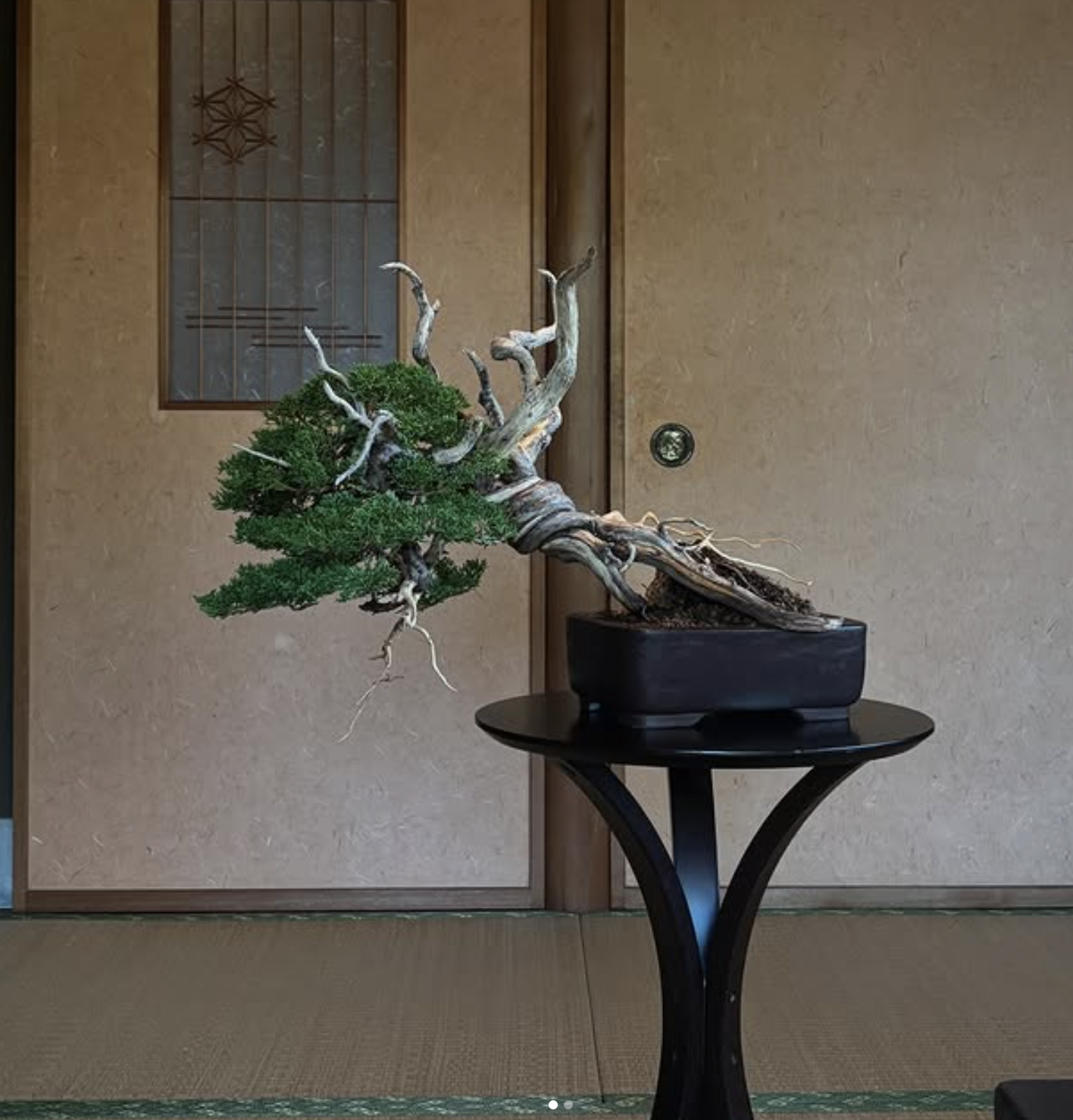
The oldest of the four bonsai in Kazuki Saeki's care has spent fifty years growing sideways instead of up. It's a shinpaku juniper, trained in han-kengai — the semi-cascade form — its trunk still reaching out past the rim of the pot the way, decades ago, a real juniper somewhere reached out from a cliff face. Glanced at quickly, it looks like a small tree in a pot, which isn't wrong — it just undersells what's actually happening inside that pot.
Bonsai is the art of shrinking a natural landscape into a pot, and then continuing to shape it, and deepen it, for as long as the tree lives.
Two characters name what's happening in the pot
A tree is planted in a pot, then shaped over years through pruning and wiring, so that the form of a great tree — or even an entire landscape — can be expressed within that pot. The word itself is two characters. Bon (盆) is a tray, a shallow vessel. Sai (栽) is a plant. Read together, literally, bonsai means "a plant in a vessel." Everything else the art does happens inside that plain definition.
Three techniques hold a tree at that size
Left alone, most bonsai species would grow several meters tall. Bonsai keeps them at the same small size, year after year, through a few concrete techniques.
- A small pot — restricting the space roots can occupy holds back the growth of the entire tree.
- Pruning — branches and leaves are cut back regularly to balance the tree's vigor.
- Root pruning — every few years, roots that have grown too long are trimmed, leaving room for new ones.
Stop any of this and the tree drifts back toward its natural size. What holds the size in place, day after day, is the ongoing relationship between the tree and the person tending it.
A thousand years turned an import into a vocabulary
Bonsai has been deepened in Japan for roughly a thousand years. Its origin lies in the Chinese practice of penjing (盆景), but inside Japan's climate and aesthetic sensibility it grew in its own direction, eventually crystallizing into a concrete vocabulary: jukei, tree forms.
Jukei forms are copies of real trees
Nobody invented jukei at a desk. Each form is the shape of a tree that actually grows somewhere on Japan's mountains, coasts, or cliffs — carved by wind, snow, or gravity over decades, then gradually settled into a formal vocabulary. Here are the four bonsai in Kazuki Saeki's care, each carrying one of those forms.
.jpg)
MKT-001 — Black Pine (Kuromatsu), 45 years, kengai (cascade)
A tree whose trunk falls over the edge of a cliff and continues downward. Found along sea cliffs and the rims of valleys. Carved by wind, leaning along the angle of the rock, growing in the direction of gravity for decades.
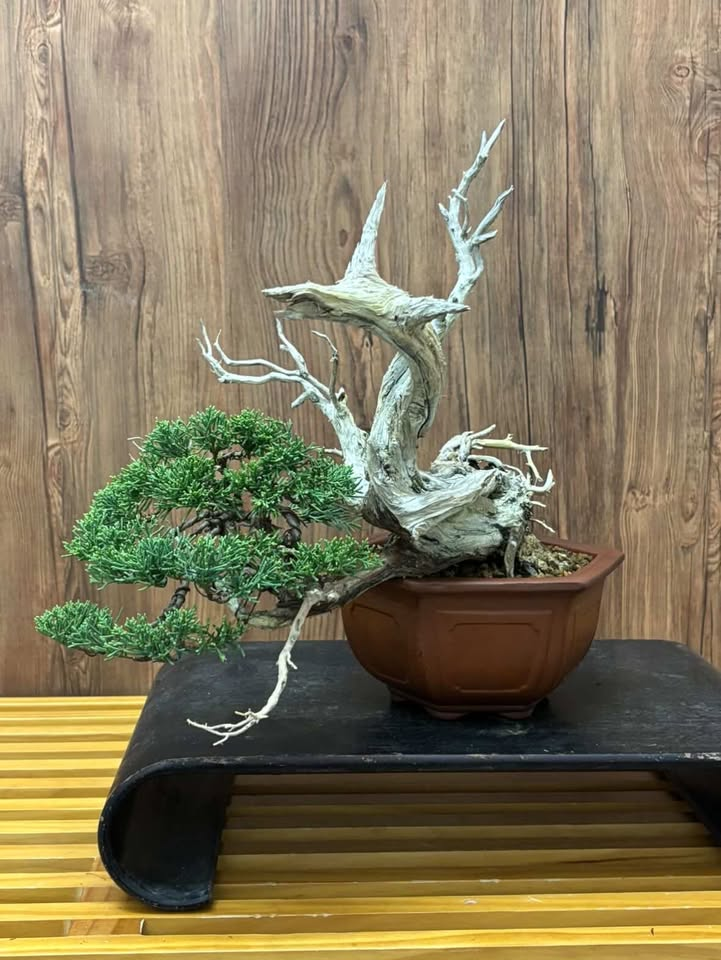
MKT-002 — Shinpaku (Sargent juniper), 40 years, han-kengai (semi-cascade)
A tree that extends sideways past the edge of the pot but doesn't fall as far as kengai. Found halfway down a cliff, where branches grow horizontally rather than down.
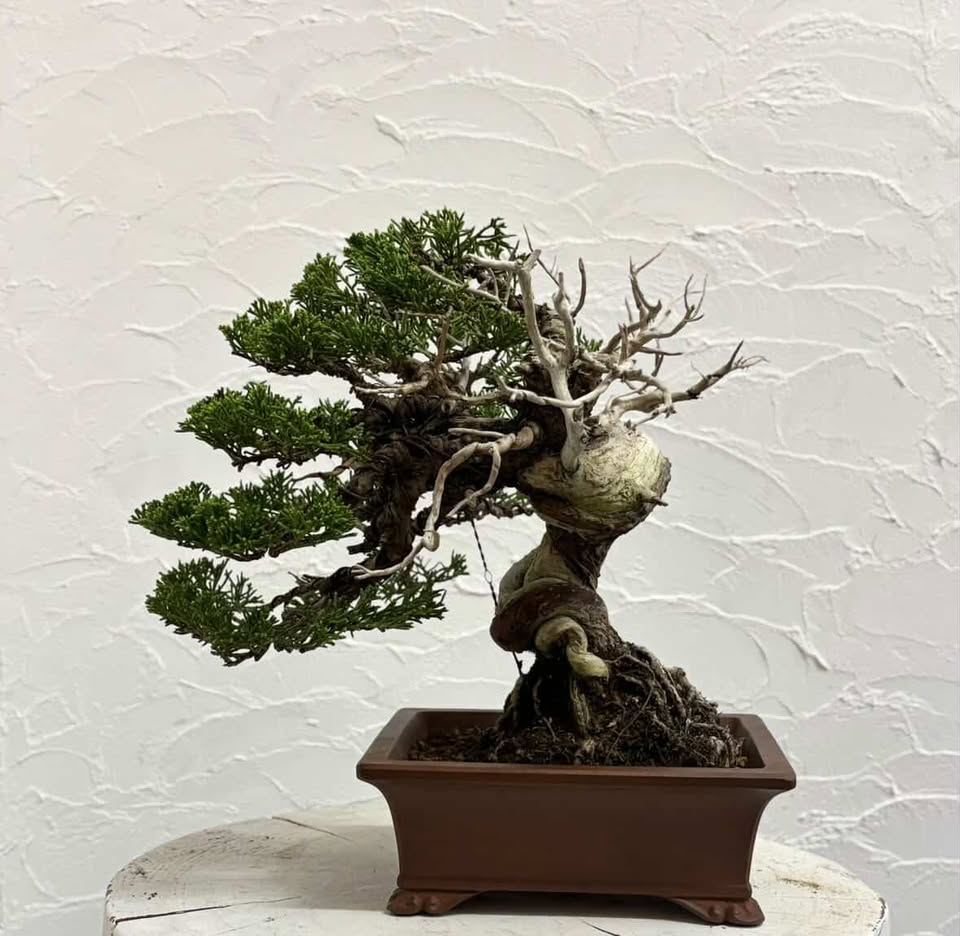
MKT-003 — Shinpaku, 30 years, moyogi (informal upright)
A trunk that rises while curving gently, settling and rising again. Found in mountain trees that have lived through generations of snow weight and shifting wind.
MKT-004 — Shinpaku, 50 years, han-kengai
The oldest of the four. Even within the same form as MKT-002, fifty years has deepened this trunk into something quieter and fuller.
In front of any bonsai, the useful question you can ask isn't "is this well grown." It's narrower than that: what form is this, and where would a tree actually grow this way? Ask it, and a small pot on a table turns back into a sea cliff, or a snowbound ridge.
Care is a daily decision about the landscape
None of this holds without the artist's hand. The artist carries an image constantly in mind — what natural scene is this tree meant to evoke — and works daily to confirm and deepen that scene: watering, seasonal pruning and wiring, repotting once every few years. Every one of those acts is a decision: preserve the landscape as it stands, or deepen it further.
A bonsai isn't a small tree pretending to be a big one. It's a landscape, still being decided, one cut and one watering at a time.