
Open an English dictionary and look up bonsai. It is there, unitalicized, defined in its own entry, exactly as it is in Japanese. No English dictionary defines it as "a dwarfed potted tree" and leaves it at that — they print the Japanese word itself as the headword. Very few words make that crossing. Most vocabulary that moves between languages gets translated, replaced, or quietly localized until the borrowing is invisible. Bonsai (盆栽, "a planting in a tray") did not. It moved into English as itself.
Bonsai belongs to a short list of Japanese words that English dictionaries adopted whole, keeping both the sound and the spelling — a list that also includes sushi and zen.
A Word With No Local Substitute
Dictionaries borrow a foreign word, rather than inventing a native one, mainly when there is no existing word in the target language for the thing being described. English had no term for a tree deliberately kept small for decades through pruning and root restriction, trained to suggest a much larger landscape compressed into a shallow pot. "Miniature tree" gestures at the size but says nothing about the discipline, the years, or the intention behind it. Faced with a genuinely new concept, English did what languages usually do in that situation: it kept the original word.
That is a different fate from most vocabulary that crosses between Japanese and English. Words for everyday objects — chair, book, road — rarely survive translation into a new language once a native equivalent exists. Bonsai survived because English speakers encountering the practice had nothing to translate it into. The word had to travel with the idea, or the idea would have arrived without a name.
When the Word First Appeared in English
Sources place the word's earliest documented appearance in English print in the final years of the nineteenth century, in exhibition catalogues and travel writing describing Japanese potted trees shown to Western visitors. From there, its path into general dictionaries took decades rather than years: Oxford's own learner's dictionary notes bonsai entering common English usage only around the 1950s, well after the earliest citations, once the postwar spread of Japanese gardening culture abroad had made the word familiar enough to need a permanent entry. Etymological dictionaries that track first documented use in a broader range of English-language sources put the date closer to the 1910s. The exact year is less important than the shape of the pattern: decades separate the word's first sighting from its formal adoption. A borrowed word does not enter a dictionary the moment someone first writes it down. It enters once enough readers already understand it without an explanation attached.
A Short List, Not a Long One
Bonsai did not travel alone. It belongs to a small set of Japanese words — sushi (寿司, vinegared rice with fish or vegetables), zen (禅, a school of Buddhist meditation practice), and later arrivals such as tsunami, karaoke, and emoji — that English dictionaries eventually recognized as loanwords in their own right rather than foreign terms requiring italics and a gloss. What ties this list together is not subject matter. Food, religion, natural disaster, entertainment, and typography have nothing obviously in common. What they share is that each named something for which English had no ready equivalent at the moment it needed one.
Most Japanese vocabulary never makes this list. Thousands of Japanese words describe everyday Japanese life in enormous specificity, and the overwhelming majority stay confined to Japanese, translated into English on the rare occasions they are needed at all. Bonsai crossed over because the practice itself — not a Japanese version of an existing Western idea, but a distinct art with its own internal logic — had no Western predecessor waiting to absorb it.
The Word Arrived Before Most of the Trees Did
Here is the part of the story that matters most. The word bonsai reached English readers, and eventually English dictionaries, long before most of those readers had any realistic chance of standing in front of a living bonsai. Nineteenth-century exhibition catalogues described trees that stayed in Japan. Early twentieth-century magazine articles ran photographs of pines and junipers that never left Japanese nurseries. For most of the word's history in English, it named something readers had only read about.
That gap between the word's reach and the trees' reach has never fully closed, and for reasons that are still true today. As we wrote in Trees Cannot Cross Borders, a living bonsai cannot simply be shipped like a book or a printed photograph. It is a rooted plant, subject to phytosanitary inspection, and in many countries to years of quarantine cultivation before it can even enter. A word crosses an ocean in the time it takes to publish a sentence. A tree, if it can cross at all, takes years, paperwork, and in some cases a change of soil down to the last root.
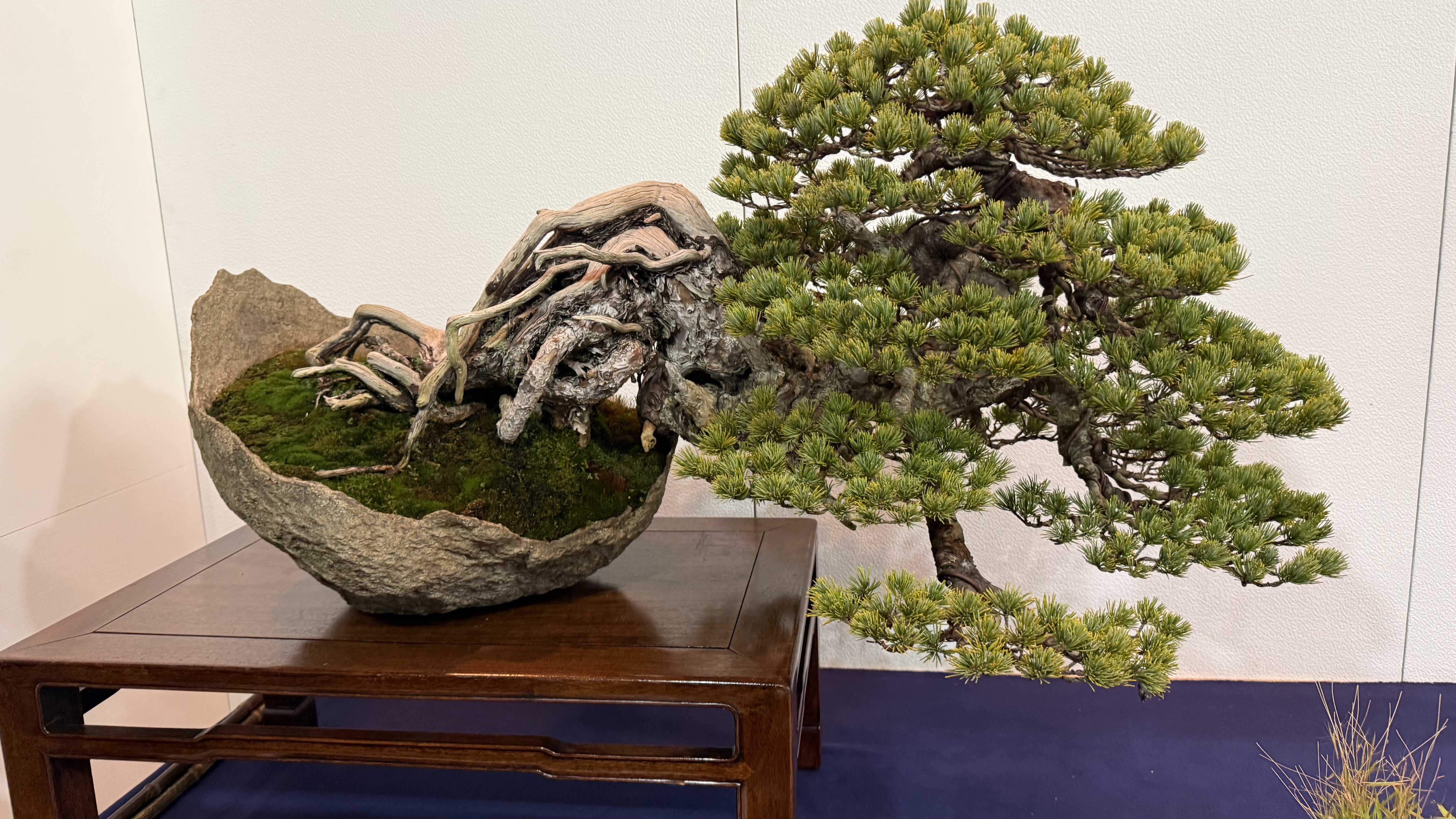
So the asymmetry that shaped bonsai's early history in English — the word travelling ahead of the object it named — was never really solved. It only changed form. Photographs gave way to television, then to the internet, and the distance between "having heard of bonsai" and "owning one still growing in Japan" narrowed for information while staying wide for the trees themselves. What Is Bonsai? is a question far more people can now answer correctly than could a century ago. Standing in front of an actual tree, trained under a Japanese artist's hand for decades, is still a narrower experience than knowing the word.
What a Word Can Carry, and What It Cannot
A word can travel with almost nothing attached to it — no soil, no root system, no need for inspection at a border. What it carries is an idea: that a tree can be kept small on purpose, shaped over a human lifetime or several, and still be alive and changing rather than finished. Dictionaries preserved that idea in English decades before most English speakers could act on it directly.
The tree itself asks for something different. A bonsai has to stay in relationship with the person tending it — watered, pruned, wired, repotted on a schedule that does not pause for a word's convenience. That relationship is harder to export than a definition, and it is the part Azukari exists to make possible: a tree stays under a Japanese artist's ongoing care while its owner, wherever they live, keeps a real connection to that one tree's continuing growth. The word made the idea of bonsai familiar around the world well over a century ago. What has always lagged behind is a way to be close to an actual tree without asking it to leave the country its whole art depends on.
References
- Oxford Advanced Learner's Dictionary — "bonsai, noun" — definition and word-origin note dating the term's entry into common English usage to the 1950s.
- Etymonline — "bonsai (n.)" — etymology and earliest documented English use, dated 1914, from Japanese bon ("basin, pot") + sai ("to plant").
- Wiktionary — "bonsai" — etymology tracing the word through Japanese 盆栽 to Middle Chinese 盆 ("bowl") and 栽 ("to plant").
- Coto Academy — "30 English Loanwords That Come From the Japanese Language" — overview of Japanese loanwords adopted into English, including bonsai alongside sushi, zen, and other words first used in the late nineteenth century.