
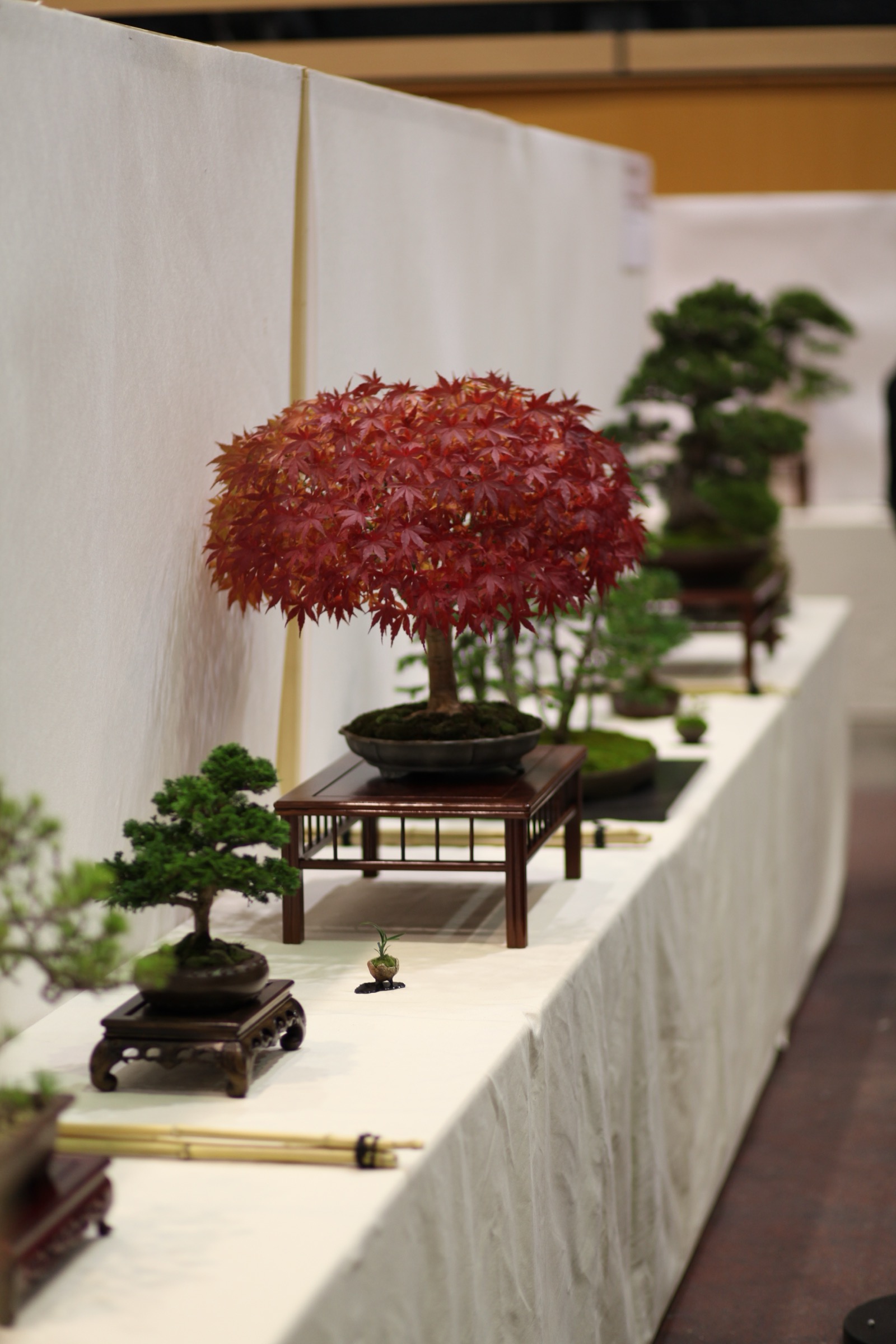
Bonsai in autumn color and green foliage displayed on stands, the kind of row a grower is working toward all season. Photo by Yves Tennevin (Esby), CC BY-SA 3.0, via Wikimedia Commons — Source

Autumn does not add anything new to a bonsai. It mostly stops hiding what spring and summer already built.
Autumn is the season a bonsai's whole year becomes visible at once — the fruit it has carried since early summer, the color its leaves have been holding back, and a branch structure that stands undressed as the canopy thins.
Fruit finishes under a lighter hand
For a fruiting bonsai — a himeringo (姫りんご, "crabapple"), a quince, a pyracantha heavy with berries — late August into September is when the fruit itself, not the leaves, becomes the thing a grower manages for. The habit that causes the most damage at this point is simple: feeding a fruiting tree the same way it was fed in spring. A nitrogen-heavy fertilizer pushes the tree toward more leaf and shoot growth instead of finishing the fruit already set, so growers switch to a fertilizer lower in nitrogen and higher in phosphorus and potassium, which supports fruit ripening and strengthens the tree ahead of winter rather than encouraging new growth it cannot yet afford to lose to frost. Watering discipline matters just as much through this stretch — a fruiting bonsai that is allowed to dry out even once during ripening can drop fruit it has already carried for months, undoing most of a season's work in an afternoon.
The canopy catches up
Leaf color runs on its own clock, tied to cooling nights rather than the calendar date, and for one species above all — the maple, or momiji (紅葉, "crimson leaves") — it is the whole reason the tree is grown. We've written elsewhere about the chemistry behind that change and about why small, densely set leaves take the color better than large ones. What matters here is the wider effect: across a bench of many species, not just maples, autumn is the one season when a grower can see, all at once, how the whole collection has actually spent its year.
Final adjustments before the show season
Once a deciduous tree's leaves thin or drop, its branch structure is finally visible without guesswork — a subject worth its own close look — and this is when growers make the small corrective cuts and wiring adjustments that summer's foliage had been hiding. Spent leaves are cleared from the soil surface and the surface itself is swept, partly for appearance and partly because a clean surface keeps air moving through the pot, which matters for root health going into winter.
This grooming lines up with Japan's own autumn exhibition calendar. The Taikan-ten, held each November at the Miyako Messe in Kyoto, is generally regarded as the second-largest national bonsai exhibition in the country after Tokyo's Kokufu-ten, and it is timed deliberately to coincide with peak autumn color. Deciduous, fruiting, and evergreen bonsai are shown together with satsuki azaleas, entered by amateurs and professional growers alike, each tree presented with a hanging scroll and often a companion stone. A tree does not need to be entered in a show to benefit from the same discipline — the judging season that runs from Kyoto's autumn exhibition through Tokyo's February Kokufu-ten is simply the clearest reason growers give this work its own name.
A second, narrower repotting window
The main repotting season for almost every bonsai is late winter into spring, in the stretch just before the buds break — a subject we cover in full elsewhere. But Japanese practice keeps a second, narrower window open at higan (彼岸, "the equinox week," observed in Japan each spring and autumn), and it is used selectively rather than as a general rule. Trees in the rose family — flowering quince and crabapple among them — are often repotted in autumn instead of spring specifically because spring repotting is thought to raise their risk of crown gall, a bacterial root disease; moving the work to autumn is a way of avoiding it rather than a claim that autumn suits every species better. Certain conifers, shimpaku included, are sometimes repotted in September once soil temperatures have dropped below roughly 25°C but are still above about 15°C — cool enough that disturbed roots are no longer at summer's heat risk, but not so cool that the work runs into the frost risk of mid-October. It is a narrower, more conditional calendar than spring's, and it is exactly why the choice is left to whoever is watching the tree that particular year.
A year's work made visible
None of these tasks originate in autumn. The fruit was set in spring and carried all summer. The color was building in the leaf since the nights first began to cool. The branch structure being corrected now is the same one a grower has been shaping since the last repotting. Autumn is simply the season that stops asking a grower to imagine the year's results and starts letting them look at it directly — fruit, color, and form, all read off the same tree in the same few weeks.
That reckoning has a long history in Japan outside of bonsai too, in a culture that built entire seasonal customs — the rice harvest, chrysanthemum shows, the autumn round of leaf-viewing — around pausing to look squarely at what a year has produced. A bonsai on a bench keeps that same rhythm in miniature, on a schedule the tree sets rather than the calendar.
Azukari is built to carry that reckoning across distance. An artist in Japan makes the calls this season asks for — the lighter fertilizer, the corrective cut, the equinox repotting for a tree that needs it, the pass that leaves the pot ready to enter a show if the year has earned it — and folds what changed into the seasonal record its owner receives. You do not have to be standing at the bench in October to know whether the fruit finished well or the color came in deep. The record carries that autumn to you.
References
- Bonsai Empire — Bonsai maintenance calendar — general autumn tasks including fertilizing as temperatures cool, clearing shed leaves and old pine needles, and preparing trees ahead of winter.
- Mistral Bonsai — "Care of fruit bonsai at the end of summer" — late-August-to-September fertilizing for fruiting bonsai, avoiding nitrogen excess, and the use of low-nitrogen, higher phosphorus-potassium fertilizer to support fruit ripening.
- Magiminiland — "Taikan-ten" — the Taikan-ten's ranking as the second-largest bonsai exhibition in Japan after the Kokufu-ten, its November timing at Kyoto's Miyako Messe, and the mix of deciduous, fruiting, evergreen, and satsuki entries from amateur and professional growers.
- Bonsai.co.jp — beginner's guide to repotting — repotting timed to the spring and autumn equinoxes, and the practice of repotting rose-family trees in autumn rather than spring to reduce disease risk.
- Ars Corporation — "Garden tasks around the autumn equinox" — September as the recommended equinox repotting window once soil temperatures fall below about 25°C but remain above 15°C, with shimpaku juniper given as an example, and the frost risk that follows after mid-October.