Set a hundred bonsai side by side and most growers will judge them the same general way: leaf quality, branch structure, the taper of the trunk, the pot it stands in. Every one of those qualities can be improved by skill, patience, or money, on almost any tree, within a single career. Raise a tree's age by fifty years, though, and change nothing else about it, and its standing rises anyway — and no skill applied to a young tree can buy back the decades it has not yet lived.
Of everything a bonsai is judged on, age is the one quality that outranks the rest and cannot be substituted for, because unlike skill, materials, or price, it cannot be produced in the present. It can only be inherited from the past.
What Actually Decides a Bonsai's Standing
In Japanese bonsai, a tree's standing is spoken of as its kaku (格, "rank" or "class"). We've written elsewhere about how that rank is actually judged; the qualities usually said to raise it are specific and learnable — a trunk with natural, unforced movement, a nebari (根張り, "surface roots") that spreads convincingly, branches placed with restraint rather than crowded on. Growers will sometimes add, a little paradoxically, that raw chronological age matters less here than its visible evidence: bark that has begun to crack and fissure into what one guide to reading bonsai calls kobokukan (古木感, "the feel of an aged tree"). But that evidence has no shortcut of its own. Bark does not crack into that texture on command, and a trunk does not gain unforced movement by being asked to. The visible sign and the years behind it are, in practice, the same thing seen from two different angles.
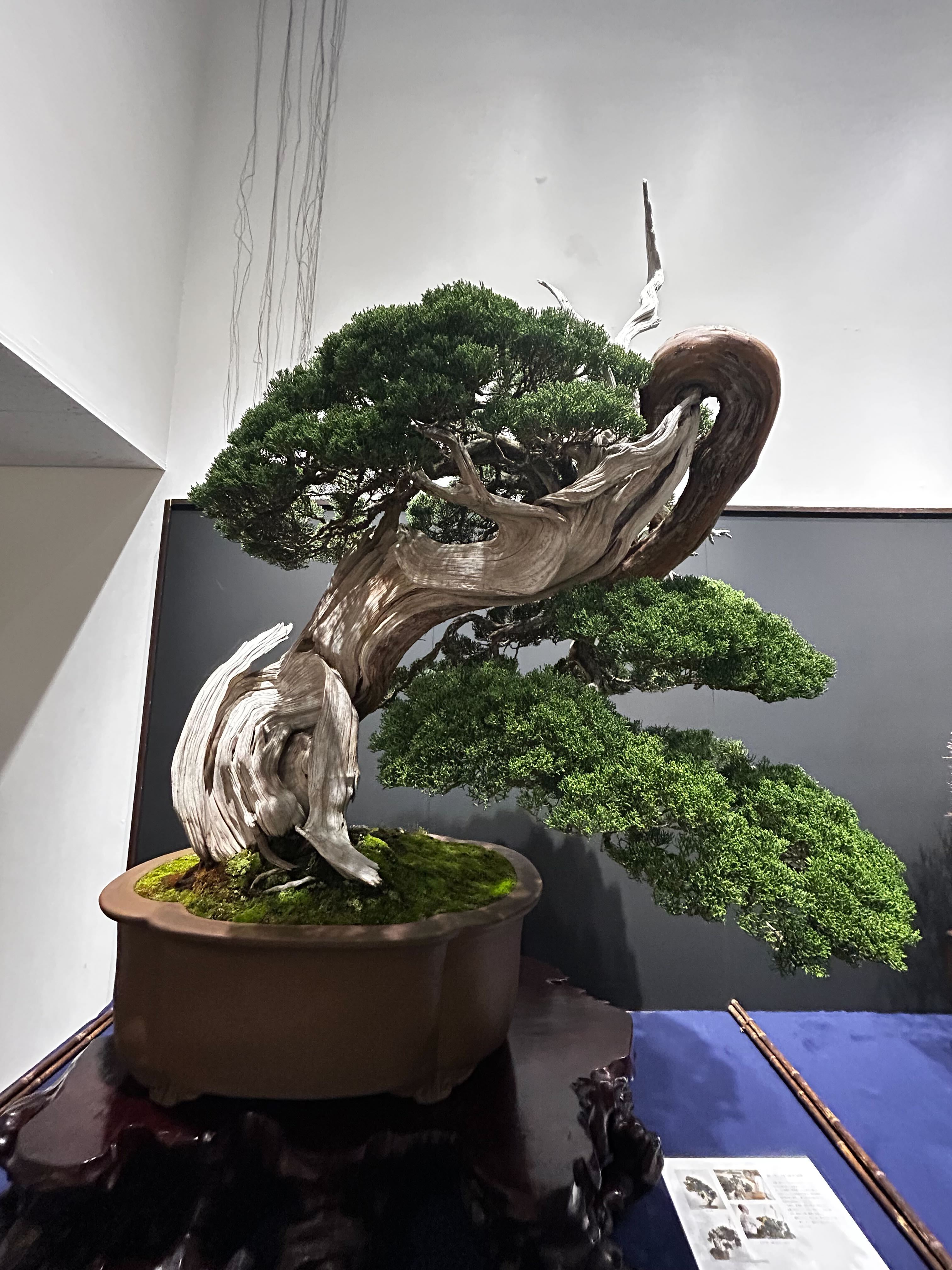
Age, in that sense, sits above the rest of the list rather than on it. Every other quality can, in principle, be matched by enough skill and enough attention. Age alone cannot. At the 100th Kokufu Bonsai Exhibition — Japan's most prestigious bonsai show, whose own judging criteria weigh a display's overall dignity and the condition of its cultivation — one shimpaku juniper on view carried an estimated age of roughly 3,000 years: a wild-collected trunk given its present form some forty years ago by one of the era's master growers, and cared for today by another. No fee, no reputation, and no technique available to any artist working now could set a second tree beside it on equal footing.
What Can Be Matched, and What Cannot
Call the first kind of quality relative: two growers can start seedlings from the same packet, and the gap between their trees five years on is a gap of skill — real, but closeable, given enough seasons and enough attention. Even the slowest ordinary part of that gap, a trunk developing the taper and bark character to look like a bonsai rather than a sapling, is generally said to take ten years or more of steady, unhurried growth, whatever the grower's skill.
Call the second kind absolute: no amount of skill closes the distance between a ten-year-old trunk and the Japanese white pine now known as the Yamaki Pine — in training since 1625 and tended across five generations of one family before it ever left Japan. That distance is not made of anything a person does today. It is made of years that have already happened, one at a time, to a tree that was there for each of them. We've written in more detail about why no shortcut, however well-funded, reaches this second kind of value; the point worth holding onto here is narrower. Of everything a bonsai is judged on, age is the only quality with no relative version. A tree can be somewhat well-pruned. It cannot be somewhat old.
The Stillness an Old Tree Earns
There is a quieter effect too, harder to name but easy to recognize once it is pointed out. A young bonsai, however well trained, tends to look as if it is still trying to prove something — new growth pushing outward, a trunk still visibly thickening, foliage still finding its final density. An old tree has largely stopped doing that. This year's growth is a small addition to a shape mostly settled decades ago; the bark has slowed from a color into a texture; the outline holds without needing to keep changing to hold attention.
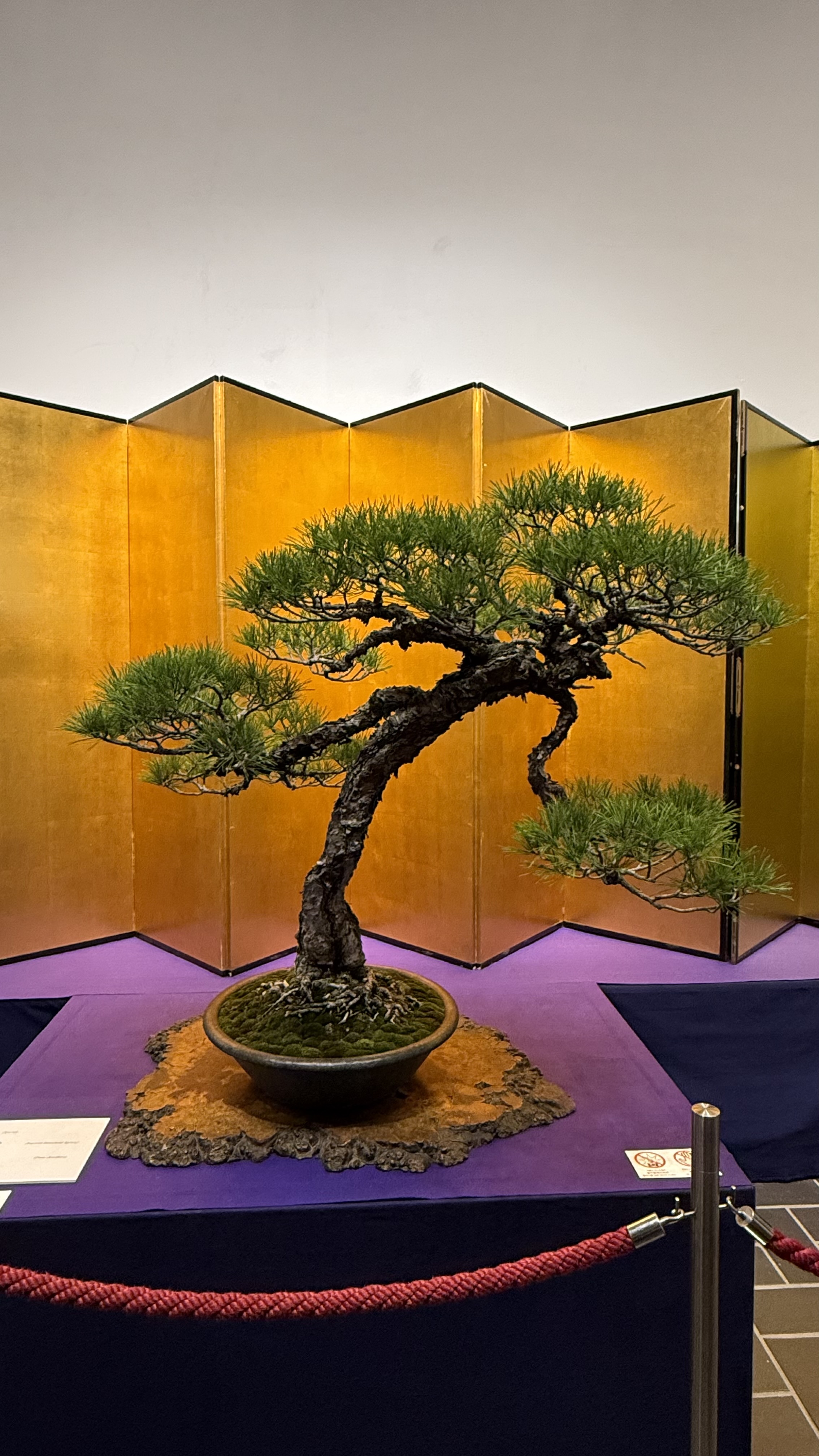
Stillness that was never built for a single season. At the Imperial Palace's Daido Garden, pines said to be centuries old are tended today by caretakers who inherited them mid-story.
Japanese has a word for the kind of presence that comes only from having lived long enough not to need to announce itself: kanroku (貫禄, "gravitas earned rather than displayed"), more often used of a person than a tree, but hard not to reach for in front of an old bonsai anyway. That quality cannot be wired or pruned into a tree ahead of schedule. It shows up only once the growing has mostly finished — which is another way of saying it shows up only with age.
What Azukari Holds at the Center
None of this describes a number that climbs, and it should not be read as one. An old bonsai's standing is not a claim on where its price might go next, any more than a documented painting's history is a claim on the subject it depicts. What age offers is closer to what a historic building or a piece of traditional craft offers: something no later effort can produce on demand, valuable because time has already passed rather than because anyone expects it to convert into more.
This is the value Azukari is built to carry forward. A tree continues its ordinary seasons in Japan, under an artist's daily care, in the same unglamorous way we've described elsewhere. The years it has already lived do not change hands, because they cannot; they simply keep accumulating, with whoever is entrusted with the tree now joining partway through its story.
Closing
A hundred-year-old bonsai and a ten-year-old one can be trained by the same hands, in the same nursery, toward the same ideal, and still not be the same tree — because one of them has ninety years the other does not have and cannot acquire on any schedule. That gap is not a flaw in how bonsai is judged. It is close to the whole of what the practice actually is: a discipline built, more than almost any other, around a value that only patience can produce, and that no other kind of effort can replace.
References
- National Bonsai Foundation — The Yamaki Pine — in training since 1625, tended across five generations of the Yamaki family, gifted to the United States in 1976.
- Nippon Bonsai Association — Kokufu-ten Exhibition and Events — on the Kokufu Award's judging criteria: overall dignity of the display, harmony with pot and stand, and cultivation condition.
- Bonsai Empire — Growing Bonsai from Seed — on the typical decade or more required to develop a mature bonsai appearance from seed.
- Botanica — "What Is Bonsai?" — on kaku (rank) being judged from cracked, fissured bark and natural trunk curve — kobokukan, "the feel of an aged tree" — rather than from chronological age alone.