The cause is almost always water, light, or the roots — and whether the yellowing is spread across the whole tree or confined to one branch is the fastest way to tell which. Sometimes it is none of those three: for a deciduous tree in autumn, or a pine shedding its oldest needles, yellowing is simply the season, not a symptom.
Start with the pattern, not the color
A single yellow leaf means very little on its own. What matters is where the yellowing shows up and how fast it spreads.
Yellowing that appears evenly across the whole canopy, developing slowly over days or weeks, points toward something affecting the whole root system — usually watering or light. Yellowing confined to one branch, one side of the tree, or the innermost, oldest foliage points toward something local: a pocket of bad soil under that branch, a root that has died back, or simply old growth being shed as newer foliage shades it out. Bonsai Tonight's troubleshooting guide for black pine makes this same distinction: localized yellowing often traces to "pockets of old soil" retaining too much or too little moisture around one part of the root mass, rather than a problem with the tree as a whole.
Speed matters too. Yellowing that turns up fast, within a few days of a missed watering, usually means the tree ran short of water and is shedding leaves to ration what it has left. Yellowing that creeps in gradually over weeks, with no obvious trigger, more often points to overwatering, low light, or a nutrient problem building up quietly in the background.
The three usual suspects
Water, in either direction. In a shallow bonsai pot, roots need both moisture and oxygen, and a pot that never gets the chance to dry between waterings starves them of the second. Overwatering is widely cited as the single most common cause of yellowing in potted trees, because compacted, constantly wet soil suffocates fine roots before any damage shows above ground. Underwatering does the opposite: the tree sheds leaves to cut its losses, and the yellowing that follows tends to be faster and more uneven than the slow, even fade caused by too much water. Bonsai Empire's troubleshooting page frames the same split — rapid yellowing after a dry spell reads as underwatering, while slow, gradual yellowing usually means something else is wearing the tree down over time. For how to judge watering itself, see how often a bonsai should actually be watered.
Light. A tree kept too far from a window, or a branch shaded out by the canopy above it, cannot support all of its own foliage on the light it receives. Rather than let every leaf starve slowly, the tree lets the least productive ones go first — which is why shaded interior branches and the underside of a dense canopy are so often where yellowing starts.
The roots. Old, compacted soil, a root that has rotted from sitting wet, or roots that were disturbed and never fully recovered can all cut off supply to one section of the tree while the rest looks fine. This is the case most likely to show up as a single yellow branch rather than an evenly faded tree, and it is also the case least likely to fix itself without a look at the root ball, usually at the next scheduled repotting.
When yellow is not a problem at all
Two situations that alarm beginners are, in fact, the tree doing exactly what it is supposed to do.
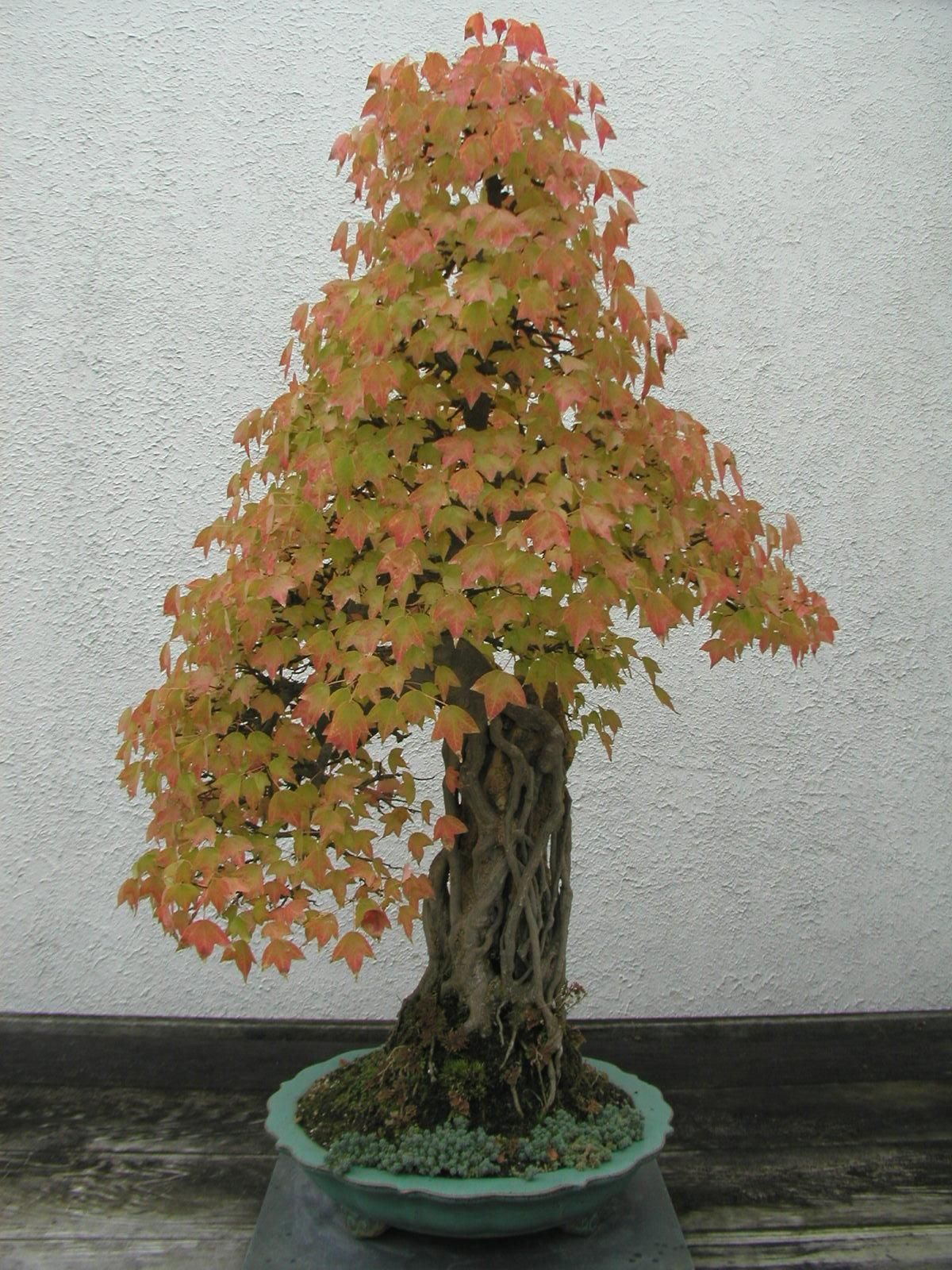
The first is a deciduous tree in autumn. Momiji (紅葉, "Japanese maple") and other deciduous bonsai are prized for the very fact that their leaves turn — yellow, orange, and red — before falling, the same annual cycle their full-sized counterparts go through. A maple that stays green into November would be the surprising case, not the one that turns color on schedule.
The second is a conifer shedding its oldest needles. Evergreen does not mean a tree keeps every needle forever. Iowa State University Extension's overview of seasonal needle loss explains that conifers regularly shed their oldest, innermost needles once those needles are shaded out by newer growth further along the branch — white pines and arborvitae often drop an entire year's needles at once in autumn, while pines such as kuromatsu (黒松, "Japanese black pine") typically hold needles for only one to two years before letting them go. Michigan State University Extension adds a useful marker for telling this apart from a real problem: normal shedding starts on the oldest, innermost needles and moves outward gradually, while pest damage or disease tends to show more random, patchy yellowing, sometimes with visible stippling or fruiting bodies under a hand lens. A tree that loses needles only from the inside out, only on its oldest growth, is very likely fine.
Reading the tree before reaching for a fix
The instinct when a leaf turns yellow is to do something — more water, less water, a dose of fertilizer. It is worth resisting that instinct for a day or two and reading the pattern first. Whole tree or one branch. Fast or slow. Oldest growth or newest. Those three questions narrow the list of causes faster than any single remedy tried at random, and they keep a healthy tree from being pushed toward a real problem by a fix it did not need. If yellowing comes with sticky residue, webbing, or visible insects rather than a plain color change, the cause has likely shifted from care to a pest or a disease, which calls for a different kind of look. And if the yellowing is severe enough to raise the question of whether the tree has died outright, that question has its own answer before any leaf color is even part of the picture.
This is, in miniature, most of what daily bonsai care actually is: not a set of fixed rules applied on a schedule, but a habit of looking closely enough, often enough, to notice a change while it is still small. In Japan, that daily attention is treated as inseparable from the tree itself — a nursery does not "maintain" a bonsai so much as stay in a running conversation with it, season after season. Azukari extends that same conversation to an owner who cannot check the pot every morning, with an artist in Japan doing the looking and reporting back what the tree is saying.
References
- Bonsai Tonight — "Why is my pine yellow? A black pine troubleshooting guide" — watering, root, and light causes of localized needle yellowing on black pine bonsai.
- Bonsai Empire — "Bonsai problems: Falling or yellow leaves and poor growth" — general troubleshooting distinguishing fast (underwatering) from gradual (overwatering, light, pests) yellowing.
- Iowa State University Extension and Outreach — "Seasonal Needle Loss" — normal annual shedding of the oldest conifer needles as a routine, non-disease process.
- Michigan State University Extension — "Why are my interior conifer needles turning yellow?" — how to distinguish normal interior needle drop from pest- or disease-driven yellowing.