Probably not. A bonsai that has dropped its leaves, turned brown at the tips, or gone bare for the winter is, in most cases, still alive. Leaf loss on its own is not a verdict, and a leafless silhouette is the normal, expected look of most deciduous bonsai for several months of the year. The one check worth actually running is a small scratch of the bark to look for green underneath — and even that test has limits worth knowing before you trust it completely.
The scratch test, and where it falls short
The standard advice, repeated across almost every bonsai forum, is the scratch test: nick a thin sliver of bark with a fingernail and look at the tissue underneath. Green and moist means living cambium is still there. Brown and dry means that section of branch is finished. Miyagi Bonsai's diagnostic guide recommends running it in more than one spot — a single green patch does not guarantee the whole tree is fine, and a single brown patch does not guarantee it is gone.
It is a useful first check, but not a complete one. GrowingBonsai.net makes the sharper point: finding green sap under the bark means there is moisture, not necessarily that the tree is alive. A conifer can hold its color for months after its roots have already died, simply because the foliage has not yet used up what moisture remains in the wood. The same source suggests reading slower, more reliable signs alongside the scratch test — whether narrow ridges are forming along the trunk as the wood dries out, whether buds have gone from green to solid dark brown, and whether young twigs have lost their shine and turned porous. None of these appear overnight, which is exactly why they are more trustworthy than one hopeful scratch.
Leaf drop is not a verdict
A tree that has lost some or all of its leaves has not necessarily died. Bonsai Empire's troubleshooting guide is direct about this: underwatering typically causes fast leaf drop, overwatering causes a slower version through root stress, and both are usually recoverable once the underlying cause is corrected, with new leaves returning within a few weeks. Older leaves also fall naturally as new growth pushes them out — a sign of a tree functioning normally, not one in decline. Confusing ordinary leaf turnover with a dying tree is one of the most common false alarms in bonsai care. Yellowing before it drops usually points to one of the same handful of causes.
A bare winter tree is on schedule, not in trouble
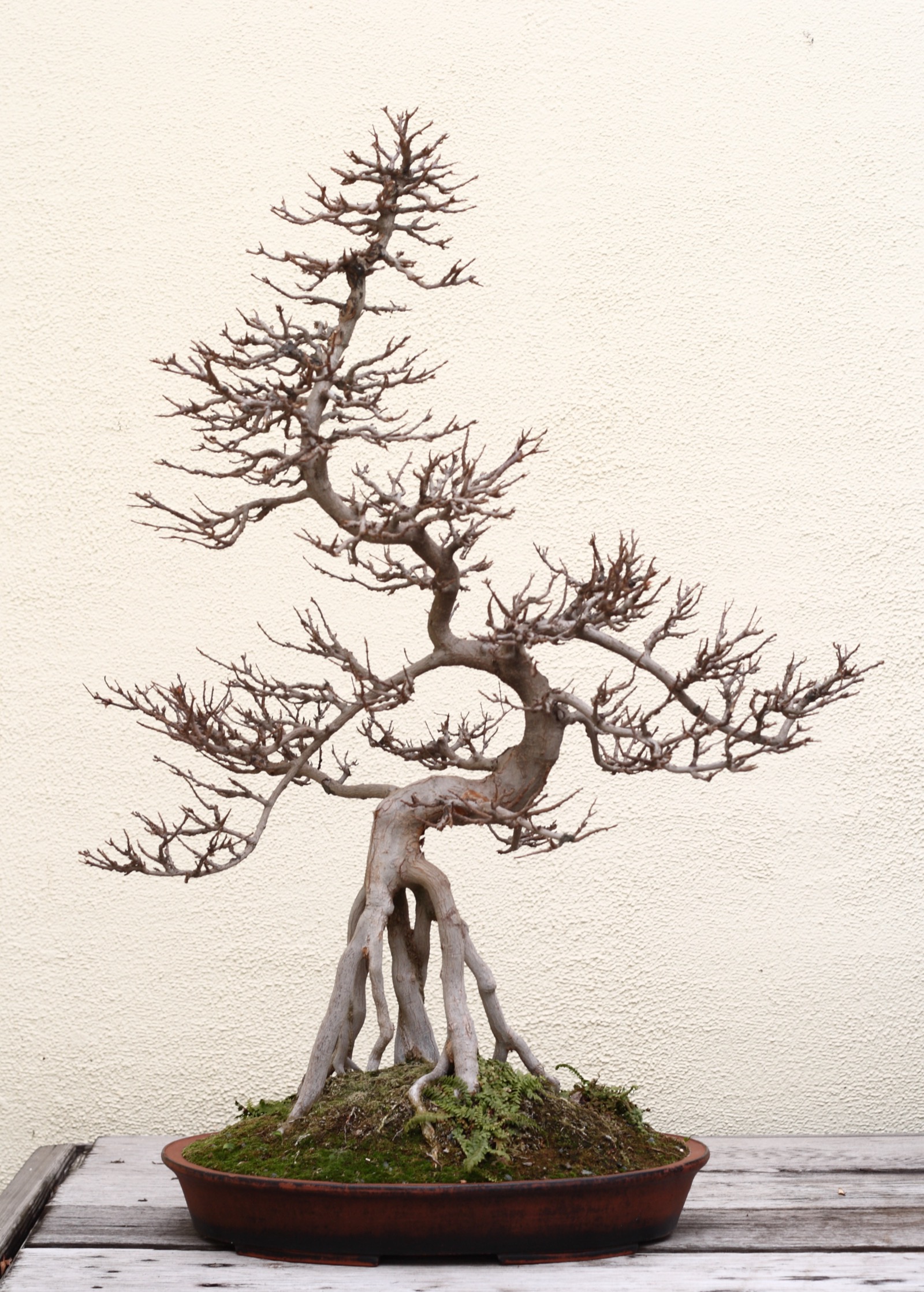
For deciduous species — most maples, elms, and quince among them — a completely bare tree from late autumn through early spring is not a symptom of anything. It is dormancy, the same seasonal rest a full-sized tree in the ground goes through. BonsaiResourceCenter explains it plainly: deciduous bonsai shed their leaves as part of a normal yearly cycle to conserve energy through the cold months, and the leafless period that follows is the tree keeping its natural rhythm, not a sign of distress. Growers in Japan generally treat this bare season as something worth admiring in its own right rather than something to worry through — a maple's fine branch structure, hidden all summer under foliage, is fully on display only once the leaves are gone. My Bonsai Dropped Its Leaves goes further into what a healthy winter silhouette should look like, tree by tree.
What to check before you give up
If a tree still looks doubtful after a scratch test, a few more checks are worth running before writing it off. Try the scratch at several points along different branches, not just one spot near the base — a tree can be dead at the tips and alive lower down, or the reverse. Look at the buds: Miyagi Bonsai notes that small, tight buds held through winter, or slight swelling as the weather warms, are healthy signs, while shriveled, dry buds are not. And give it time — several weeks of correct watering and placement should pass, ideally into the start of the growing season, before a tree with no new growth at all is called finished. A juniper kept on an indoor windowsill is a special case worth its own read, since it can stay outwardly green for months after it has already died indoors — a different failure pattern from ordinary seasonal dormancy.
Before you decide
Most of the trees that prompt this question turn out fine by spring. A scratch of green bark, a set of tight buds, and patience through one growing season answer it far more reliably than a first glance at a bare or brown-looking tree ever can. This is, in its own small way, what bonsai asks of anyone who keeps one: to look closely, to know what a tree's season is supposed to look like, and not to mistake rest for loss. It is the same attentiveness that runs through the practice in Japan, where an artist reads a tree's condition daily rather than reacting to how it looks on any single afternoon — the kind of close, dated watching that Azukari keeps as part of a tree's ongoing record, season after season, whether or not anything dramatic is happening at all.
References
- GrowingBonsai.net — "Is my Bonsai dead?" — on the limits of the bark scratch test and slower, more reliable signs of death: drying ridges on the trunk, bud color, and twig texture.
- Miyagi Bonsai — "Is my Bonsai Dead or Dormant? Signs, Tests & What to Do Next" — on running the scratch test in multiple locations, bud checks, and a several-week timeframe before concluding a tree has died.
- Bonsai Empire — "Bonsai problems: Falling or yellow leaves and poor growth" — on leaf drop from over- or under-watering as usually recoverable, and normal seasonal leaf turnover.
- BonsaiResourceCenter — "Why Bonsai Lose Their Leaves in Winter" — on deciduous dormancy as a normal, energy-conserving seasonal cycle rather than a sign of decline.