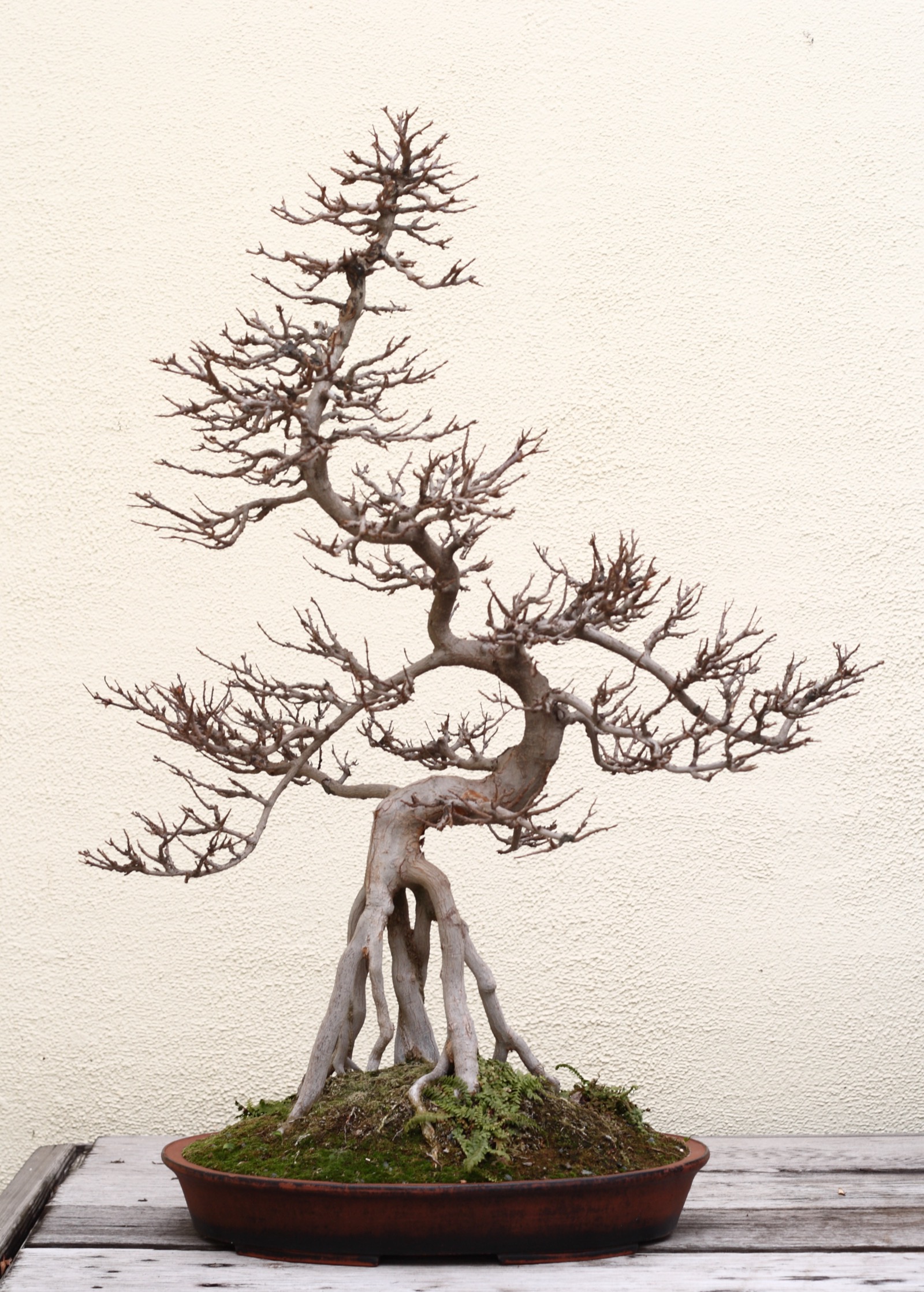
Trident maple (Acer buergerianum), exposed-root style, National Bonsai & Penjing Museum, U.S. National Arboretum, in its bare winter branch structure. Photo by Sage Ross, CC BY-SA 3.0, via Wikimedia Commons — Source

If the tree is a deciduous species — a maple, an elm, a quince — going fully bare from late autumn into early spring is normal, not a symptom. It is the same yearly cycle a full-sized tree of the same species goes through in the ground, and most bonsai that trigger this question are fine by spring.
Why the leaves go
As days shorten and temperatures drop, a deciduous tree stops sending resources to its foliage and lets it go, conserving energy for the months when growth isn't possible anyway. BonsaiResourceCenter lays this out plainly: shedding leaves is part of a deciduous bonsai's normal annual rhythm, not a sign that anything has gone wrong. A small pot does not change this. If the species drops leaves outdoors in nature, it will drop them in a pot too — the pot just makes the bare result harder to miss.
That's worth separating from leaf drop that happens outside this window. Bonsai Empire's guide to leaf loss distinguishes ordinary seasonal shedding from the kind caused by overwatering, underwatering, or poor light — the difference being timing and pattern. An evergreen species going bare, or a deciduous one dropping leaves mid-summer, is worth investigating. A deciduous tree going bare on schedule, in winter, is not.
Why this is the moment overseas beginners panic
Of all the questions a new bonsai owner asks, this is one of the most common outside Japan, and the timing explains why. A tree bought or shipped in spring or summer arrives in full leaf — it looks the way houseplants are supposed to look. Then autumn comes, the leaves go, and the pot that once looked full now looks empty. Nothing about a bare pot reads as healthy to someone whose only reference point is a houseplant, where leaf loss usually does mean trouble. A deciduous bonsai simply doesn't follow that logic. If a scratch of bark still shows green underneath and the buds are firm, a bare tree in winter is a tree on schedule, not a tree in decline — the fuller diagnostic checks are covered in Is My Bonsai Dead?
The season some growers wait all year for
Once the panic settles, there's a second thing worth knowing: in Japanese bonsai practice, this bare stretch isn't simply tolerated until spring — it has its own name and its own audience. Growers call it kanju (寒樹, "cold tree," a deciduous bonsai's leafless winter form), and it's treated as one of the year's most revealing views of a tree, the moment when a zoki (雑木, "deciduous or broadleaf tree, as a bonsai category") shows its structure with nothing left to hide behind. A trunk's taper, the honesty of a branch's line, how evenly a canopy has been built up over years of pruning — none of it is visible in July. All of it is visible in January.
This isn't a niche taste confined to Japan, either. Bonsai clubs across the United States hold dedicated winter exhibitions built entirely around bare trees — the Winter Silhouette Bonsai Expo, now well into its second decade, gathers growers specifically to look at leafless deciduous bonsai side by side and judge them on branch structure alone. A bare tree, in other words, is not a tree with nothing to show. It's a tree showing something a leafy one can't.
What a bare tree is actually revealing
That fine branch structure doesn't appear on its own — it's the accumulated result of years of pinching, occasional defoliation, and patient pruning during the growing season, the kind of work traced in detail in Kaede: The Delicacy of the Branch. Winter is simply when the bill comes due, in the best sense: every year of careful work becomes visible at once, and every year of neglect becomes just as visible. Meanwhile the bare season carries its own responsibilities of its own — protecting roots from hard frost, doing the structural pruning and wiring that's easiest with no foliage in the way — covered in Winter: Bare Branches and Rest.
A tree that hasn't gone anywhere
A leafless bonsai in January hasn't stopped being a bonsai. It's simply in the part of its year when there's nothing between the viewer and the tree's actual shape. That habit — reading a tree by its structure and its season rather than by how impressive it looks on any single afternoon — runs through the daily practice of tending bonsai in Japan, where a kanju isn't a problem to wait out but a view worth walking outside for. It's the same close, season-by-season attention Azukari keeps as part of a tree's ongoing record, whether that season happens to be dramatic or, like this one, quietly bare.
References
- BonsaiResourceCenter — "Why Bonsai Lose Their Leaves in Winter" — on deciduous dormancy as a normal, energy-conserving seasonal cycle rather than a sign of decline.
- Bonsai Empire — "Help! My Bonsai is losing leaves" — on distinguishing normal seasonal leaf drop in deciduous species from leaf loss caused by watering, light, or pest problems.
- JeePe — "Bonsai: Japan's Miniature-Tree Art for Beginners" — on kanju, the bare winter branch silhouette of deciduous (zoki) bonsai, as a form worth admiring on its own terms in Japanese practice.
- Valavanis Bonsai Blog — "13th Winter Silhouette Bonsai Expo 2025" — on a long-running U.S. exhibition dedicated to judging leafless deciduous bonsai on branch structure alone.