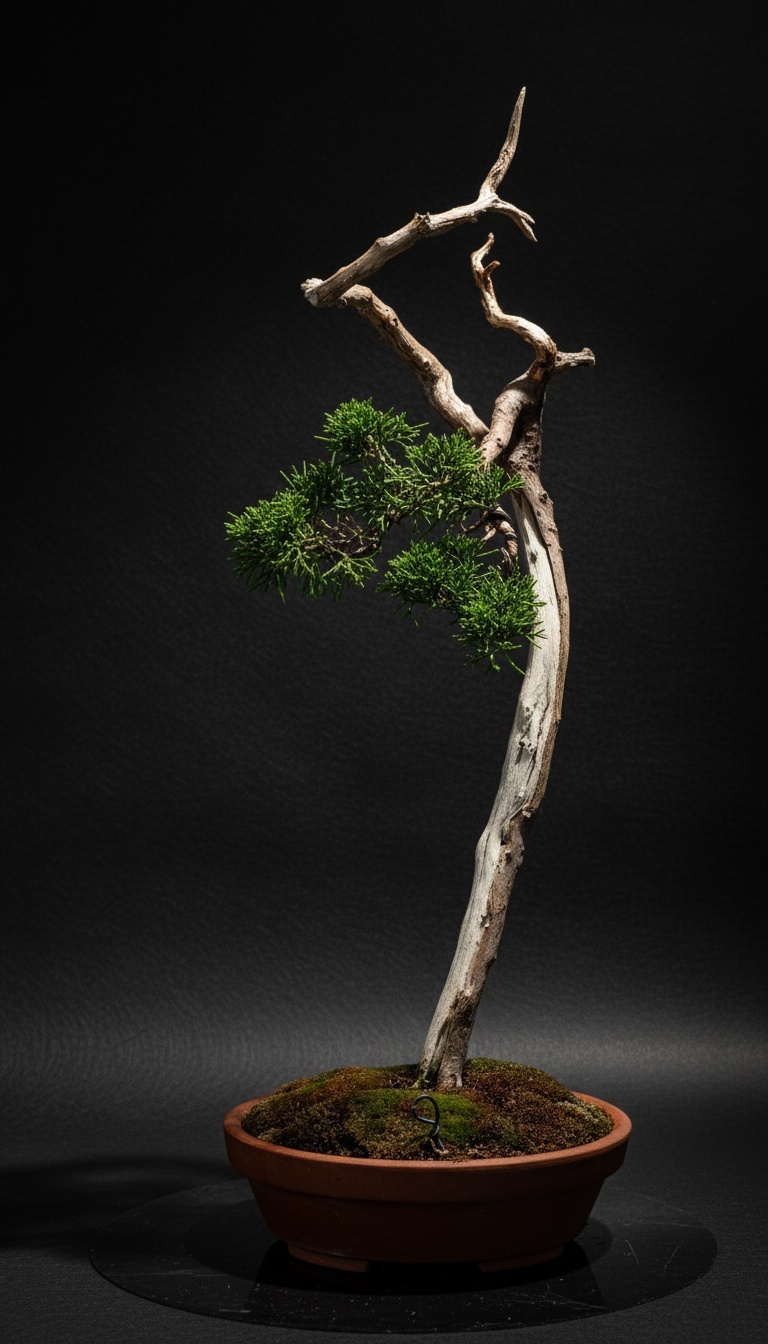
A shimpaku juniper bonsai, its foliage close enough to check needle by needle — the range at which a pest's damage and a disease's damage actually look different from each other.
Look for an organism, not just a symptom. A pest problem almost always leaves something to find — an insect, a web, a shell, a chewed or notched edge — concentrated at one spot on the tree. A disease almost always shows a spreading discoloration, spotting, or wilt with nothing visibly crawling on it, and it tends to appear after the tree was already under some other stress.
Signs versus symptoms
Plant diagnosticians draw a useful line between a sign and a symptom. A sign is the actual culprit visible on the tree — a scale insect's shell, a spider mite's fine webbing, a fungus's powdery coating. A symptom is how the tree reacts — a yellowing leaf, a wilted shoot, a patch of dieback — and a symptom alone does not say what caused it. Cornell and Penn State's extension guides both frame diagnosis this way: find the sign if you can, because two very different problems can produce a nearly identical symptom. A pest infestation and a root-rot fungus can both leave a branch looking thin and pale. Only one of them leaves something you can actually point to.
What a pest leaves behind
Pest damage tends to be mechanical and localized. Kaigaramushi (カイガラムシ, "scale insects") sit under a hard shell on bark and branch junctions; hadani (ハダニ, "spider mites") leave fine webbing and a stippled, dusty discoloration on the underside of a leaf; aphids cluster visibly around new shoots and leave a sticky residue behind them. In every case, something is physically there, or has physically bitten, sucked, or notched the tissue — often at one branch or one section of the canopy rather than the whole tree at once. Bonsai4Me's guide to pests and diseases makes the same distinction in practice: its pest section is built around spotting the insect itself, while its disease section is built around reading a discoloration pattern with no insect in sight.
What a disease leaves behind
Disease more often spreads, and more often arrives second, after a pest or a stress has already weakened the tree. Powdery mildew whitens foliage in a widening patch rather than a single point. Sooty mold is a telling example of how the two categories connect rather than compete: it is a fungus, but it grows specifically on the sugary honeydew that aphids, scale, or whiteflies secrete, so the black film on a leaf is a disease sign sitting directly on top of a pest's residue. The fungus itself does little direct harm, but it blocks light from reaching the leaf beneath it — which is why treating the mold without treating the insect underneath it rarely holds.
Where to look, and how often
Neither category announces itself from a step back. The habit that catches both is the same: turn a leaf over, run a finger along the bark, check the branch junctions where scale likes to settle and mildew likes to start — folded into the watering can already happen daily rather than saved for a separate weekly round. How often to water a bonsai already puts a grower's hand and eyes close to the tree on a near-daily basis; a pest-or-disease check adds almost nothing beyond that existing routine. Good placement, with real light and airflow reaching the foliage, lowers the odds that either shows up in the first place.
Why the clock matters more in a small pot
A tree in open ground can absorb a colony of pests across a wide root system or dilute a patch of fungus in soil it isn't fully occupying. A bonsai's roots fill the same few liters of soil the tree has always had, so whatever takes hold — insect or fungus — has almost nowhere to spread into that doesn't also mean spreading into more of the tree. That is the deeper reason early identification matters more here than in a garden bed: a pest caught as newly hatched larvae, before a protective shell forms, can often be brushed away by hand, while a mature colony usually has to be picked off one insect at a time. A disease caught while it is still a small patch can often be pruned out and the tree's growing conditions corrected; left to spread across a canopy this size, it can take a season's growth with it.
Closing
Neither diagnosis calls for a lab test. It calls for looking closely enough, often enough, to ask the right first question — is something actually there, or is something just discolored — before deciding what to do next. We go into that daily habit, and the specific pests and diseases it is trained to catch, at more length in Pests and Disease: Daily Watch. In Japan, that same close look is simply folded into the ordinary rhythm of caring for a tree, season after season, whether or not the tree happens to be worth writing home about.
References
- Penn State Extension — "Diagnosing a Plant Problem 101" — on the distinction between a pathogen's visible "sign" and a plant's reactive "symptom," and on spreading versus localized damage as a diagnostic clue.
- Bonsai4Me — "A Basic Guide to Pests and Diseases That Affect Bonsai" — identification notes that separate visible-insect pest damage (scale, mites, aphids) from discoloration-pattern disease symptoms (mildew, rust, viruses).
- Agriculture Notes by Agriculture.Institute — "Common Pests and Diseases in Bonsai and How to Manage Them" — on weekly close inspection of leaf undersides and branch junctions as the primary defense against both categories.
- University of Maryland Extension — "Honeydew and Sooty Mold" — on sooty mold as a fungal growth that develops on the honeydew secreted by sap-sucking pests such as aphids and scale.