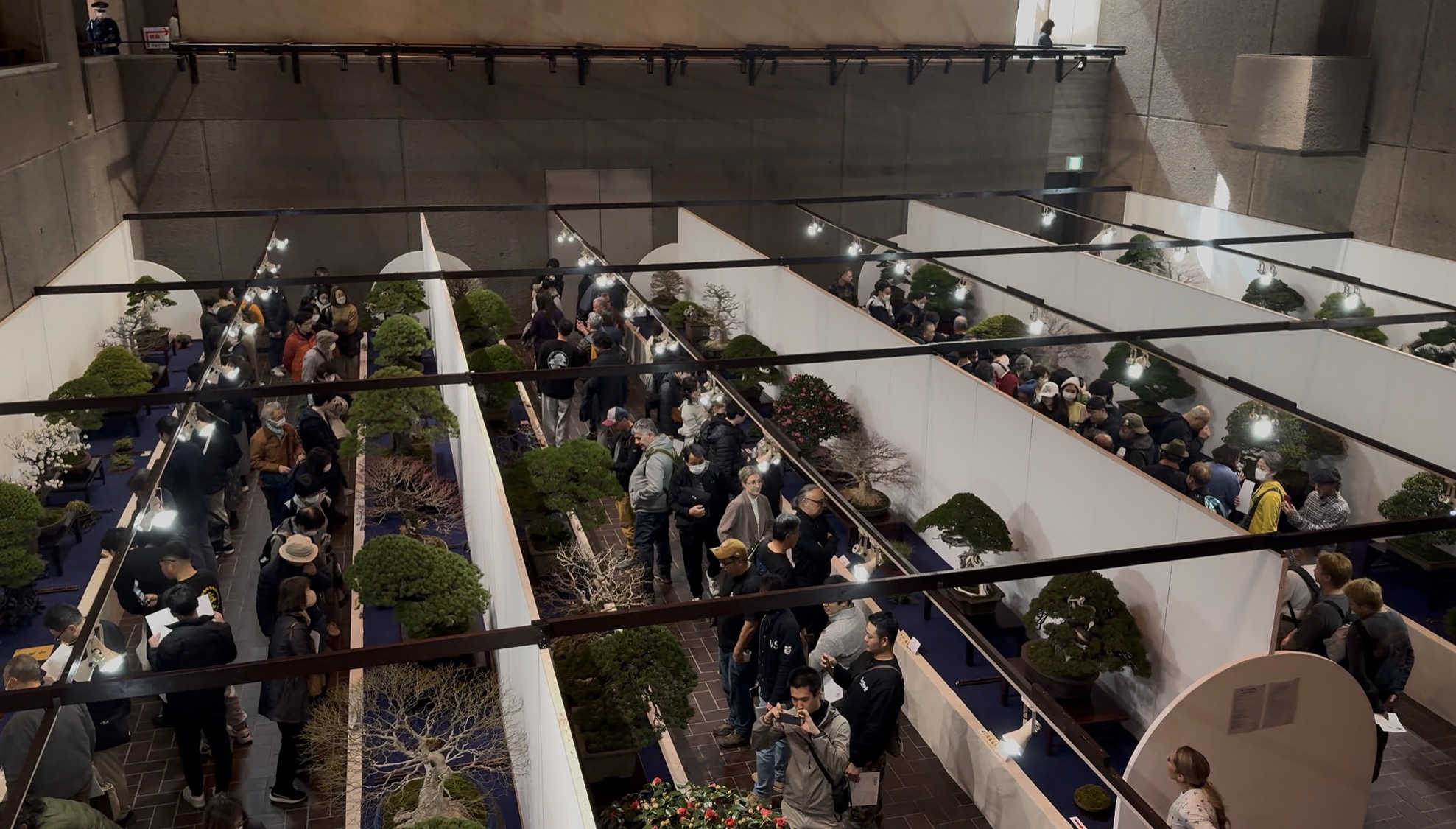
Viewers at a Kokufu Bonsai Exhibition — an audience that has always been part of what a tree's standing is built from.
In Omiya, the historic bonsai district outside Tokyo, a nursery has long billed a client a modest monthly fee to keep his tree alive between visits: watering it, wiring it, deciding when it needs repotting, while the client comes by when it suits him and signs nothing more than the invoice. Politicians, doctors, and industrialists have kept bonsai this way for a century, and by most accounts the arrangement still runs today. Ask any of them who owns the tree, and the paperwork gives one answer. Stand in the nursery and watch who is actually keeping it alive, and the paperwork stops being the whole story.
A bonsai is never held by one person alone. An owner, an artist, and a viewer each hold a claim on what the tree is, and the tree needs all three to keep being what it is.
The Paperwork Names Only One of the Three Claims
The owner is whoever is recorded — on a certificate, in an exhibition catalogue, in family memory. Omiya took shape around exactly this separation: nurserymen displaced by the Great Kanto earthquake of 1923 settled the district in 1925, and a large part of a garden's work there has never been selling trees outright. It has been caring for trees owned by people who could not, or would not, care for them personally.
The artist is whoever's hands actually keep the tree alive: watering on a schedule the owner rarely sees, wiring a branch this year to cut the wire away the next, deciding season after season what to remove and what to leave. At Japan's most prestigious exhibitions, a tree is still entered and displayed under its owner's name rather than the name of the artist who trained it that year — an old convention, and by design a little hard on the artist. Ownership receives the credit; skill earns something less visible but longer-lasting, the trust of the next owner and the next tree.
The viewer is the one a bonsai has ultimately always been made for. A tree tended for no one to see is doing only half its work. Bonsai carries its own word for a deliberate, unhurried act of looking: kansho (鑑賞, "appreciative viewing," attention paid with the intent to understand rather than a passing glance). A tree's front is chosen with a viewer's eye in mind; its position in a tokonoma alcove is set for a guest, not for the owner alone. Omiya grew around this fact early on — enthusiasts and dignitaries traveled there from around the world even in the district's first decades — and it is now home to the world's first publicly run museum built for a single purpose: letting people who own nothing in the collection stand in front of trees that were, for most of their lives, tended inside someone else's private garden.
Remove Any One of the Three and the Tree Stops Holding Together
An owner without an artist does not stay the owner of a living tree for long. A season of wrong watering, a wire left on past its time, one missed repotting after the roots have run out of room — a tree can lose decades of careful shaping faster than those decades were built, and ownership by itself has no way to stop that.
An artist without an owner is not quite practicing the discipline either, in the everyday sense: a tree grown purely for oneself is a private hobby, and the craft only becomes what it actually is — a matter of trust, reputation, and eventual succession — when the hands doing the work are working on someone else's tree. Our report from the 100th Kokufu Bonsai Exhibition looks at that particular pairing more closely.
A tree that is never viewed, meanwhile, accumulates nothing beyond its own wood. Being seen, entered, judged, and placed in front of people outside the household that owns it is what turns simple age into a keireki (経歴, "a traceable record of who has shaped and held a tree") — the kind of record that can eventually earn a tree the name meiboku (銘木), the subject of an earlier piece. Without a viewer, no one is positioned to notice the difference between an old tree and a distinguished one.
Each Role Adds What the Other Two Cannot
The owner adds continuity of intention: the decision of which artist to entrust a tree to, when to let it rest for a season and when to enter it in a show, the willingness to keep paying for a tree's care long after any novelty has worn off. The artist adds years of technical judgment that no amount of good intention can substitute for — knowing which branch to sacrifice this decade so the whole tree gains from it the next. The viewer adds something more easily overlooked: a kind of witness. A tree judged well at an exhibition, described in a museum's records, or simply remembered fondly by strangers who once stood in front of it, carries something forward that an unseen tree, however skillfully kept, does not — a reputation that outlives any single owner's memory of it.
Closing
This three-way structure is not a modern invention. It is closer to how Japanese bonsai culture has organized itself for as long as trees have been passed from hand to hand at all, an idea explored more directly in a piece on the culture of entrusting a tree. The next time a tree's ownership gets settled in a single sentence, the more useful question is not whose name is on it, but which of the three jobs — recording, tending, watching — that name is actually doing this year. Not the paperwork, not the hands alone, but all three holding on at once are what a tree's standing has always rested on.
References
- Saitama City Visitors Guide — "Omiya Bonsai Village" — on the district's 1925 founding after the 1923 Great Kanto earthquake, and on nurseries historically caring for bonsai owned by politicians, doctors, and industrialists in exchange for a monthly retainer.
- Bonsai Empire — "Kokufu-ten Exhibition, Tokyo" — on trees at Japan's leading exhibition being displayed under the owner's name rather than the artist's.
- Japan National Tourism Organization — "Omiya Bonsai Village" — on bonsai enthusiasts and dignitaries traveling to Omiya from around the world.
- Omiya Bonsai Art Museum — "About the Omiya Bonsai Village" — on the museum's role as the world's first publicly run museum dedicated to bonsai.