The earliest surviving evidence for what became bonsai is not a tree. It is a wall painting inside a tomb: the burial chamber of Crown Prince Li Xian (654–684), sealed in 706 AD at the Qianling Mausoleum in Shaanxi and excavated in 1972, its corridor murals showing court attendants carrying trays that hold miniature rockeries and small trees together — not a tree alone. Ask most people where bonsai came from and they will say China and stop there. That answer is correct, and the mural is the reason it is also incomplete: what China handed down was never a single potted tree.
Bonsai began in Tang-dynasty China as a landscape of rock, sand, and miniature trees held together in a tray — and the single tree standing in a shallow pot is a Japanese invention, built over more than a thousand years by taking that landscape apart.
The record starts with a landscape, not a tree
Historians treat the Qianling murals as the earliest surviving evidence of what the Chinese called penjing (盆景, "tray scenery"), a term still used in China today. As the National Bonsai Foundation, custodian of the National Bonsai & Penjing Museum in Washington, D.C., puts it, penjing means "landscape in a pot," and its classical forms range from tree-focused compositions to elaborate arrangements of carved rock standing in for mountains and islands, sometimes finished with miniature figures added to complete a scene. The idea, shared with Chinese landscape painting, was compressing a whole natural world into a container small enough to hold in two hands. A narrower branch of the practice, centered on the tree alone rather than the full landscape, came to be called penzai (盆栽, "tray planting") — the same two characters that, read in Japanese, became bonsai. The narrowing this piece traces began, in other words, with an act of naming a slice of something larger.
The import arrived before Japan had a use for it
The transmission was not a single event. Between 603 and 839, Japan sent at least seventeen official missions to the Tang court, carrying home Buddhist teaching and court ritual, and, travelers' accounts suggest, souvenirs that included container-grown plants. What arrived in those early centuries was closer to raw material than to a settled art: China had exported the object well before Japan had settled on what to do with it.
That gap closed slowly. By the Heian period, a Japanese sense of what a potted tree should be was taking shape. The tenth-century tale Utsubo Monogatari (宇津保物語, c. 970) contains a line often cited as the earliest Japanese statement of bonsai's guiding idea: a tree "left growing in its natural state is a crude thing," and it is only when "kept close to human beings who fashion it with loving care" that its form gains the power to move someone. That is an aesthetic taking shape, not yet a discipline — but it marks the point where Japan stopped simply receiving the Chinese habit and started asking what a potted tree was meant to do.
Visual evidence follows about a century later. The Saigyo Monogatari Emaki (西行物語絵巻, 1195) is the earliest known Japanese painting to depict a dwarfed potted tree, and the Kasuga Gongen Genki-e (春日権現験記絵, 1309), a twenty-scroll set painted by the court artist Takashina Takakane, includes a scene rendered in what art historians now describe as the "bonsai with rocks" style — trees in trays, displayed on wooden shelves, valued enough to be worth painting into a devotional narrative. By the fourteenth century, the object had a name of its own: hachi no ki (鉢の木, "the bowl's tree"), for the fairly deep pots used at the time.
A Noh play made the potted tree worth sacrificing for
That name is also the title of one of the oldest and best-loved plays in the Noh repertoire, Hachi no Ki, attributed to Kan'ami or his son Zeami, the two founders of Noh in the fourteenth century. Its plot is set in the Kamakura period: an impoverished samurai named Sano Genzaemon Tsuneyo shelters a traveling monk on a snowbound night and, having no firewood left, burns his three most treasured potted trees — plum, cherry, and pine — to keep his guest warm. The monk turns out to be the regent Hojo Tokiyori traveling in disguise, and Tsuneyo's sacrifice is later rewarded with land named for each of the three trees he gave up.
The play became especially popular in the Edo period, prized for dramatizing the loyalty and self-sacrifice at the center of bushido (武士道, "the way of the warrior"), and is said to have been a favorite of Tokugawa Ieyasu himself. By the time bonsai became a connoisseur's pursuit among the samurai class, the potted tree already carried centuries of that association — a thing worth giving up something for, not just a thing to look at.
The shoguns made judgment public, then someone wrote the rules down
The Tokugawa shoguns did more than enjoy that story. Tokugawa Iemitsu (r. 1623–1651) was a serious bonsai enthusiast, and among the trees linked to his name is a five-needle pine still alive today, thought to be over 500 years old and, by the most conservative account, already trained as a bonsai by 1610. That tree is remembered as "Sandai Shogun" — the same pine we wrote about in "Meiboku: Japan's Historic Bonsai," now cared for at the Imperial Palace's Daido Garden.
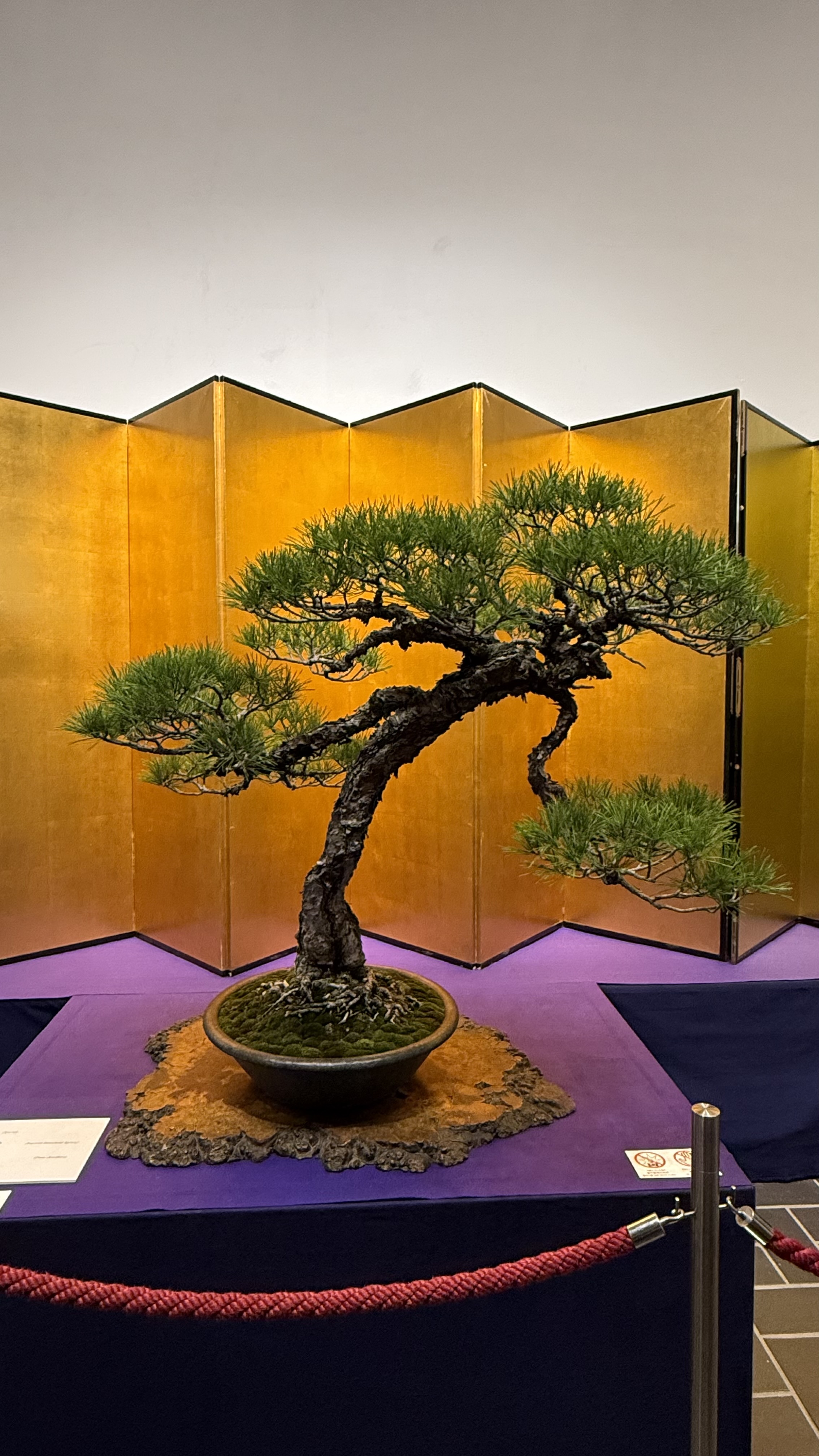
A pine connected to the Imperial Palace. Trees linked to Tokugawa Iemitsu's era are still cared for there today, generations after they left Edo Castle.
By the late eighteenth century, cultivation had moved from private devotion toward public appraisal: records describe an annual exhibition of potted pines in Kyoto beginning in the Tenmei era (1781–1788), where growers could show trees to one another instead of simply keeping them at home. Then, in the early nineteenth century, scholars around Itami, near Osaka, began using a new word for the refined trees they cultivated — bonsai, the Japanese reading of the Chinese penzai — to set them apart from the plainer, deeper-potted hachi no ki still common elsewhere. In 1829, the illustrated manual Somoku Kin'yo-shu (草木錦葉集) codified detailed criteria for pine cultivation, giving the newly named art its first written standard. Public judgment came first; the written rule came after, to settle what was already being judged.
The same period split the original import in two. The Chinese penjing — rock, sand, and tree together — did not simply relabel itself as bonsai. The tree-only line kept narrowing until it became bonsai proper, refined by removing everything that was not the tree. A separate, parallel Japanese art called bonkei (盆景, using the same characters as penjing, "tray landscape") kept the rock and the sand and let the living plant go — a bonkei scene is built entirely from dry material and needs no watering at all. Japan did not copy the Chinese landscape-in-a-tray so much as take it apart and specialize each half.
The narrowing is a pattern, not a coincidence
Seen from this distance, bonsai's history looks like one long instance of a pattern that recurs across Japanese craft: learn something arriving from outside, absorb it closely, branch it into distinct schools, then keep narrowing each branch, generation after generation, until it holds far more than its size suggests. We wrote about the same pattern at work in sushi and industrial manufacturing in "Japan's Format: Super-Niche Quality." Bonsai may be the oldest example of it on record: a Tang-dynasty tray full of rock and tree, learned, split, and narrowed for well over a thousand years, until one species of pine grown by one artist across one lifetime was enough to hold a whole landscape. For the aesthetic logic behind that narrowing — why removing things, rather than adding them, is what makes a bonsai feel finished — see "Bonsai Is Not a Small Tree."
What a bonsai in front of you still proves
There is a rough way to read that history back out of the object itself. The deeper the pot, and the more it shares space with rock, sand, or ornament, the closer a piece sits to the original Tang landscape. The shallower the pot, and the more the whole composition rests on a single trunk with nothing else in the frame, the further it has traveled down the narrowing this piece has traced — and the more generations of restraint, rather than addition, likely stand behind it. That is not a dated measurement, only a rough one, but it holds up in front of almost any tree grown in a Japanese nursery today: a shallow bowl, one trunk, and a form shaped by seasons of holding back rather than by any single act of building.
Azukari's part in that lineage is smaller than it sounds: not to narrow the tradition further, but to keep one already-narrow branch of it moving forward for one more owner, one season at a time, in the hands of an artist still doing the narrowing thirteen hundred years after that tomb was sealed.
References
- National Bonsai Foundation — "Penjing Master Weighs In: What Are the Differences Between Bonsai and Penjing?" — on the Tang-dynasty origin of penjing, its definition as "landscape in a pot," and its distinction from tree-focused penzai/bonsai.
- Wikipedia — "History of Bonsai" — on the seventh-to-ninth-century missions to Tang China, the Utsubo Monogatari citation, the Saigyo Monogatari Emaki and Kasuga Gongen Genki-e scrolls, the terms hachi no ki and bonsai, Tokugawa Iemitsu and the "Sandai Shogun" pine, and the 1829 Somoku Kin'yo-shu.
- Google Arts & Culture / Art Research Center, Ritsumeikan University — "Kasuga Gongen Genki E, Bonsai" — on the 1309 scroll's depiction of a tree in the "bonsai with rocks" style and its relation to the thirteenth-century Saigyo Monogatari Emaki.
- the-noh.com — "Hachinoki (Potted Trees)" — synopsis and historical context for the Noh play, its Kamakura-period setting, and its Edo-period popularity as a story of samurai loyalty.
- Wikipedia — "Bonkei" — on bonkei as a tray-landscape art using only dry materials, distinguished from the living trees of bonsai and saikei.