Keido (景道, "the way of the view"), the discipline I am training in at Shunkaen, a bonsai garden in Tokyo, judges a display on four things at once: the tree or stone itself, the stand beneath it, the piece placed beside it, and the space left bare around all three. I've written elsewhere about how I came to study it. What matters here is the fourth item on that list, which needs its own name in Japanese: ma (間, an interval of space or time, treated as an active element rather than a void).
Ma treats an interval of space, time, or silence as something built with the same intention as the objects placed around it.
In English, an empty stretch usually reads as a shortfall — a pause where speech has run dry, a gap where a floor plan fell short, a rest where the music has nothing left to say. Japanese aesthetics starts from a different assumption: the interval carries as much design intention as anything placed inside it. This single idea runs quietly through how Japan builds a house, holds a conversation, performs music — and, in the discipline I am now training in, arranges a tree in a pot.
A shared character does real work across four different arts
The character 間 turns up across an unusually wide range of Japanese vocabulary, and that range is itself the evidence. Ma is the counter for a room in a traditional house, the first half of the word for a household's floor plan — madori (間取り, literally "the taking of intervals," how a house divides its space into rooms) — and a fixture of ordinary phrases about timing and social rhythm. One character, applied to a wall of a house and to a beat of silence in a sentence, is doing structural work in every case: it separates one thing from another so both can be read clearly. A room needs walls, but a house needs the space between the walls even more, or there is nothing to walk through, only material stacked together. The architect Arata Isozaki built an entire international exhibition, MA: Space-Time in Japan, on the premise that this same interval organizes Japanese painting, theater, music, and daily life as one continuous idea rather than nine separate ones.
A pause signals attention, not a gap in the conversation
The clearest place to watch ma at work is an ordinary conversation. A pause before answering a question doesn't read as dead air the way it can elsewhere — it can be read as consideration, as respect for what was just said, as room left for the other person's words to finish landing. Cut that pause short, and something is lost before a single word of reply is spoken.
Noh (能, a masked, highly formalized theater tradition dating to the 14th century) is usually cited as the art form that builds this most deliberately into its craft. Performers move and speak across long stretches of near-stillness, and the drummers space their strikes apart rather than filling the beat — the silence between two strikes is treated as part of the rhythm, not an absence of it. Zeami, the actor and theorist who codified noh in the medieval period, wrote that "what is not done" can hold as much interest as what is. Traditional Japanese music more broadly gives the space between notes the same weight as the notes themselves — closer to a rest written deliberately into a score than to silence left by default.
A house is organized by what stays empty
Architecture makes the idea physical. A traditional Japanese house is organized less around fixed rooms than around adjustable intervals: sliding partitions, an alcove kept empty until a single scroll or branch is placed inside it, a floor plan (madori, 間取り) whose logic is which spaces to leave open rather than which to fill. The alcove's emptiness is the room's most deliberated part, held open so that whatever is placed there — for one season, one visit, one arrangement — can be seen clearly against it.
A bad room and a bad moment share one word
The clearest sign that this idea has settled into daily life is an ordinary phrase: ma ga warui (間が悪い, literally "the interval is bad," used for an awkward, ill-timed, or unlucky moment). Someone walks in exactly when they shouldn't. A joke lands a beat late. Japanese doesn't reach for a separate word meaning "awkward" here — it reaches back to the same character used for a room, a musical rest, a pause on a noh stage. An awkward moment and a badly proportioned room are, in the language itself, treated as the same kind of failure: an interval that wasn't shaped with enough care.
A language doesn't build a phrase like that by accident. Ma ga warui only makes sense in a culture that already treats the interval as something that can be handled well or badly — which is another way of saying it treats the interval as a decision.
A bonsai pot follows the same rule as the alcove
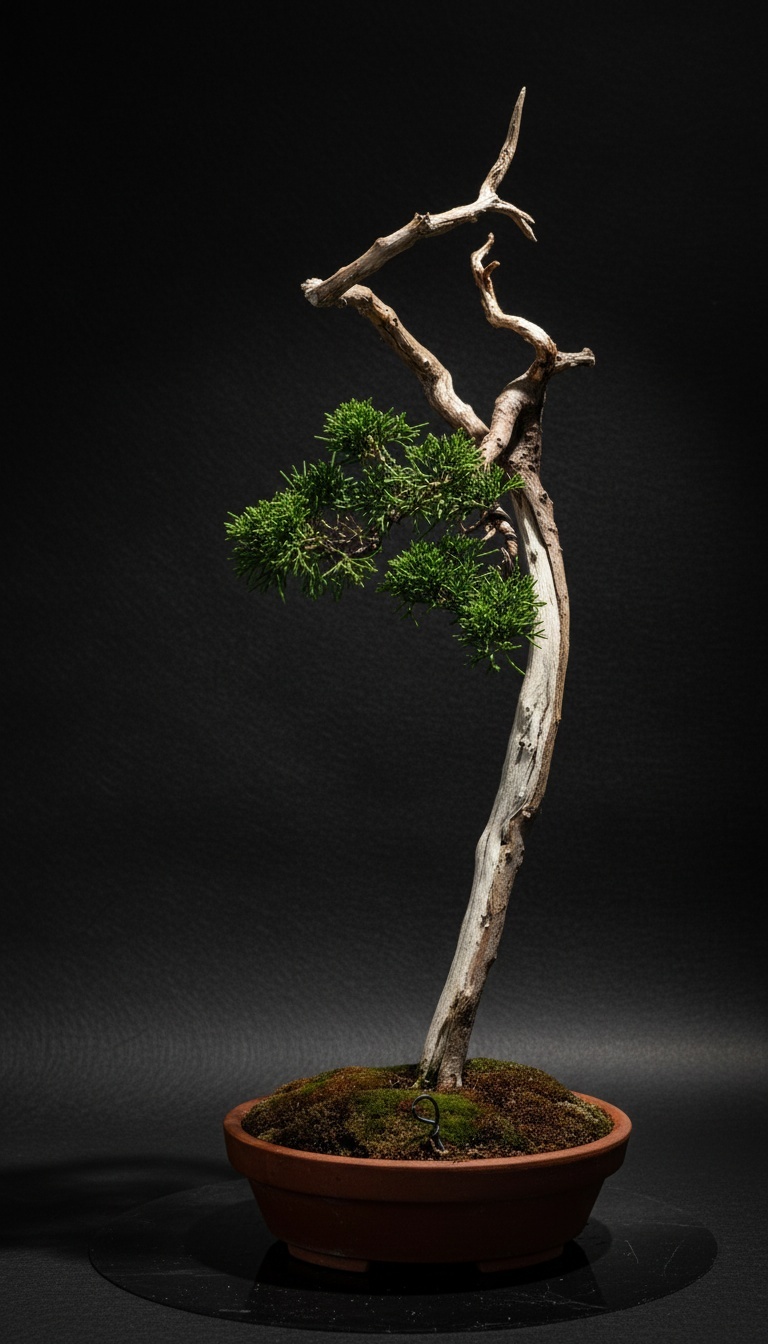
A shimpaku juniper kept open around its own form — the bare space here is not an omission, but part of what the tree is arranged to say.
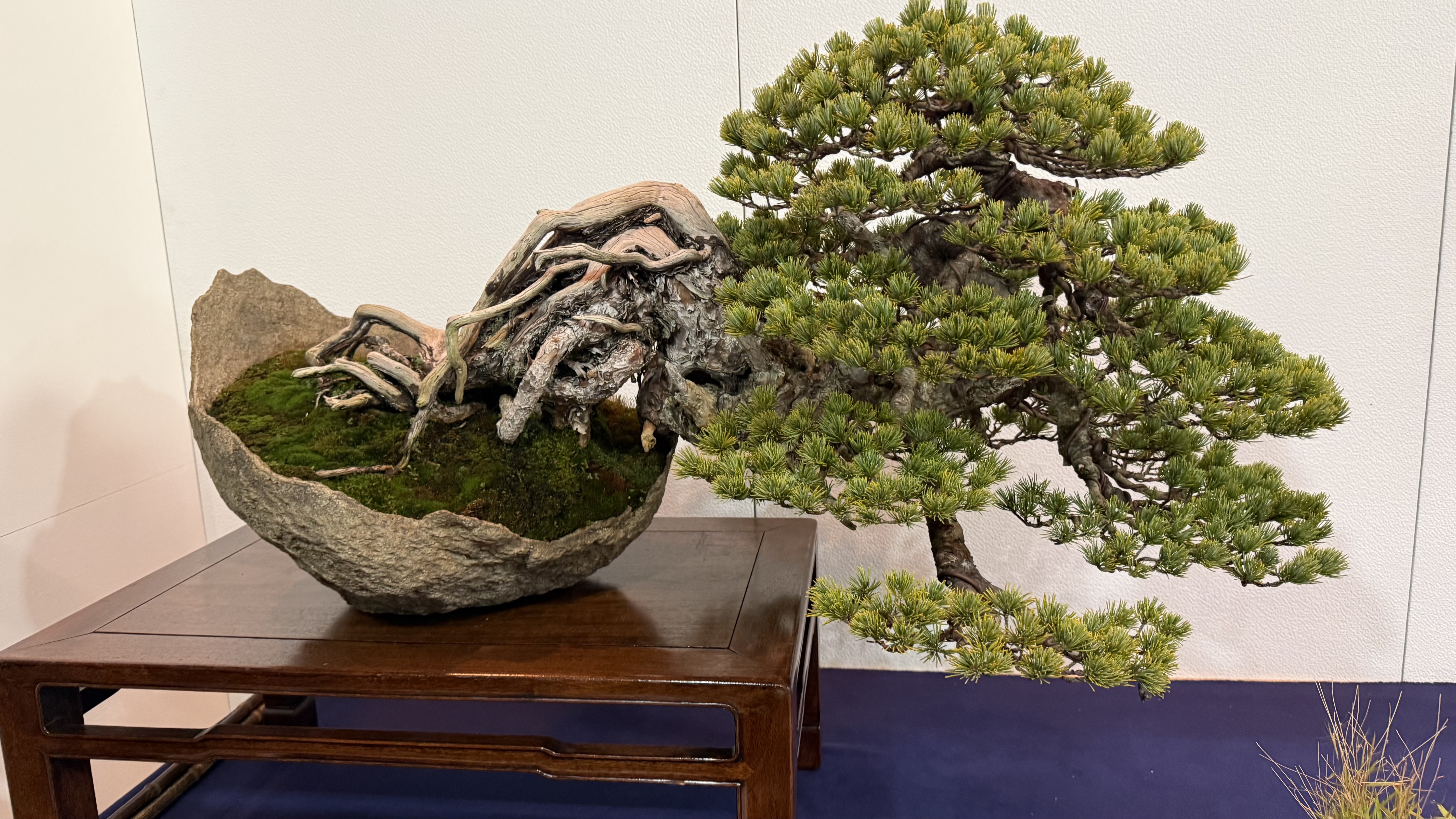
This is the fourth item keido trains me to check before any other: the gap between the lowest branch and the soil, the reach of empty air a cascading trunk falls through, the bare silhouette a shimpaku juniper's deadwood is allowed to keep around itself. None of it is unused space waiting for more foliage. It is placed with the same care as a branch, so the branches that do exist can be read clearly against it.
An artist pruning a bonsai spends as much attention on what to remove as on what to keep, for the same reason a noh drummer spaces out a strike or a house leaves an alcove bare: so the interval can do its work. A pot filled to the edge with foliage would only be a tree without ma — busy, but with no room left in which any single branch could be read clearly.
The test I've started applying, on a tree or anywhere else, is not whether something looks missing. It is whether the empty part was placed on purpose, or simply never decided.
For a tree kept under Azukari's care, that decision belongs to the artist tending it, season after season, long before an owner ever sees the record of it.
For more on how a bonsai's form is read at all, see "How to Look at a Bonsai," and on why the tree itself resists being treated as a finished miniature, "Bonsai Is Not a Small Tree." I first touched on ma in passing while writing about bonsai's small appearances on screen — this piece is the fuller telling.
References
- Wikipedia — Ma (negative space) — overview of ma across visual art, architecture, martial arts, and music, including the tokonoma alcove and Isaac Stern's description of silence between notes.
- ArchDaily — "Arata Isozaki on 'Ma,' the Japanese Concept of In-Between Space" — architect Arata Isozaki discussing ma as in-between space and time in his design practice.
- Buddhistdoor Global — "Ma: The Art of Empty Space" by Joseph Houseal — on ma in noh theater, Shinto shrine space, and Zen gardens, including the drummer's spaced-out strikes.
- Real Estate Japan — "Madori (間取り)" — explanation of madori as the Japanese term for a house's room layout and floor plan.