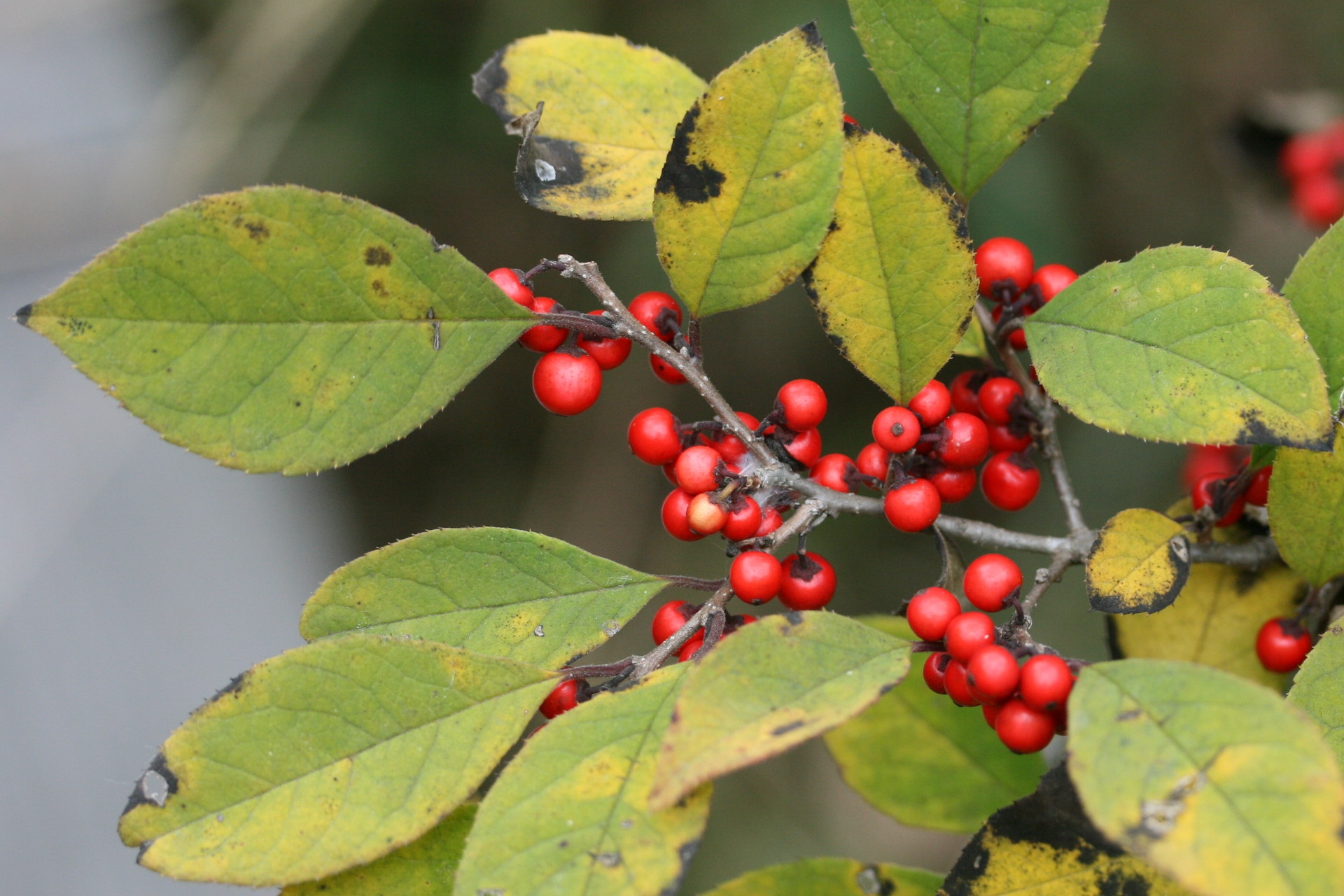
Photo by Alpsdake, CC BY-SA 3.0, via Wikimedia Commons — Source

By the time most flowering and fruiting bonsai have finished their year's display, umemodoki (梅擬, "Ilex serrata," literally "mock ume") is only getting started. Its small red berries, packed along bare branches deep into winter, are a modest, deciduous holly's answer to a season most trees have nothing left to say about.
Umemodoki sets its berries in tight clusters along the length of the branch, keeps them there long after its own leaves have dropped, reads in Japan as one of the plainer expressions of wabi-sabi in the bonsai canon, and exists, more than almost any other potted tree, for the sake of winter alone.
A name that admits what it isn't
Start with the name, because it gives away the tree's whole character. Umemodoki joins ume (梅, the flowering apricot prized for blooming ahead of spring) with modoki (擬き, "a thing that resembles the genuine article without being it"). Japanese reference sources trace the name to the shape of the leaf — oval, finely toothed, close enough to an ume leaf at a glance to invite the comparison — with some accounts adding that the small flowers were once thought to echo ume blossoms as well. Botanically the resemblance stops there: umemodoki is Ilex serrata, a member of the holly family (Aquifoliaceae), with no relation to ume, a stone fruit in the rose family. The name was never a claim of kinship. It was a plain admission of likeness, offered without apology — a tree content to be known as a look-alike rather than to insist on a name of its own.
Berries set the length of the branch
Umemodoki is a deciduous shrub native to Japan — mainly Honshu south of Iwate and Akita prefectures, along with Shikoku and Kyushu — and to parts of China. Small, pale purple-pink flowers open along the previous year's wood in early summer, easy to miss unless a grower is looking for them. What follows is the point of the tree: on female plants, tight clusters of berries form directly along the branch at almost every leaf node, rather than at the branch tips the way many fruiting bonsai, the princess persimmon among them, carry their crop. Because the species is dioecious — male and female flowers grow on separate plants — a female umemodoki needs a male nearby, in bloom at the same time, or the branch stays bare. (A dwarf cultivar known as koshobai, valued in shohin-size bonsai, is reported to set fruit without one.) Growers who want the berries are, in effect, keeping two trees for the sake of one.
What the leaves take with them, and what stays
The berries begin green in late summer and color gradually, reaching a deep crimson by autumn. In Japanese haiku almanacs, umemodoki is registered as a season word for late autumn, marking the point at which the berries have fully reddened and the year visibly turns toward winter. What makes the tree worth growing, though, is what happens next: the leaves yellow and drop through November, and the berries do not go with them. Freed of foliage, the fruit stays fixed along the bare wood — reportedly holding, if birds do not take it first, well into the following spring. Horticultural guides note plainly that growers value umemodoki for its berries rather than its flowers, and prune and feed with that priority in mind through the growing season, protecting against summer drought that can cost the following year's crop.
A modest kind of beauty
A branch with no leaves and a scatter of red fruit is not a showy image by the standards of a flowering cherry or a full-crowned maple in autumn color. That plainness is closer to the point. Wabi-sabi, the aesthetic sense that finds beauty in the sparse, the aged, and the incomplete rather than the polished and the abundant, has room for exactly this kind of tree: bare, quiet, carrying just enough color to be noticed and no more. A name built on resemblance rather than assertion fits the same sensibility — umemodoki does not claim to be ume, does not compete with it, and asks only to be seen for what it plainly is.
A tree that waits for December
Most bonsai species have their moment and then recede for the rest of the year — a pine's silhouette, a maple's spring leaf or autumn color, a flowering apricot's few weeks in bloom. Umemodoki is built around the opposite calendar. Its flowers are unremarkable, its summer foliage ordinary, and its entire reason for being potted and trained arrives only once the rest of the garden has gone quiet: a stretch of bare branch, strung with berries, at the exact point in the year when little else offers color. Growers who keep it are, in a small way, tending a tree for a season everything else has already given up on.
Closing
Some trees are grown for a single week of bloom. Umemodoki is grown for a stretch of gray months when a single branch of red against bare wood is enough. Keeping it well means watching for a mate to flower at the right time in early summer, watching for drought through the following months, and then, in December, watching the berries hold their color as everything nearby goes bare — the kind of unglamorous, season-long attention that most of a bonsai's value never shows in a single photograph.
At Azukari, that kind of attention is exactly what a season's record is meant to capture: not only the weeks a tree is at its most photogenic, but also the quieter months an artist in Japan spends making sure the next display arrives on time.
References
- Bonsai Empire — Japanese Winterberry Bonsai Care Guide (Ilex serrata) — deciduous habit, dioecious pollination requirement, berry color and persistence after leaf fall, and general care.
- 植木ペディア — ウメモドキ(梅擬) — name origin from leaf resemblance to ume, and leaf description.
- Wikipedia (Japanese) — ウメモドキ — classification as Ilex serrata in the Aquifoliaceae, native distribution across Honshu, Shikoku, Kyushu, and China, dioecious habit, and berries ripening from around September and persisting on the branch after leaf fall.
- 季語と歳時記 — 梅擬(うめもどき)晩秋 — registration of umemodoki as a late-autumn season word (kigo), with berries coloring deep red as the season turns.
- Bonsai4Me — Ilex Holly Bonsai species guide — description of Ilex serrata flowers and fruit, native range, and dioecious pollination needs distinct from evergreen Ilex crenata.