
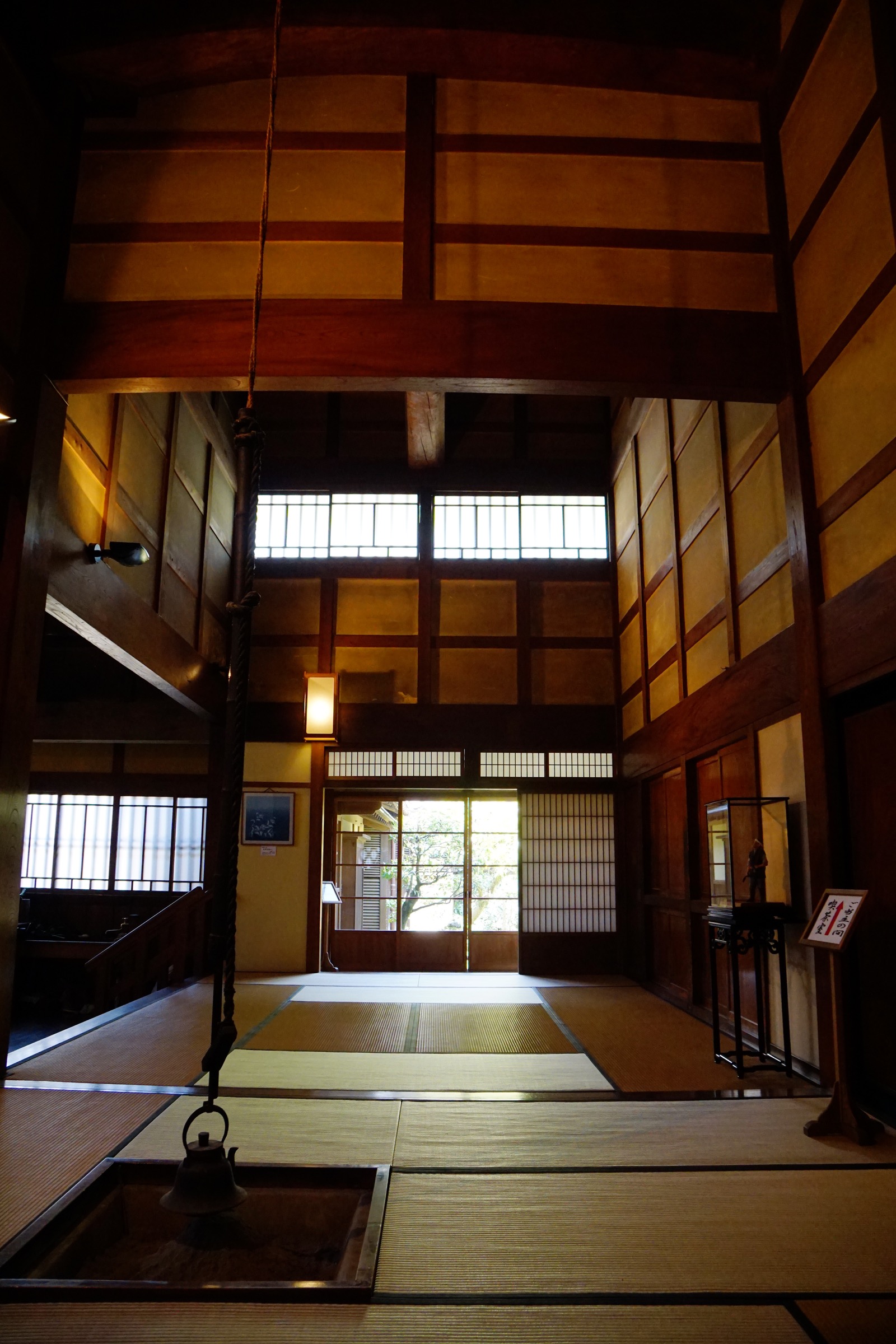
At the Ishitani Residence in Tottori, the building in the photograph above, late-afternoon sun turns the paper screens into a single even field of gold: no window, no lamp, and no bright patch anywhere in the room, only the wooden lattice printed faintly across the glow. That is the effect a shoji (障子, a sliding paper-and-lattice screen) is built to produce. It takes direct sunlight on one side and releases something else on the other.
A shoji converts a directional beam of sunlight into an ambient field with no visible source, and that conversion is the starting point for understanding why a traditional Japanese room feels the way it does.
A Membrane Does What a Wall Cannot
A glass window admits sunlight as it is: bright, directional, casting a hard edge across the floor. A solid wall stops it outright. The material doing neither job is washi (和紙, traditional handmade paper), stretched taut over a kumiko lattice of thin wooden strips. Washi is made by hand from the inner bark fibers of plants such as kozo (paper mulberry), a craft old enough that in 2014 UNESCO inscribed traditional washi-making techniques — including the Hon-minoshi, Sekishu-banshi, and Hosokawa-shi traditions — on its Representative List of the Intangible Cultural Heritage of Humanity. The fibers are separated, soaked in clear river water, and filtered by hand through a bamboo screen, a process that has continued for well over a millennium.
Washi's usefulness here is optical rather than structural. It is translucent: light passes through and scatters in every direction, but a clear view does not. Look at a shoji wall and the garden beyond it stays hidden; what shows instead is that the sun exists out there, spread evenly across a pale gold plane with the lattice's crossbars printed on it like a quiet grid. A directional phenomenon becomes an ambient one.
Diffuse Light Changes What the Eye Notices
Direct sunlight is legible and sharp: it reveals texture aggressively, throws hard contrast, and moves visibly across a room as the sun crosses the sky. Diffuse light works the other way. It fills a room evenly, reveals surfaces gently, and shifts so slowly that the change is felt rather than watched. A room lit by shoji has no single bright spot and no true shadow, only gradients — and that evenness is what frees the eye to settle on everything else in the room: the grain of aged wood, the weave of tatami, the faint warmth of paper darkened by decades of sun.
The novelist Jun'ichiro Tanizaki made this preference explicit in his 1933 essay In'ei Raisan (陰翳礼讃, "In Praise of Shadows," a meditation on shadow and dim light in traditional Japanese interiors). He contrasted Western paper, which reflects light off its surface, with Japanese paper, which seems to absorb it "like the soft surface of a first snowfall," holding a beam of sun rather than bouncing it back at the viewer. Tanizaki was writing as electric light began replacing the shoji-lit interior, and the essay reads in part as an elegy for a way of inhabiting a room built on exactly the restraint a paper screen imposes. His claim is one writer's argument rather than a universal account of Japanese aesthetics. It still names something real: what a shoji changes is the relationship between a room and the sun outside it, beyond simply the light's intensity.
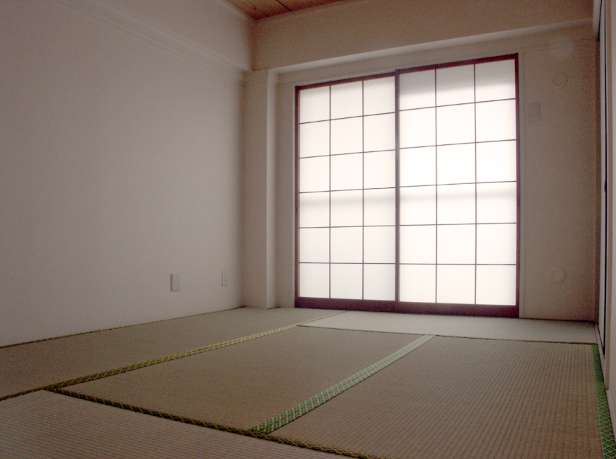
A plain tatami room in winter light. With no other source in view, the shoji itself appears to glow — the wall has become the room's only visible light fixture.
The Room Keeps Its Own Clock
Because a shoji never shows the sun directly, it registers the sun's movement as a change in a surface's quality rather than the position of a beam. Morning light through washi reads pale and faintly blue-white, thin with the coolness of early hours. By midday, with the sun higher and stronger, the same screen glows a denser, more even gold, and the room brightens without any patch of floor turning harsh. Toward evening, as the light lowers and reddens, the paper takes on a warmer, more amber cast, and the kumiko lattice — nearly invisible at midday — begins throwing faint, elongated shadows of its own grid across the tatami.
The same holds across the year. High summer light, intense and glaring, is what the screen tempers most aggressively, part of why shoji remained standard through humid, glaring summers even after glass became available. Low winter light passes through with less alteration, so a room that felt evenly bright in August can read almost silvery in January. None of this asks anything of the people inside. The screen performs the same quiet translation regardless of season — only the input changes, and the room's mood changes with it.
There is a plain way to test the difference yourself: watch a room for an hour. A plain window holds one bright patch that crawls across the floor and is gone by dusk. A room lit the way a shoji lights it never holds a patch at all — the light simply deepens in color through the day, hour to hour, without pointing at anything in particular.
The Wall Learns to Filter Like a Forest Canopy
Stand in a forest and komorebi (木漏れ日, sunlight filtering and scattering through a canopy of leaves) is what happens when light passes through something irregular enough to break it apart without stopping it. A shoji builds that same relationship between light and a surface into a fixed architectural element, making a wall filter the way a stand of trees filters.
This is close to the organizing idea behind the traditional Japanese house, more than an incidental side effect of its materials. Long eaves keep direct sun from reaching deep into a room in the first place, engawa verandas sit as an intermediate zone between garden and interior, and the shoji is the last and finest filter in that sequence — daylight design achieved with a single sheet of paper rather than mechanical shading. The logic extends to what a room is built to hold: a bonsai kept indoors, even briefly for a tea gathering or a seasonal display in the tokonoma alcove, is traditionally placed near this kind of filtered light rather than in direct sun or in the room's darkest corner — the same even illumination that flatters aged wood and paper also lets bark and foliage read gently instead of bleaching under glare.
For more on how Japanese rooms are built around emptiness and light, see "What Is Ma?" and "The Tokonoma: An Eloquent Emptiness." For how Sen no Rikyu pushed the same thinking to its extreme in a two-mat tea room, see "Rikyu's Windows."
A shoji does not choose what a room shows. It chooses how gently the room lets anything be seen.
References
- UNESCO Intangible Cultural Heritage — "Washi, craftsmanship of traditional Japanese hand-made paper" — official listing describing the washi-making traditions inscribed on the Representative List in 2014.
- Wikipedia — In Praise of Shadows — overview of Tanizaki Jun'ichiro's 1933 essay In'ei Raisan, its themes, and its publication and translation history.
- Wikipedia — Shoji — description of shoji construction, the use of washi paper over a wooden lattice, and its function diffusing sunlight in traditional Japanese architecture.
- Nippon.com — "The World of 'Washi': Paper That Lasts a Thousand Years" — on washi's history, manufacturing process, and its role filtering soft light through shoji screens.
- Ishitani Residence, Chizu, Tottori — via Wikimedia Commons — a preserved traditional merchant residence, source of this article's cover photograph.