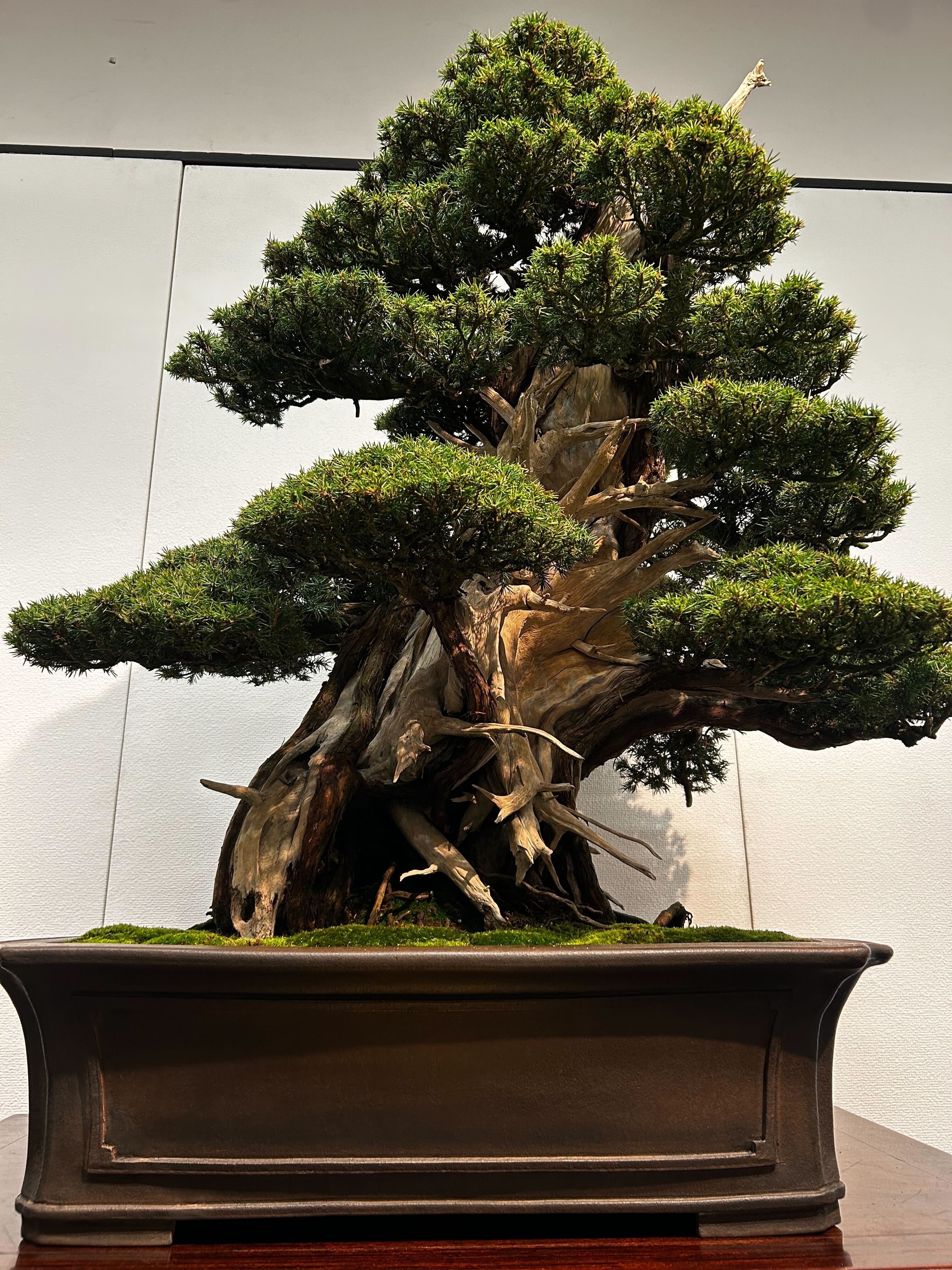
A conifer bonsai from the shohaku (松柏, "pine and cypress," the collective term for bonsai's conifer lineage) tradition. Sekka hinoki belongs to this same family, though its foliage looks almost nothing like the tree pictured here.
Most conifers grown as bonsai are judged by how closely they can be made to recall an old tree in the wild — a pine bent low by coastal wind, a juniper gripping a ridge. Sekka hinoki (石化檜, "petrified hinoki cypress") does not play that game. Nothing about its foliage points back to a mountain. It fuses into dense, congested clusters unlike anything else in the conifer lineage, and growers reach for it precisely because it resembles no other bonsai in the room.
Sekka hinoki holds its place among Japan's conifer bonsai not by imitating nature more faithfully than the classical pines, but by refusing to — a growth mutation gave it a fused, stone-textured foliage found nowhere else in shohaku, and that singularity is exactly what draws growers to it.
A mutation, not a mountain
Hinoki (檜, "Japanese cypress," Chamaecyparis obtusa) was a tree of some standing long before it became bonsai material. Native to the mountains of Honshu, Shikoku, and Kyushu, the species can grow past 30 meters in the wild and live for centuries. Its lemon-scented, rot-resistant wood was used to build Horyu-ji, generally cited as the world's oldest surviving wooden structure, and has re-framed the halls of Ise Grand Shrine through generations of the shrine's own ritual rebuilding. One telling of the tree's name traces it to hi no ki (火の木, "tree of fire"), for its early use in starting fire by friction; other tellings point instead to hi (日, "sun") or hi (霊, "spirit") — the etymology itself is not settled, only the tree's long standing in Japanese life is.
Sekka (石化, literally "turning to stone") names something narrower: a mutation at the growing tip. Japanese horticulture groups it with the broader phenomenon called taika (帯化, "fasciation"), in which a normally cone-shaped growing point spreads sideways instead of extending forward, producing flattened or congested growth in place of an ordinary single shoot. The mutation turns up across hundreds of unrelated plant families — cockscomb flowers are the textbook garden example — and where it appears in ornamental species, it is prized rather than corrected. Cuttings taken from a fasciated hinoki branch reproduce the same congested growth reliably, which is how sekka stopped being a one-off curiosity and became a stable, nameable cultivar that nurseries could propagate on purpose.
Foliage fused into stone
Ordinary hinoki carries its scale leaves in flat, fan-like sprays — the layered silhouette familiar from temple gardens. Sekka's foliage abandons that structure entirely. Its scales bunch into tight, rounded clusters only a few millimeters across, packed so densely that individual leaves are hard to pick out at a glance, closer to a mineral crust than a spray of leaves. The name fits the look: whatever the term's origin in the wider language of horticulture, few plants wear "turning to stone" as literally as this one does.
The same congestion reaches into the wood. Because the growing tip splits and folds back on itself rather than running outward along one line, branches thicken unevenly, and the clustered growth shades itself more readily than an open pine canopy does — interior foliage that loses light browns and dies back if left unattended, so growers who keep sekka hinoki clear spent growth each spring and prune more attentively than an ordinary hinoki requires. What results, on an old specimen, is a tree that reads less as something grown in a season's light than something formed under pressure, closer in feel to a stone shaped by water than a branch shaped by sun.
A form the rest of shohaku doesn't have
Within shohaku, most species are distinguished by degree rather than kind. Goyomatsu (五葉松, "Japanese white pine") reads as delicate, kuromatsu (黒松, "Japanese black pine") reads as forceful, but both are recognizably pine, built from a trunk, branches, and needles arranged the way a pine in the wild might arrange them. Sekka hinoki sits outside that spectrum. Its congested clusters cannot be combed into the flat, layered pads a grower shapes on a pine, and because the fused branch tips are more brittle than an ordinary shoot, the tree tends to be shaped more through pruning than through the wiring and bending vocabulary built for pines and junipers — a matter of removing what does not belong, and leaving the rest to thicken at its own unhurried pace.
That difference is the point, not a limitation. Sekka hinoki was never going to compete with goyomatsu or kuromatsu for the same kind of admiration — a refined pad, a powerful trunk. It offers something the wider world of bonsai already makes room for, as we've written elsewhere: a willingness to hold trees that share almost nothing with each other except the pot, the pruning, and the years of attention.
The grower who chooses the odd one
Because it stays compact, grows slowly, and tolerates both summer heat and winter cold reasonably well, sekka hinoki is often recommended to newer growers — a tree that can be kept alive and interesting without the exacting technique a formal pine demands. But the same tree holds steady appeal among growers who have already worked through the classical pines and are looking for something else. For a collector drawn to the unusual over the orthodox, a tree whose entire identity rests on a growth mutation rather than an approximation of a mountain original sits close to the opposite of a formal upright black pine — and that contrast is the appeal, not a compromise. Sekka hinoki does not ask to be measured against the wild. It asks to be looked at on its own terms, as a texture that exists nowhere else in the pot.
Closing
A tree that grows this way asks something specific of the person keeping it: patience with a form that will never resemble the pines and junipers around it, and attention paid to a texture rather than a silhouette. That is not so different from what any bonsai asks — only sharpened. Every conifer under cultivation is, in its own way, a negotiation between what a species would do left alone and what years of a grower's hand can coax it toward. Sekka hinoki simply starts from a stranger mutation than most, and over the years it spends settled in the same pot, that oddness becomes as familiar as any pine's more orthodox form.
Azukari tends trees across that same range, from the classical pines to cultivars that answer to no established form. Whatever shape a tree arrived with — mountain-bent or mutation-born — the care that follows in Japan stays the same: seasonal attention, recorded and passed along to whoever holds the tree's next stretch of time.
References
- Wikipedia — Chamaecyparis obtusa — species description: native range, height, bark, foliage, and traditional use in temple and shrine construction.
- Japanese Wikipedia — ヒノキ (Hinoki) — etymology theories (火の木 / 日の木 / 霊の木), Horyu-ji as the world's oldest surviving wooden structure, and hinoki's long-term strength curve.
- Kotobank — "石化" (Sekka) — dictionary definition of sekka as synonymous with taika (帯化, fasciation): a growing point spreading laterally into flattened or fan-shaped growth.
- Bonsai Myo — セッカヒノキ(石化ヒノキ)(Sekka hinoki care guide) — foliage character, heat and cold tolerance, and seasonal care for sekka hinoki as bonsai.
- Bonsai Tonight — "Repotting Nursery Stock: Sekka Hinoki" — cultivation notes on sekka hinoki's fine foliage, vigorous rooting, and its popularity for shohin-sized bonsai.
- Bonsai Empire — Hinoki Cypress Care Guide — general hinoki cultivation guidance and mention of Yatsubusa, Chirimen, and Sekka as dwarf cultivars suited to bonsai.