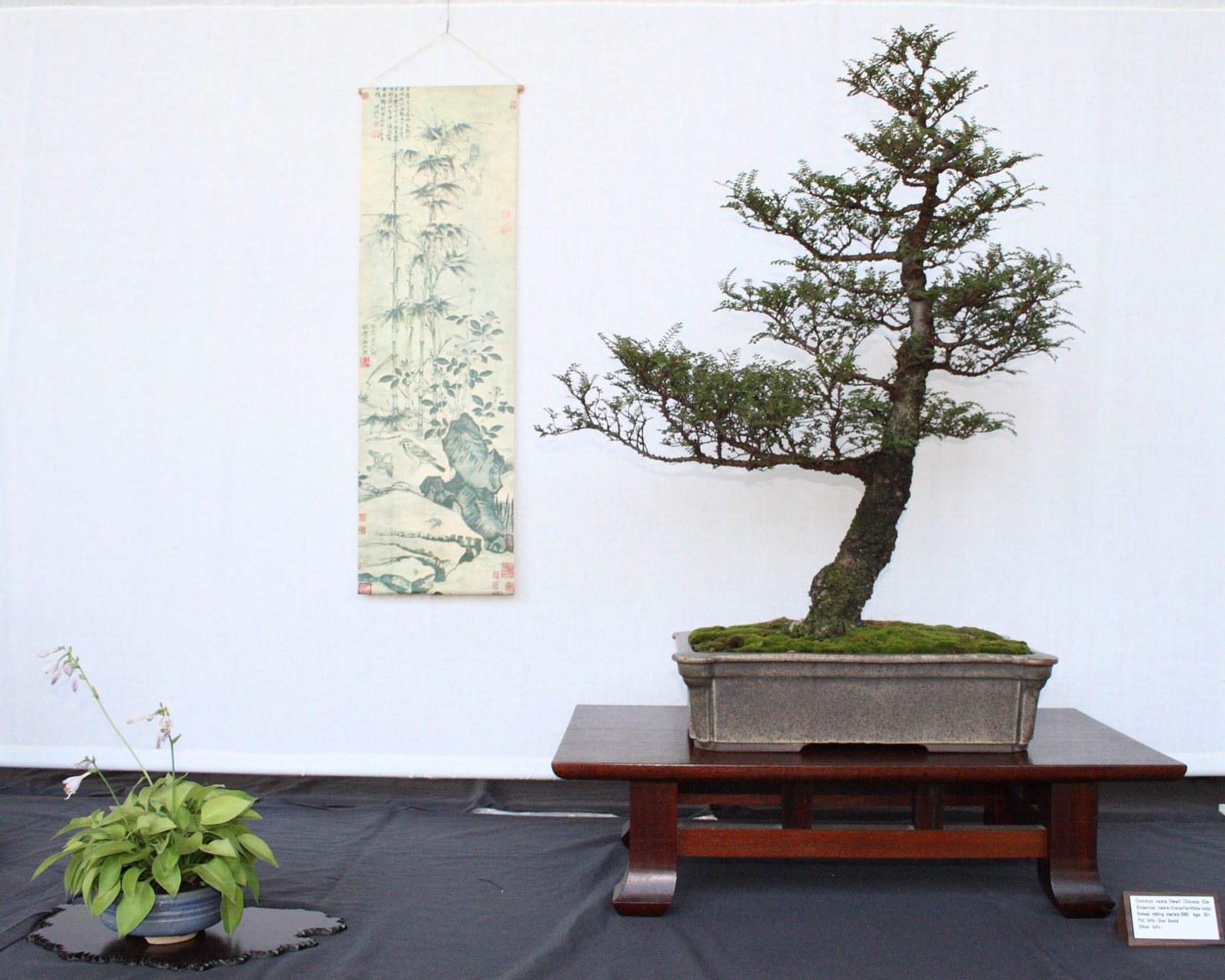
A Seiju elm bonsai shown with its ceramic pot, a wooden stand, a miniature hosta as accent planting, and a hanging scroll, forming a single composed seki-kazari at the 2009 exhibition of the Bonsai Society of Greater Hartford. Photo by Sage Ross, CC BY-SA 3.0, via Wikimedia Commons — Source

A seki-kazari is not a tree with two objects placed near it. It is a main tree, a companion planting, and a hanging scroll built into a single composition — laid out on an unequal triangle, carrying one season's story, and read by a viewer, and judged by a jury, as one work rather than three.
A discipline with its own name
Seki-kazari (席飾り, literally "seat decoration," "a formal display") is the general term Japanese practice uses for arranging a bonsai for presentation, whether inside the alcove of a tokonoma (床の間) — a version of the practice specifically called toko-kazari (床飾り, "alcove display"), treated at length elsewhere — or on a shelf or table at an exhibition. The wider vocabulary of that practice — the pot matched to the tree, the stand chosen to lift it — is its own subject. What belongs specifically to seki-kazari is narrower and more exacting: the formal grammar for combining a tree with a small number of supporting objects into a composition a visitor can read in a single glance, the way a sentence is read rather than spelled out letter by letter.
Three points, one seat
The classical form of a seki-kazari rests on three elements, named plainly for what each contributes: the shuboku (主木, "main tree"), a soe (添え, "an accompaniment") — usually a small accent planting or a viewing stone — and a kakejiku (掛け軸, "hanging scroll") set behind them both. Guides written for growers describe the arrangement in blunt terms: the composition is built on these three points, and the main tree is set with a visible lean or flow toward the scroll rather than standing dead center; the soe is then placed to "receive" that flow, on the same side the tree leans toward, so the eye is carried from tree to companion to scroll and back rather than stopping at any one of them. A display built this way, with a single tree at its center, is sometimes called an isseki-kazari (一席飾り, "a one-sitting display") — one composition, meant to be read whole.
The unequal triangle
None of this is arranged symmetrically, and that is deliberate. Bonsai practice already avoids mirror symmetry inside the tree itself: a trunk's own branches are conventionally read as tracing a fudohen sankakkei (不等辺三角形, "a scalene, or intentionally unequal-sided, triangle"), because — as one Japanese grower's guide to tree-form design puts it — perfect symmetry looks unnatural, so a bonsai's outline, and even the smaller branch clusters within it, are built as nested unequal triangles rather than balanced halves. The same instinct governs how the seki-kazari's three objects sit in relation to each other. The tree is not centered between scroll and companion; it is set off to one side, tall against the shorter scroll behind it and the lower companion beside it, so that main tree, scroll, and accent form three points of uneven height and uneven distance rather than a tidy, static row. A display arranged this way carries visual motion before a viewer has even started reading what season or story it is telling.
A season folded into one sitting
That story is not something any single object is required to carry alone. One bonsai teacher's account of assembling a three-point display makes the point directly: paired with a quiet stone suggesting distant mountains, a literati-style white pine on its own gave the arrangement no particular season — so he completed it with a scroll painted with geese returning in autumn, and only then did pine, stone, and scroll together read as one clear moment: an old tree, a far mountain, migrating birds crossing an autumn sky. No single object stated the season on its own. The combination did. This is close to what a seasonal word, a kigo (季語), does inside a haiku — one fixed reference that locates an entire poem in a single moment of the year. A seki-kazari asks its three objects to do together the work a kigo does alone: fix the whole composition to one season, one occasion, one unrepeatable sitting.
Read, and judged, as one work
This is why a seki-kazari is not simply "a good tree with some things next to it." At exhibition, and in the older practice of composing a display for a guest, the arrangement is read and judged as a single unit. A superb tree paired with a companion that fights its lean, or a scroll whose season contradicts the pot's glaze, reads as a weaker display than three more modest objects chosen to genuinely agree with one another — the way three ordinary words in the right order can carry more than one striking word standing alone. Building a seki-kazari well is a form of authorship distinct from growing the tree itself: deciding what the tree needs beside it to say something complete, this one time, in this one room.
Closing
None of this changes daily life. A tree spends the overwhelming majority of its life on an ordinary bench, not composed into a seki-kazari for an afternoon. But the instinct behind the practice — that separate facts, arranged with care, add up to one legible story — is not confined to the tokonoma. It is close to what an artist's seasonal record does for a tree over years rather than an afternoon: a note on this spring's repotting, a photograph after autumn pruning, the pot a tree was moved to and why. Taken alone, each entry is a fragment. Read in order, together they do for a tree's whole life what a shuboku, a soe, and a kakejiku do for one sitting — turn separate facts into a single, readable work. Azukari keeps that record as a tree continues its life in Japan under an artist's care.
For more on the wider practice of display, see "The Art of Display," "The Empty Tokonoma," and "What Is Keido? The Aesthetics of Bonsai and Suiseki."
References
- Bonsai Myo — "正しい盆栽の飾り方" ("The Correct Way to Display Bonsai") — on the three-point shuboku/soe/kakejiku composition, the main tree's directional flow toward the scroll, and the companion piece placed to receive that flow.
- Kindai Shuppan (近代出版) — "樹形構想" ("Conceiving a Tree's Form") — on the scalene, unequal-sided triangle as the basic principle for a bonsai's outline, applied at the scale of the whole silhouette and of individual branch clusters.
- Bonsai Made Simple — "The Significance of the Triangle in Bonsai Design" — English-language explanation of the scalene triangle principle and why symmetry is avoided in bonsai styling.
- 雨竹 盆栽・水石便り — "盆栽・水石・掛軸 三点飾り、何処かに「季節」を忘れずに" — a bonsai teacher's worked example of building seasonal meaning into a three-point display through the choice of scroll.
- Bonsai Navi — "盆栽を美しく飾る「席飾り」「水石」について" — on the meaning of seki-kazari, its toko-kazari and tana-kazari variants, and the basic scroll-flanked-by-tree-and-stone arrangement.
- Wikimedia Commons — File: Bonsai display with Seiju elm, miniature hosta and hanging scroll — source and license (CC BY-SA 3.0, photo by Sage Ross) for the header image.