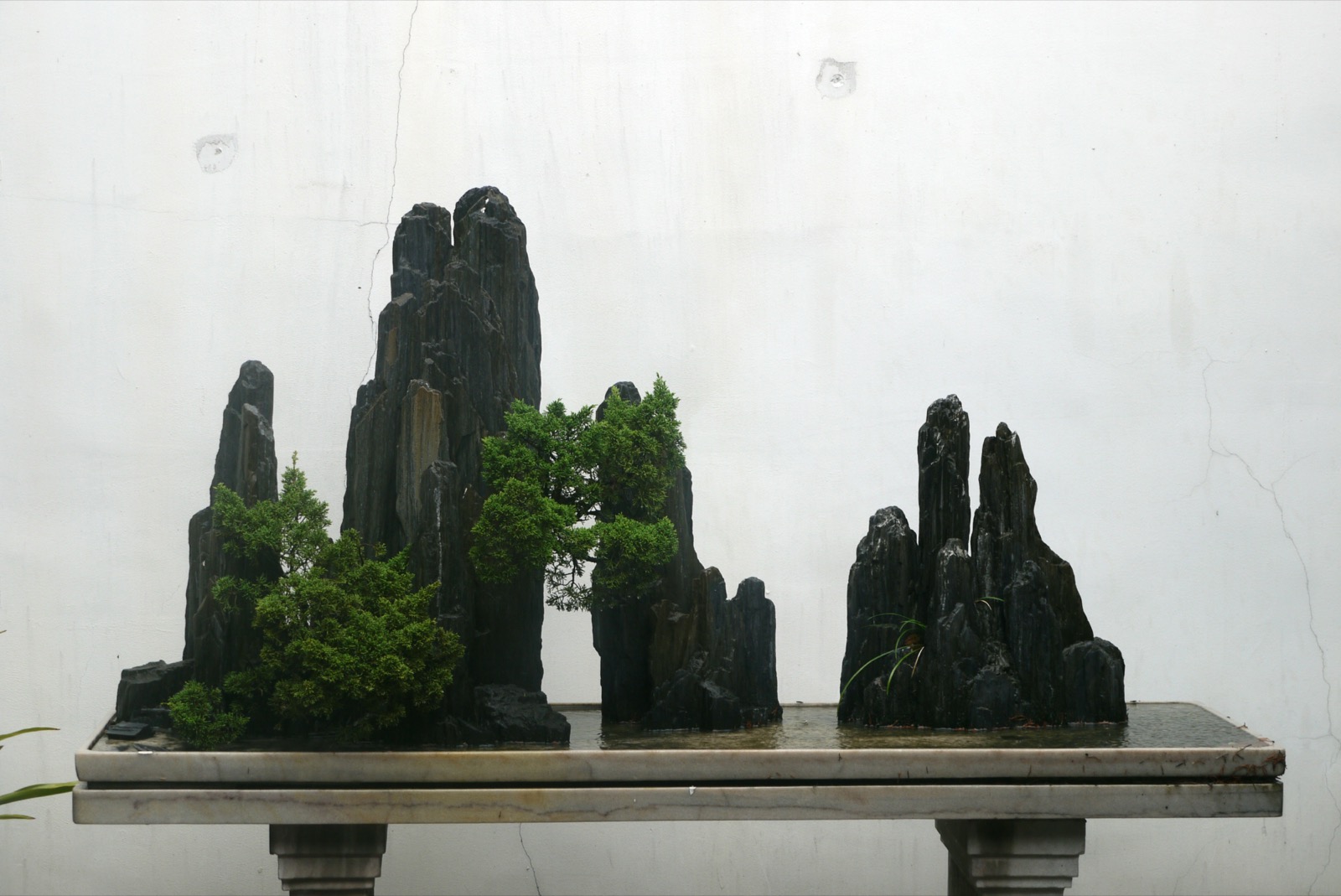
A landscape penjing at the Suzhou Museum — rock standing in for mountains, water standing in for a lake, trees scaled to match. Photo: Pascal3012, CC BY-SA 3.0, via Wikimedia Commons.
Stand a Chinese penjing (盆景, "tray scenery") next to a Japanese bonsai and the family resemblance is obvious — both are living plants, trained for years, held in a container small enough to carry. Look longer, and the resemblance starts to matter less than the difference. One is built to hold a whole world. The other is built to leave almost everything out.
Penjing and bonsai grew from the same root, but they answer different questions: penjing asks how much of a landscape a tray can hold, bonsai asks how little a tree needs to still be a landscape.
We have told the origin story in full elsewhere — how a Tang-dynasty tray of rock and tree crossed into Japan and was narrowed, over more than a thousand years, into the art now called bonsai. See "Where Bonsai Came From" for that history. This piece is not about lineage. It is about what a viewer is actually looking at once the two traditions had gone their separate ways.
A scene, or a tree
Chinese penjing comes in three recognized forms, and only one of them is close to what most people picture when they hear "bonsai." Shumu penjing ("tree penjing") is a container-grown tree or small group of trees, trimmed and shaped much like a Japanese specimen. Shanshui penjing ("mountain-water penjing") uses no living tree at all — it is carved and selected rock, arranged in a shallow basin of water, standing in for peaks and shorelines. Shuihan penjing ("water-and-land penjing") combines both, and according to the U.S. National Arboretum's National Bonsai & Penjing Museum, which displays Chinese and Japanese collections side by side, this hybrid form can include "miniature trees and optionally miniature figures and structures."
Miniature figures and structures are the detail that tends to surprise Western visitors most. A shuihan composition might include a tiny ceramic fisherman on the rocks, a pavilion tucked into a fold of stone, a bridge crossing the water. As the National Bonsai Foundation has explained, this third category of penjing "effectively combines" tree and landscape work into a single scene meant to be read as a place — a specific, implied setting with its own quiet narrative, rather than a specimen presented for its own sake.
Bonsai, in nearly every case, gives up all of it. No water, no rock standing in for mountains, no bridge, no fisherman. Just the tree, in a plain container chosen specifically not to compete with it.
Why the figures disappeared
That absence was not an oversight. According to the historical record on bonsai's development in Japan, early potted arrangements arriving from China did include miniature figurines, "after the Chinese fashion," to give the scene a sense of scale and story. Later generations of Japanese artists removed them. Those same figurines "would eventually be considered garnishes, decidedly to be excluded by Japanese artists who were simplifying their creations in the spirit of Zen Buddhism."
That single sentence is close to the whole difference. Penjing gained meaning by adding a social or historical context around the tree — a fisherman implies a lake and a life lived near it; a pavilion implies a garden and a visitor who might sit there. Bonsai gained meaning by subtracting that context and asking the tree to carry the same weight alone. We wrote about the discipline this demands in "Bonsai Is Not a Small Tree": with no rock, no water, and no figure to lean on, every line the tree carries — trunk movement, branch placement, the negative space between them — has to do the work a whole landscape used to share.
The container follows the same logic on both sides. Penjing pots are often glazed in strong color and cast or carved into elaborate shapes, chosen to read as part of the scene. Bonsai pots trend toward muted, unobtrusive glazes and simple, low-sided forms, chosen specifically to disappear.
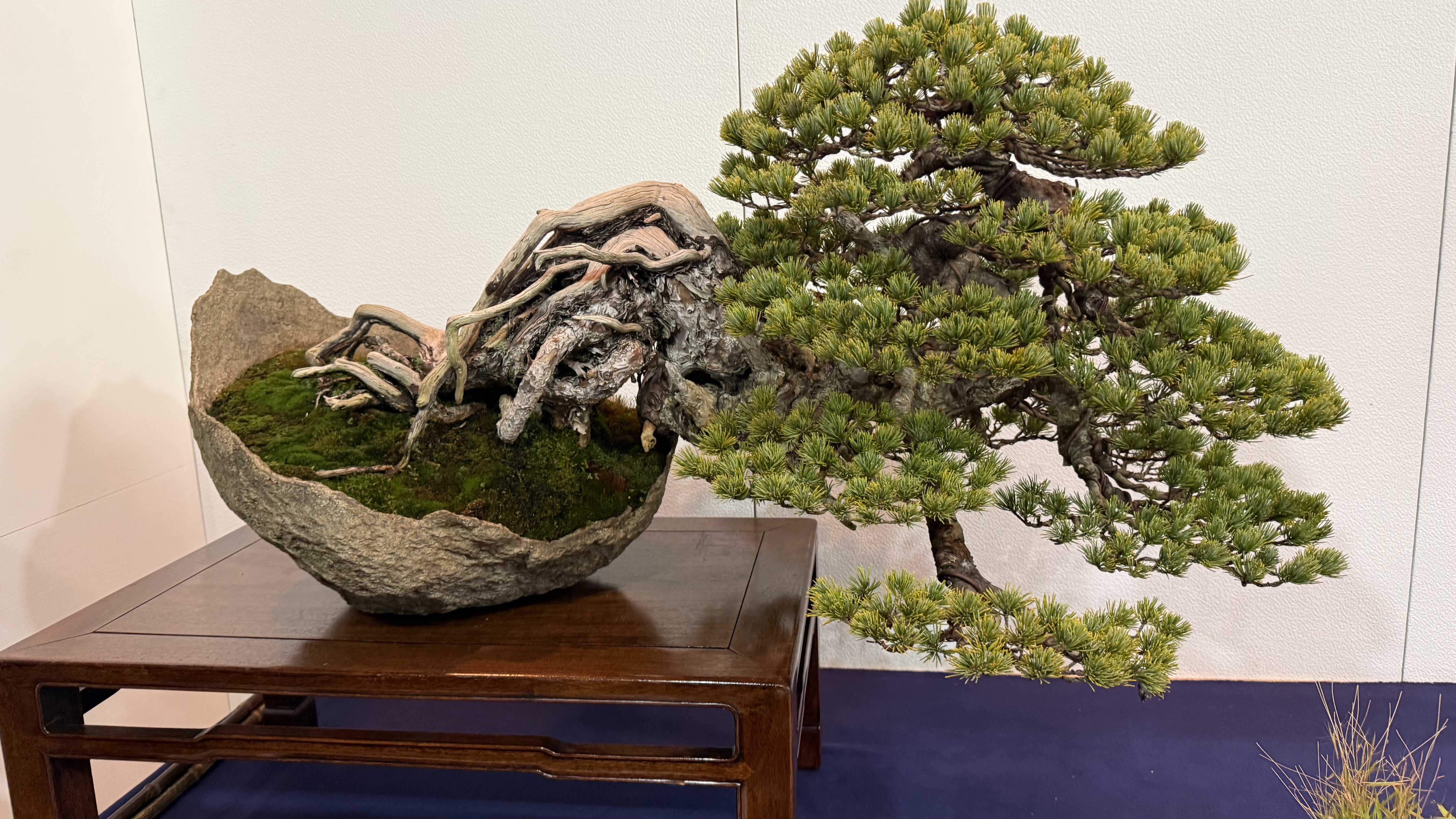
A Japanese white pine bonsai. No rock, no water, no companion figure — the tree alone is asked to carry the whole composition.
Two ways of deepening the same idea
None of this makes one art richer than the other. It makes them richer in different directions, and each direction became possible only because the other elements were let go.
Penjing kept its freedom to build a scene, and that freedom is exactly what let it develop into three distinct categories — tree, landscape, and combined — plus a related, tree-free art of pure rock-and-water arrangement. A single penjing artist can work in water, stone, and living plant material in a way no bonsai artist ever does, because the composition is still allowed to include all of it.
Bonsai gave up that freedom and, in exchange, pushed further into what a single tree by itself can express. Styles like cascade, literati, and windswept exist because bonsai artists spent centuries asking a lone trunk to suggest a cliffside, a lifetime of wind, or a mountain slope with nothing but its own silhouette. That is a narrower question than the one penjing asks, but a narrower question, pursued long enough, tends to go deeper rather than shallower. Bonsai's parallel dry-landscape art, bonkei (盆景, written with the same characters as penjing but read in Japanese), took the opposite half of the split — keeping the rock and sand, letting the living tree go — which is its own proof that the original tray of rock, water, and tree was never really one idea to begin with. It was several, waiting to be separated.
Standing in front of either one
At the Suzhou Museum, a viewer reads a penjing the way they might read a landscape painting: mountain here, water there, a small figure to give the scale a human anchor. At a Japanese nursery, a viewer reads a bonsai the way they might read a single line of calligraphy: everything that could be said, said with the fewest possible strokes.
Both habits of looking took centuries to build, and both are still being practiced today, on two different continents, by artists who inherited a shared idea and then spent a thousand years disagreeing, quietly and productively, about what to do with it. Caring for either tree — penjing or bonsai — means stepping into that same long conversation: seasons of patient attention, one artist's decisions handed to the next. Azukari exists to make that stretch of the bonsai side of it possible for an owner living anywhere in the world.
References
- National Bonsai Foundation — "Penjing Master Weighs In: What Are the Differences Between Bonsai and Penjing?" — on the three penjing categories and the inclusion of miniature figures in water-and-land penjing.
- Wikipedia — "Penjing" — on shumu, shanshui, and shuihan penjing classifications, the symbolic role of miniature figures and structures, and the contrast with Japanese bonsai's simplified forms and unobtrusive pots.
- Wikipedia — "History of Bonsai" — on early Japanese potted arrangements including Chinese-style figurines for scale and story, later excluded as "garnishes" in the course of Japanese simplification.
- U.S. National Arboretum — National Bonsai & Penjing Museum — on the museum's side-by-side Japanese bonsai and Chinese penjing collections.
- Wikimedia Commons — "Penjing.JPG" — source and license (CC BY-SA 3.0) for the Suzhou Museum photograph used above.
