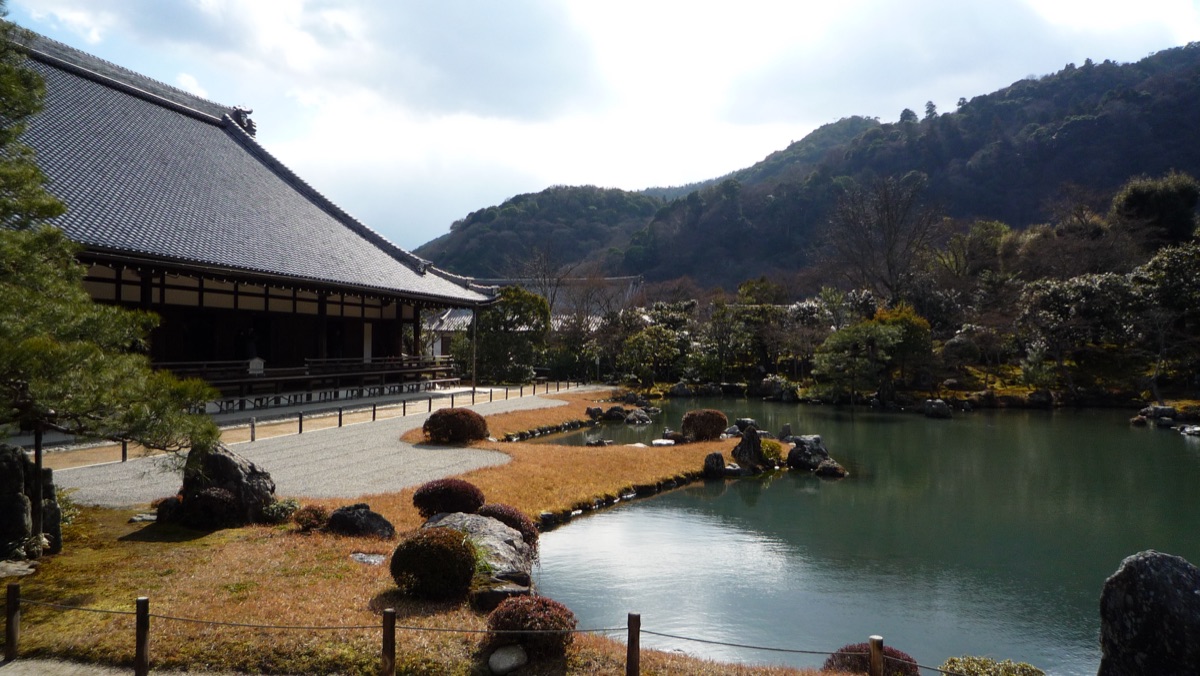
At Tenryu-ji in Kyoto, the garden's pond stops well short of Mt. Arashiyama, yet the mountain reads as though it were part of the garden itself. The technique has a name, shakkei (借景, "borrowed scenery"): a distant, untouched slope framed into the view so that no wall, hedge, or clear boundary marks where the tended ground ends and the rest of the world begins. Nothing on the mountain was planted, pruned, or arranged. It was simply allowed to belong.
That refusal to draw a hard line between the garden and the world beyond it is not only a landscaping habit. Whether a culture pictures one Creator standing outside the world he authored, or countless kami inhabiting the world from within it, changes how sharply nature and the sacred are expected to separate — and it is a large part of why Japan came to treat a tree with something close to reverence.
A single creator implies a single correct reading of the world
Ask how many worldviews a religion allows for, and the answer depends heavily on where the tradition starts. In the monotheistic traditions that shaped much of the West, the Middle East, and South Asia — Judaism, Christianity, Islam — there is one Creator, one authorship of the universe, and by extension one vantage point from which the world is correctly understood. Nature, in that picture, is authored: it points back to a single maker, and it can in principle be read correctly or incorrectly against that standard.
Shinto, Japan's native religious tradition, starts from a different premise. No single creator-figure stands outside the world, authoring it. Instead there are kami (神, spirits or divine presences, not directly equivalent to "god" in the monotheistic sense) — an open, uncounted multitude of them, each residing in a particular mountain, river, tree, ancestor, or force of weather. The Association of Shinto Shrines states this plainly: Shinto "accepts no one single, omnipotent Creator." Its worldview runs closer to countless local vantage points, each valid in its own place, than to one master vantage point everything else is measured against.
The difference matters beyond doctrine: it changes what nature is in each picture. A creator stands outside and above what he makes. A kami is woven into the particulars of the world itself — a mountain, a river-bend, an old tree, the way Arashiyama itself is composed into Tenryu-ji's garden rather than fenced off from it. Neither picture is more sophisticated than the other. They describe different relationships between the world and whatever is sacred in it, and each has produced its own depth of art, ethics, and devotion.
A creator stands outside his creation; a kami stands inside what it fills
In the monotheistic framing, nature is a creation — the product of an intentional act, separate from its maker the way a painting is separate from a painter. A mountain can be beautiful, even awe-inspiring, and still be categorically distinct from God. Reverence for nature, in that frame, is usually reverence for the Creator expressed through his handiwork, more than reverence for the mountain itself.
Shinto collapses that distance. A kami is not a spirit watching a tree from a short remove. In the traditional understanding, the tree, the rock, or the waterfall can itself be the seat of the kami — close enough that "sacred being" and "natural object" stop being separate categories worth drawing a line between. Kokugakuin University's Encyclopedia of Shinto notes that kami is a term applied not only to ancestral or creator spirits but to "both animate and inanimate things, such as plants, rocks, birds, beasts, and fish." The Shinto term for this expansiveness is yaoyorozu no kami (八百万の神, literally "eight million gods," an idiom meaning an uncountable multitude): divinity distributed everywhere in the textures of the physical world, rather than concentrated in one origin point. (A companion piece, "Eight Million Gods," looks at this idiom more closely.)
Neither view denies that nature can be dangerous as well as generous. The Association of Shinto Shrines is candid that the same sun which "gives life to all living things" can also "parch the earth, causing drought and famine," and that the kami of wind and sea carry storms as readily as blessings. What differs is where the response points. A tradition with a single Creator tends to look past nature, toward the authority standing over it. Shinto addresses the specific kami of the specific place — the mountain, the river, the tree in front of a person — because the divinity in question is not somewhere else. It is, in some real sense, right there.
Shinto ranks harmony above a broken law
A further difference sits in how each tradition frames wrongdoing. Sin-centered traditions tend to organize ethics around a moral ledger: an act is judged against a fixed law, and the consequence is guilt to be confessed or atoned for.
Shinto's center of gravity sits elsewhere: on wa (和, harmony) and its opposite, disturbance, more than on a ledger of right and wrong acts measured against a code. What matters most is whether the relationship between people, and between people and the kami-filled world around them, has stayed in balance or been thrown out of it. The response to wrongdoing follows from that: harae (祓, purification) — a ritual clearing of accumulated defilement that restores the relationship. A shrine's purification rites before a festival, the ritual washing at a temizuya basin, and the seasonal renewal of a shrine building itself all point to the same instinct: keeping the relationship clean and in proportion.
This has a direct bearing on how nature gets treated day to day. If the highest value is harmony rather than a verdict, cutting a tree carelessly, over-pruning a garden, or disturbing a landscape without care reads as a disturbance of a relationship, one that calls for restraint and correction. Chowa (調和, harmony or balance) becomes a working standard applied to how a person treats the physical world, not only to how they treat other people.
Where a tree can be sacred, it stops being merely a resource
None of this is meant to argue that one religious picture is truer or better than the other — a monotheistic world has produced its own long traditions of stewardship, gratitude, and care for the created order. It is offered to make one practical difference legible: when deciding whether an old tree is a resource or a counterpart, ask which side of that line its culture starts from — nature as something made, or nature as something that can itself carry the sacred. That single question predicts, more reliably than any stated aesthetic, how patiently a tradition will spend decades tending one tree.
In a strict reading of nature as something made and subordinate, a tree is a resource, however beautifully rendered. Where a tree might itself house a kami, or where cutting one out of season disturbs a wa that has to be actively maintained, a tree sits closer to a counterpart than a possession. This is part of why Japan built an art form entirely around the patient, decades-long tending of a single living tree, and why a bonsai artist can speak of "listening to what the tree wants" without the phrase sounding like poetic license. Shrines across the country mark certain old trees with a shimenawa (注連縄, a plaited straw rope denoting sacred status) — not a boundary keeping the tree apart from the world, but a sign that this piece of the world was never ordinary timber to begin with.
For related reading, see "Where Kami Dwell in Trees," "Eight Million Gods," and "Bonsai and the World's Cultures."
References
- Jinja Honcho (Association of Shinto Shrines) — "What is Shinto?" — official overview describing Shinto as reverence for kami found in all things and places.
- Jinja Honcho — "What is Shinto? — Kami" — states that "Shinto accepts no one single, omnipotent Creator" and describes kami of rain, wind, mountains, sea, and thunder, including nature's dual capacity for blessing and harshness.
- Kokugakuin University — Encyclopedia of Shinto Portal — English-language academic reference portal on Shinto terms and concepts, including the definition of kami as extending to plants, rocks, and animals.
- Wikipedia — "Yaoyorozu no Kami" — general reference on the idiom "eight million gods" and its role in Shinto's animistic worldview.