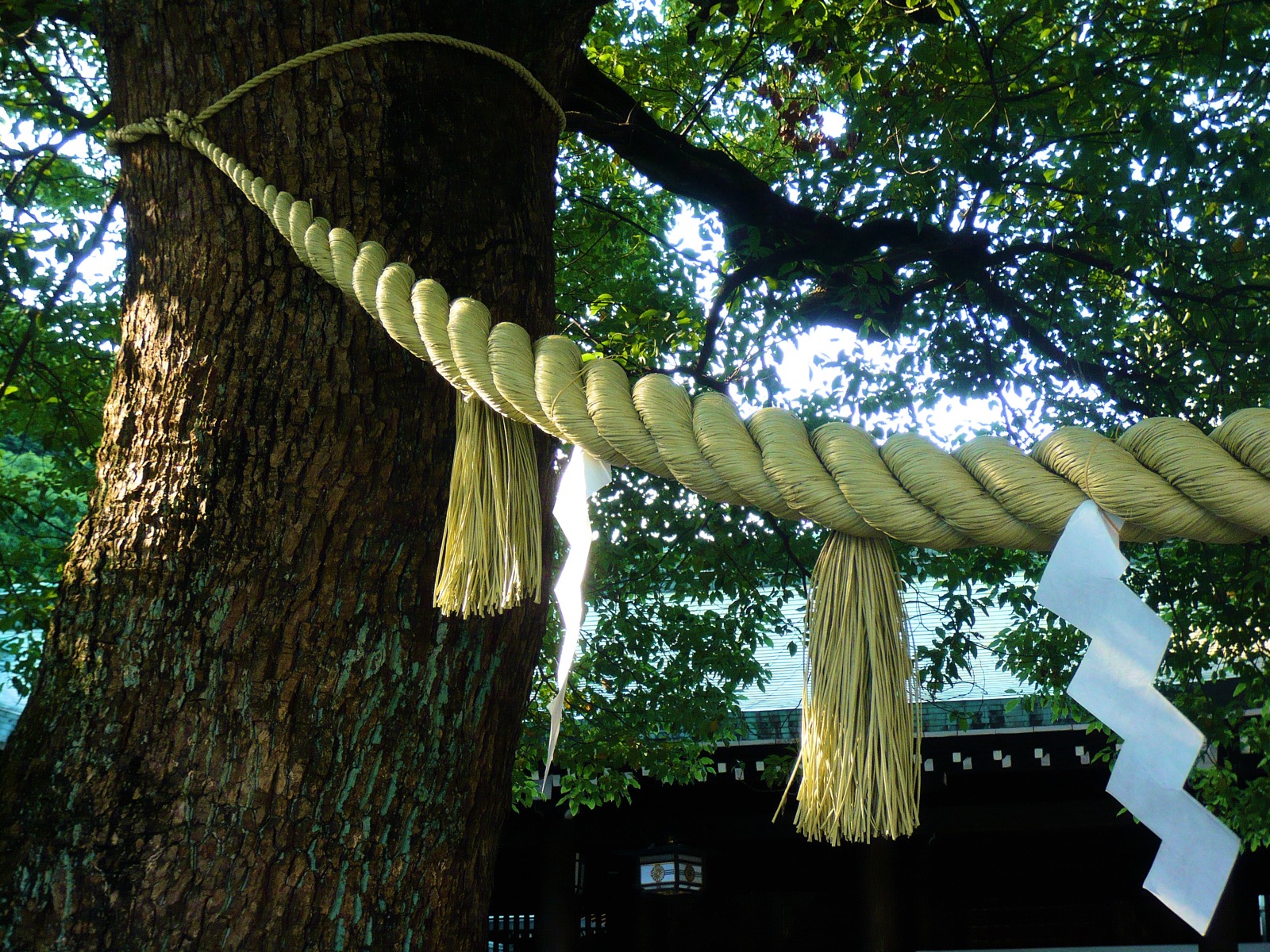
At Meiji Jingu in Tokyo, a single shimenawa (注連縄, "a twisted straw rope marking sacred ground") is wound around two camphor trees planted side by side, hung with folded white paper strips that catch more attention on the approach path than the shrine buildings do. Visitors know the pair as the Meoto Kusu (夫婦楠, "husband-and-wife camphor"). No one on the grounds staff prunes them into a shape, or manages them the way the hedges nearby are managed.
In Japan, a tree like this can become an object of worship in its own right, not a stand-in for something else.
A rope marks where the ordinary ends
A tree singled out this way is called a goshinboku (御神木, "an honored sacred tree") — usually a shrine's oldest or largest specimen, sometimes a species found nowhere else nearby, treated less as shrine property than as a body the local kami might occupy. The idea behind that is old in Shinto thought: a kami has no fixed form of its own, and needs a yorishiro (依り代, "a vessel a kami may occupy") — a tree, a rock, some physical thing — to take up temporary residence during a rite. A tree doesn't have to be ancient to serve this way, but scale is usually what gets one noticed for it; size alone suggests a tree has witnessed something the trees around it have not.
The rope itself doesn't decorate a tree so much as draw a line around it. Everything inside belongs to the sacred; everything outside stays the ordinary world of people. A shimenawa appears in the myth of Amaterasu, the sun goddess who once withdrew into a cave and plunged the world into darkness — when she was coaxed back out, a rope was drawn across the cave's mouth so she could never retreat into it again. The rope wound around a tree's trunk still carries that idea forward: something sacred lives here, and the boundary is not to be crossed carelessly.
A tree earns reverence by surviving centuries
Not every large tree becomes a goshinboku, but almost every goshinboku is large, and old in a way that's legible in its bark and girth without anyone having to explain it. Age isn't incidental to the reverence — it's close to the reason for it. A tree that has stood through centuries of weather, war, and the passing of the people who once stood beneath it is treated as having accumulated something beyond mere biological persistence.
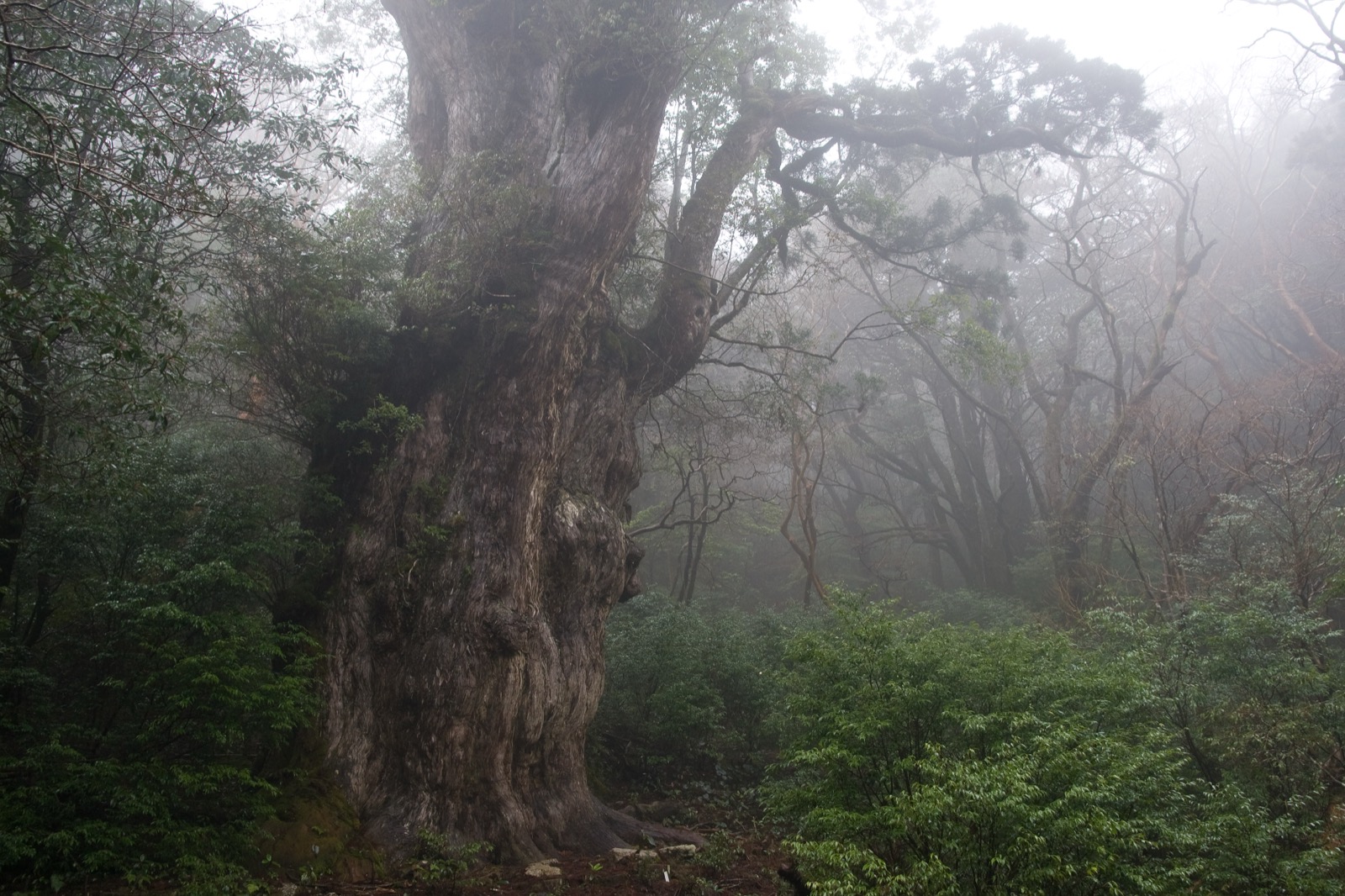
Nowhere is that belief clearer than on the island of Yakushima, where the ancient cryptomeria known as Jomon Sugi (縄文杉, "the Jomon-era cedar") stands at an estimated age of somewhere between two and seven thousand years, girthed too broadly for a person's arms to reach around. The island's old-growth cedars over a millennium old are known collectively as yakusugi (屋久杉, "Yakushima's ancient cedars"), and the island's mountainous interior was long treated as the dwelling place of the gods, its oldest and largest cedars regarded as sacred trees in their own right. A scholar native to the island is remembered for having taught islanders how to recognize which great cedars deserved that reverence, a practice credited with holding back over-cutting long before conservation had any modern name. The tree wasn't spared because someone calculated its ecological value. It was spared because its age had already told people what it was.
Even a felling begins with a prayer
That same reverence surfaces, in a more practical form, whenever an old and significant tree must actually come down. The clearest living example is the felling of the sacred timber for Ise Jingu's periodic shikinen sengu (式年遷宮, "the ceremonial rebuilding of the shrine every twenty years"). Before any cypress is cut in the shrine's own forest, priests conduct the Misoma Hajime-sai (御杣始祭, "the rite marking the first cut of sacred timber"), asking the mountain's kami for a safe and successful felling. The chosen cypress, sometimes three centuries old, is brought down using an old three-cut technique performed by hand, and once it falls, the crew performs a rite called toritachi (鳥総立て, "the planting of a felled tree's own branch tip in its stump") — a sprig from the tree's own crown set upright in the stump left behind, a small, quiet gesture of thanks to the tree and the mountain for what has been given.
This isn't limited to imperial shrine building. Across ordinary forestry and shrine-grounds tree removal in Japan, it remains common practice to perform a purification rite before felling any tree judged large or old enough to warrant it — asking pardon of the tree's spirit and giving thanks before the saw ever touches bark. The custom doesn't survive because anyone believes the tree will object in a literal sense. It survives because cutting down something that has stood for centuries is treated as an act that deserves a moment of acknowledgment first, not a task to be started without ceremony.
An old bonsai earns the same quiet, without the rope
None of this is really about trees standing untouched in a shrine forest. It explains something closer to home: the instinct to pause, just slightly, in front of a bonsai that has been under cultivation for a hundred years or more.
A tree that old has already outlived the artist who first shaped it, and probably the one after that. It has been watered through summers none of us saw, wired and unwired by hands now gone, carried through wars and house moves and the quiet decades in between. It doesn't need a rope tied around it to deserve a kind of attention that's different from what you'd give a young tree grown quickly for sale.
A shrine can tie a rope around a tree in an afternoon. What actually separates a goshinboku from an ordinary old tree is whether the tending kept happening, generation after generation, without a gap long enough to let the tree go wild or die. The next time you're weighing how much respect an old tree, or an old bonsai, deserves, that's the question worth asking instead of just counting rings: has someone kept showing up for it the whole way here?
A goshinboku is never tended by one caretaker for its whole life — shrine keepers are reassigned, priests retire, the rope itself gets rewoven every few years by hands that will also eventually be replaced. What doesn't change is that someone keeps returning. Azukari is built on that same continuity: the trees in its care stay in Japan under artists who keep tending them long after any one relationship with an owner has passed through their hands. Some of the trees being shaped today are still young. Given enough seasons, and enough hands passed down without a gap, a few of them may one day earn a version of the same quiet respect as the oldest trees standing in Japan's shrine forests.
For more, see our report from the Meiji Jingu Bonsai & Suiseki Exhibition, our piece on why bonsai live so long, and "The Eight Million Kami," on the wider Japanese idea that spirits inhabit the natural world.
References
- Tokyo Metropolitan Association of Shrines — "What does it mean for a shimenawa to be tied around a tree?" — official explainer on shinboku and shimenawa, and the belief that a sacred tree is a dwelling place for kami.
- Encyclopedia of Shinto, Kokugakuin University — "Yorishiro" — scholarly entry on yorishiro as a vessel for kami, including trees planted or preserved for this purpose.
- Encyclopedia of Shinto, Kokugakuin University — "Shinboku, Shinju" — entry on sacred trees and groves, their protection from felling, and their marking with shimenawa.
- Ise Jingu — "The Eternal Forest" — official Ise Jingu page on the shrine's own forest, the felling rites for shikinen sengu timber, and the toritachi custom of thanking a felled tree.
- Yakusugi Museum, Yakushima Town — "What is Yakusugi?" — municipal museum page on Yakushima's ancient cedars, their multi-century lifespans, and their standing as sacred trees on the island.