The Kojiki (古事記, "Japan's oldest chronicle") describes the kami (神, "a Shinto deity or spirit") gathering "in their eight hundred myriads" on the banks of the Heavenly River. That scene gave Japan's oldest religious vocabulary its defining phrase: yaoyorozu no kami (八百万の神, "eight million gods," meaning countless gods). The eighteenth-century scholar Motoori Norinaga, glossing the same passage in his commentary on the Kojiki, described what the number meant in his own words: "the utmost profusion of number."
Shinto never tried to settle on a final number of gods, or arrange them under one supreme figure. The Association of Shinto Shrines describes deities governing the sea, the mountains, the wind, the harvest, the founding of the land — so many, and so varied, that the tradition needed a number that stood for too many to count rather than an actual sum.
Any mountain, any tree, could join the list
New kami could always be recognized, and the category never closed. A mountain could hold one. A particularly old tree could hold one. A person of great achievement, after death, could become one. Nobody was completing a census of the sacred. The point was that the sacred was distributed everywhere, in amounts no one needed to fix.
An old tool could earn its own spirit
That distribution reached past mountains and rivers into the household. Tsukumogami (付喪神, "a spirit inhabiting an old tool") is the folk belief that everyday implements — an umbrella, a sandal, a koto, a teakettle — could, after enough years of use, acquire a spirit of their own. The Tsukumogami Emaki, an illustrated scroll from the Muromachi period, tells of household objects thrown out before their hundredth year, resentful at being discarded, rising up to take revenge on the people who abandoned them. Like yaoyorozu itself, the number was not meant literally. What the story preserved was the sense that long use forms an attachment, imagined as something with a will of its own.
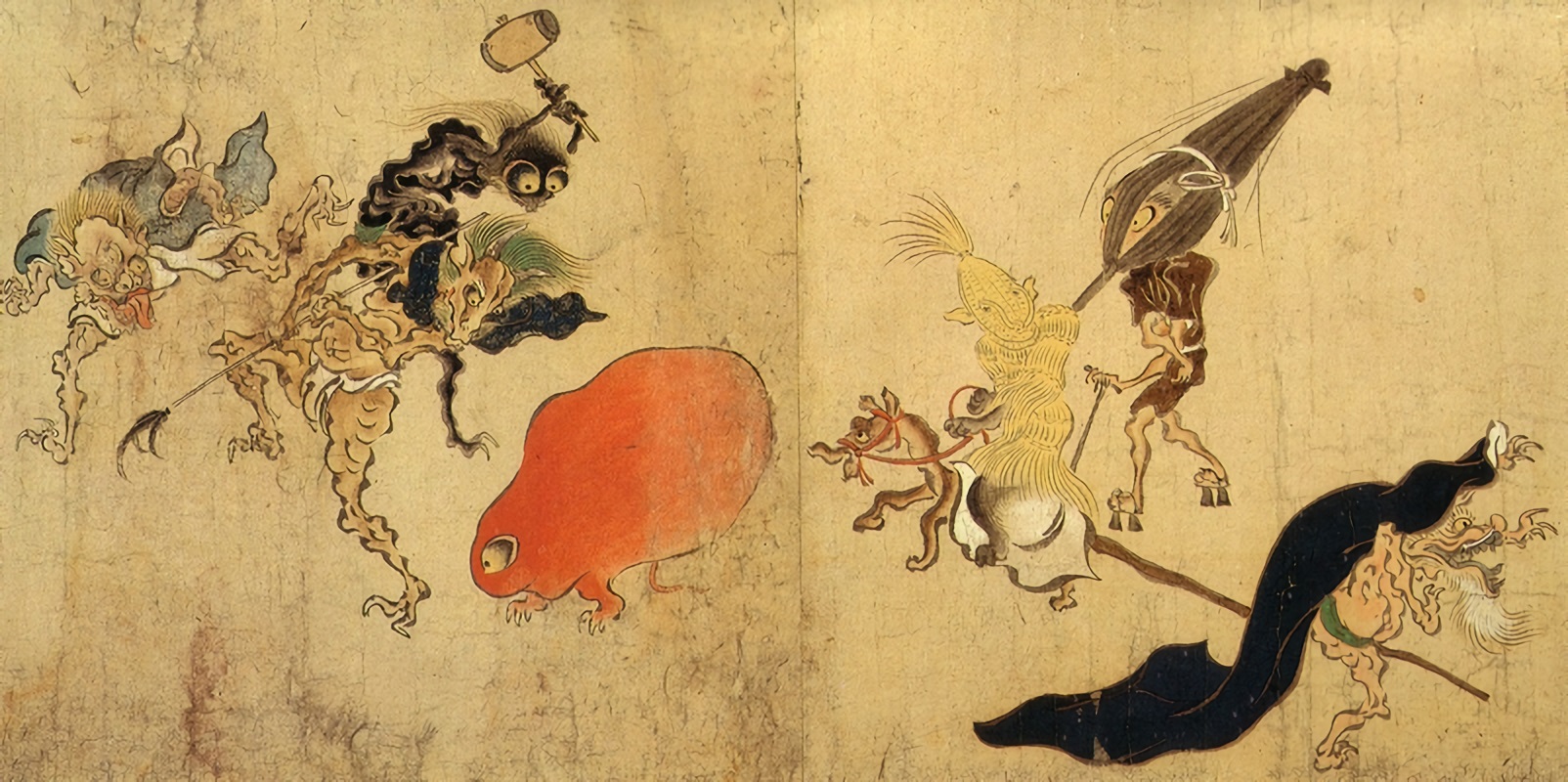
A Muromachi-period scroll depicting tsukumogami — household tools said to gain a spirit after long years of use.
A gentler version of the same idea survives in a saying still taught to children: that a single grain of rice houses seven gods. Depending on who tells it, the seven stand for water, soil, wind, sun, insects, cloud, and the labor of the farmer who grew it — the full chain of conditions, human and otherwise, that had to align for that one grain to exist. Whether the number is exactly seven matters less than the habit of mind behind it: nothing reaches a table, a workshop, or a garden without an unseen history of contributions standing behind it.
The same kami that blessed could just as easily curse
None of this made kami into comfortable house spirits. A kami could bring a good harvest or a fair wind, and the same kami, offended or neglected, could just as easily bring drought, illness, or disaster. The Association of Shinto Shrines is direct on this point in its own account: the deities inhabit natural things too imposing or too uncanny to fully explain — towering peaks, ancient rocks, waterfalls — and are approached with a mixture of reverence and unease rather than simple affection.
To live among yaoyorozu no kami was to live among presences that required care precisely because indifference toward them carried a cost. A tool, a well, a tree earned its upkeep because letting the relationship lapse invited consequences no one wanted to test.
Long service earns a formal goodbye
That mixture of reverence and risk is the root of mottainai (勿体無い, "what a waste," an expression of regret at wasting something of value). The word carries an implicit accusation: discarding something still capable of use fails a relationship the object was owed. Japan's National Tourism Organization traces the same instinct into calendar customs still observed today — hari-kuyo (針供養, a memorial service for broken sewing needles), typically held every February, in which needles that snapped or bent over a year of work are laid to rest in a block of soft tofu, in gratitude rather than simply thrown away. Comparable services exist for writing brushes and other well-worn tools, all following the same logic: an object that served faithfully earns a retirement of its own — thanked, and let go with a small ceremony.
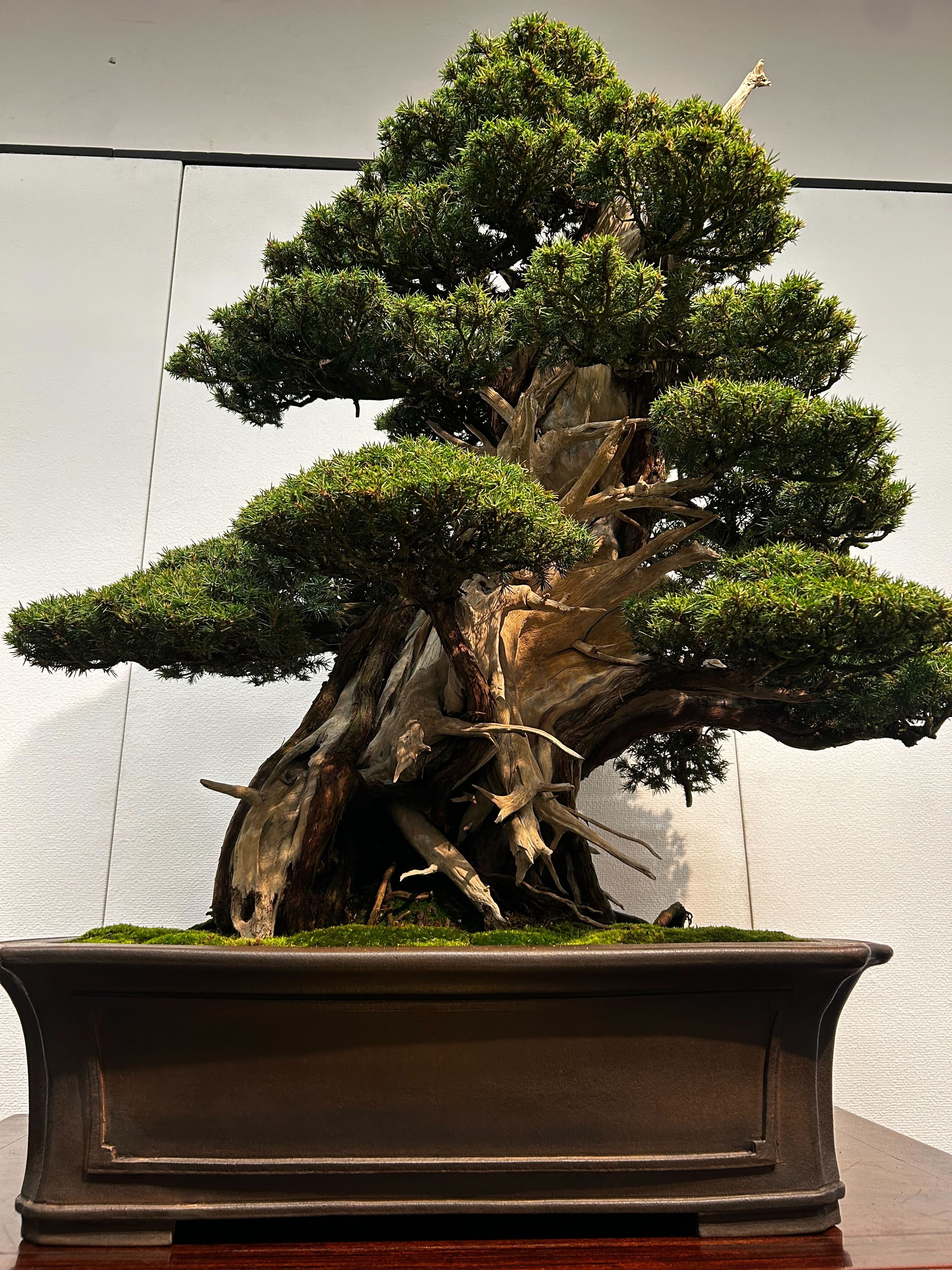
Bonsai runs on the same instinct, worked into the plainest materials of the practice. A cracked pot is repaired rather than swapped out on a whim. Concave cutters and jin pliers are sharpened and handed down instead of treated as consumables. Wire is uncoiled and reused rather than thrown away after one season on a branch. A tree kept this way — including the ones kept under Azukari — can outlive the artist who first trained it, passed on with its pot and its tools to whoever tends it next. The needles laid to rest each February at a hari-kuyo service were never judged by what they had cost to buy. Measured that way, the question yaoyorozu no kami leaves behind for anything kept this long is not what it is worth today, but how long it has already been depended on.
Two companion pieces continue this thread: Trees Where Gods Dwell, on the sacred trees of Japan's shrines, and One God or Eight Million, on how this way of seeing differs from the monotheistic one.
References
- Association of Shinto Shrines — "What is Shinto" — official explanation of yaoyorozu no kami, describing the multitude and variety of Shinto deities governing nature, livelihood, and land.
- Wikipedia — "Yaoyorozu no kami" — overview of the term's meaning as "too many gods to count" and its roots in the Kojiki and Nihon Shoki.
- Wikipedia — "Tsukumogami" — history of the belief that tools gain a spirit after roughly a hundred years of use, and the Tsukumogami Emaki as its primary textual source.
- Japan National Tourism Organization — "Mottainai: Japan's Culture of Mindful Consumption" — official tourism-board account of mottainai and its expression in repair and reuse traditions.
- Wikipedia — "Hari-Kuyo" — description of the needle memorial service, its February 8 observance, and its connection to mottainai.