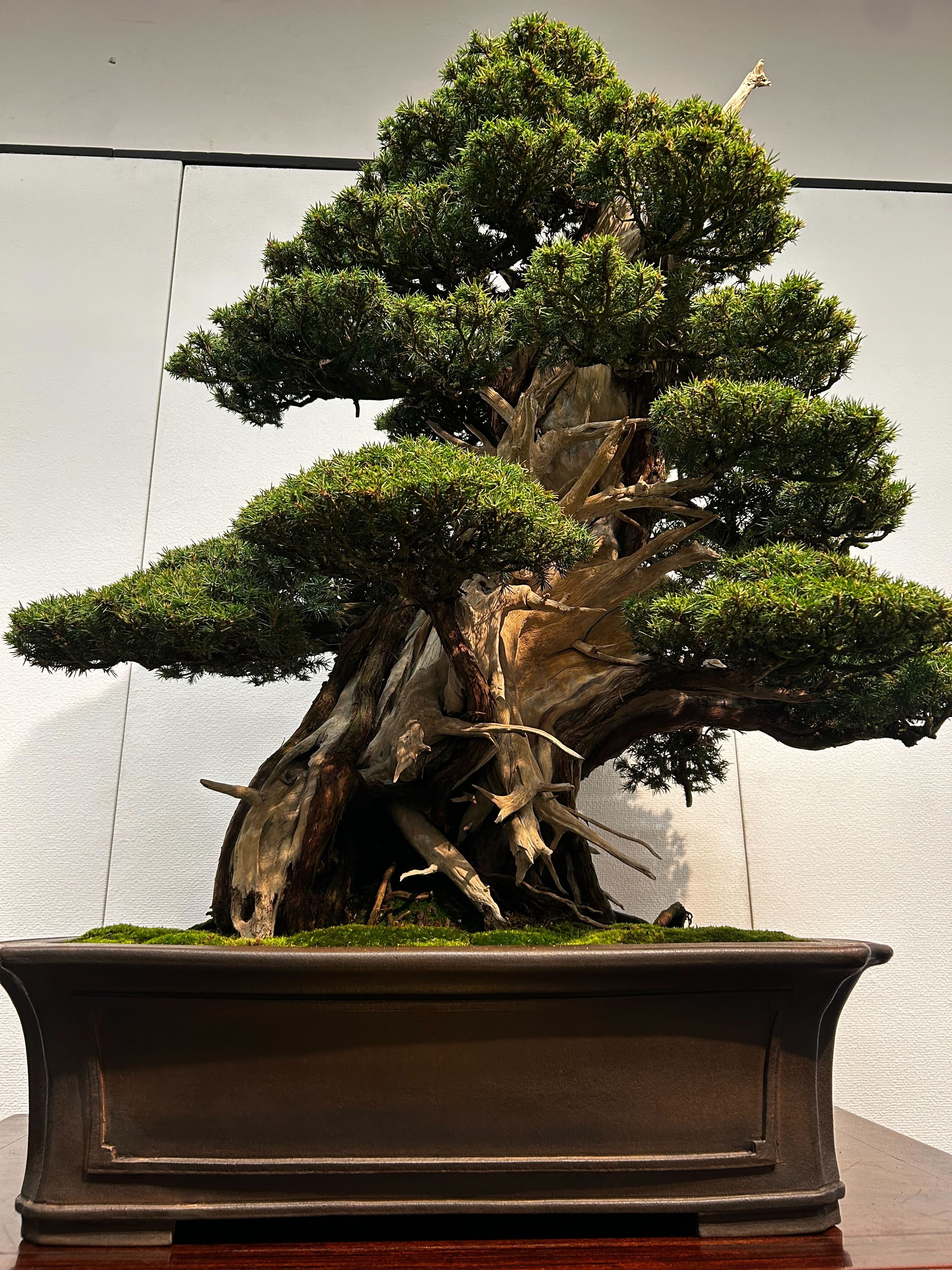
Look at a fine bonsai and the eye goes first to the trunk, then the branches, then, if there is one, to a flash of fruit or blossom. It is easy to miss the low green surface at the base entirely — the thin skin of koke (苔, "moss") pressed over the soil. That surface is not decoration added at the last minute. It is one of the few parts of a bonsai that cannot be finished ahead of schedule, no matter how skilled the hand doing the finishing.
A bonsai's moss cannot be hurried into looking old, and that is exactly why growers read it as evidence that a tree's years in its pot are real.
What Actually Grows There
Moss used on bonsai soil is not one plant but several, chosen for different jobs. Sunagoke (スナゴケ, sand moss, Racomitrium canescens) tolerates the sun and dry spells a pot's surface goes through between waterings. Gingoke (ギンゴケ, silver moss, Bryum argenteum) is the fine, silvery species most often pressed onto a pot as a finishing dressing before a tree is shown. Haigoke (ハイゴケ, a carpet-forming Hypnum) spreads low and thick and is the moss most often bound around the roots of a kokedama (苔玉, "moss ball," a root ball wrapped in moss instead of potted). None of them are incidental. Each does a specific job on the surface of a pot too shallow to hold much water on its own — moss slows how quickly that thin layer of soil dries out, and its dense growth makes it harder for birds to dig through the surface hunting for insects.
Pressed onto roughened, damp soil and kept misted, moss of this kind takes hold quickly by plant standards: growers see the first green stubble within a couple of weeks, and a full, even cover within a month or two. That speed is exactly why moss alone is not proof of much. A fresh dressing looks convincing within a season of a tree changing hands. What takes far longer is the moss actually being valued.
An Age That Cannot Be Rushed
A newly pressed moss dressing is one species, one texture, and close to one shade of green — laid down all at once, it reads as laid down all at once. Left alone across repeated growing seasons, that uniform mat slowly gives way to something else: a mix of two or three moss species arriving on their own, patches of differing texture and height, a surface with some age showing in it. Growers in Japan distinguish this from a fresh dressing by calling it kyutai (旧苔, literally "old moss") — moss that has simply been left to keep living on the same patch of soil, uninterrupted, for years.
That settled unevenness cannot be manufactured on a shorter timeline. Feeding a tree harder does not make its moss mix and mature any faster than forcing growth makes a trunk's bark look genuinely old — in both cases, the shortcut shows on close inspection, while the real thing does not. It can also be lost in an afternoon: when a bonsai is repotted, the entire root mass and its surface soil are typically lifted and reworked, and with it the moss that had settled there over years is usually stripped away and replaced with a fresh dressing once the tree goes back into its pot. Whatever texture the old moss had taken years to reach, the new mat starts again from one species and one shade of green.
What the Moss Is Actually Proving
That reset is what makes settled moss worth reading in the first place. A mature bonsai is repotted only occasionally — commonly every few years rather than annually — and each repotting resets the moss to zero along with the soil beneath it. A pot carrying an old, mixed, textured mat is therefore not simply showing that a tree is old. It is showing something narrower and, in its way, more exacting: that the years since that tree's soil was last disturbed have actually passed, undisturbed, one after another. It sits alongside mochikomi, the separate measure of how long a tree has actually been worked in a pot, and alongside the bark that thickens and plates with age — one more small, legible sign among several that a tree's years were spent, not merely claimed.
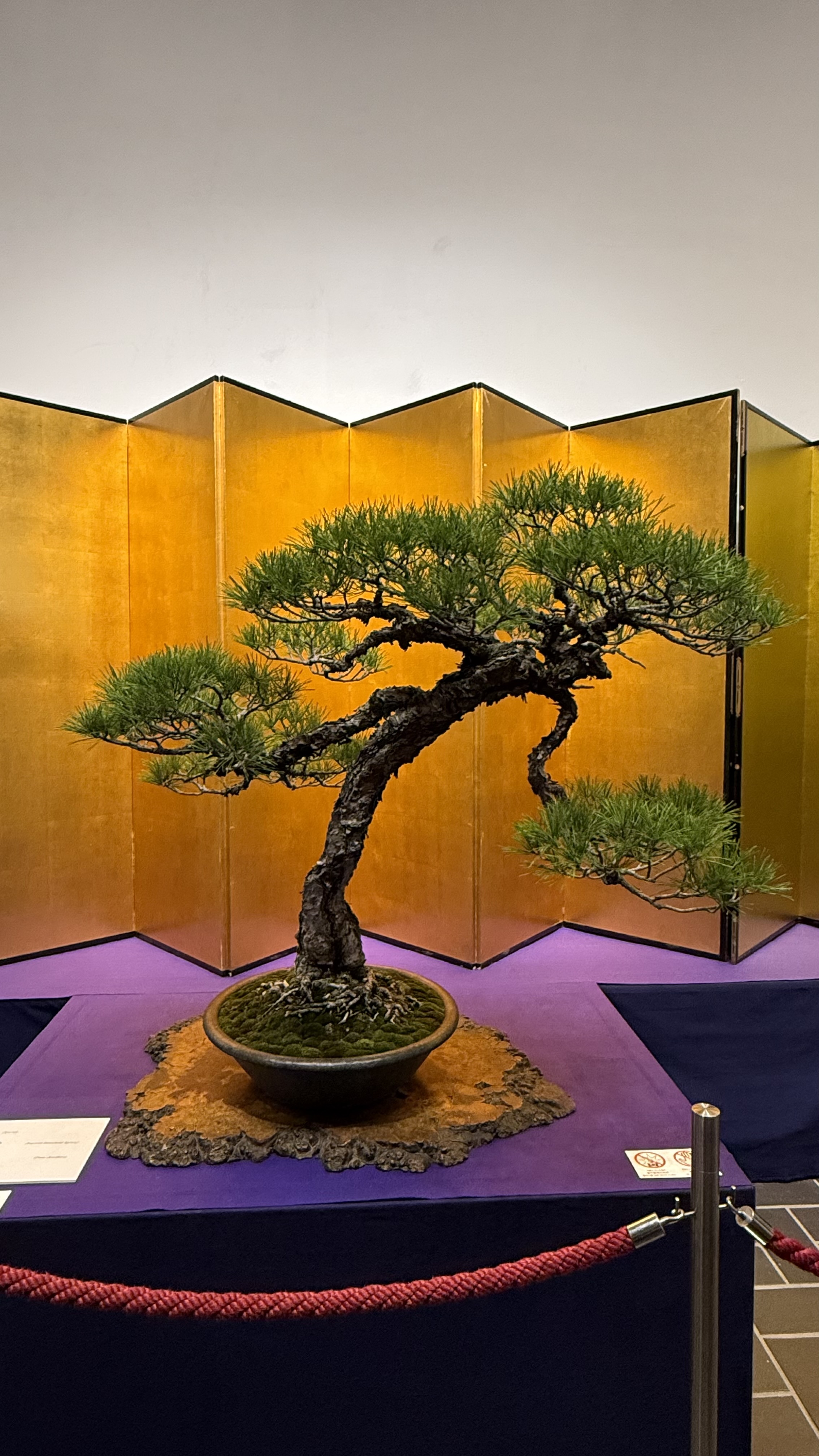
A pot's surface fully covered in moss, standard practice at Japan's most formal bonsai exhibitions since the 1930s.
A Small Green Detail, Judged in Public
When the Kokufu-ten, Japan's most prestigious bonsai exhibition, first sought a venue at Tokyo's prefectural art museum in the early 1930s, the museum's own directors resisted the idea of soil inside a gallery built for art. The compromise that let the show go ahead in March 1934 was practical: every pot's soil had to be covered completely in moss before a tree could be displayed. Nearly a century later, that requirement has outlived its original, purely practical reason and become part of how a tree is judged fit to be shown at all — a bare or freshly dressed soil surface reads, to a trained eye, as a tree presented before it was ready.
None of this is about a bonsai's price. What a settled mat of moss is actually judged on is closer to what the rest of this practice is judged on throughout: whether the years behind a tree were spent working, or simply waited out.
Moss Beyond the Pot
Bonsai did not invent the idea of moss as a sign of time. Japan's own national anthem, Kimigayo (君が代), closes on the image of small pebbles growing, over an unspecified and enormous stretch of years, into boulders thick with moss — a picture chosen specifically because moss on stone is one of the plainest, most patient signs of time a person can actually see. At Saiho-ji (西芳寺) in Kyoto, better known as Kokedera (苔寺, "the moss temple"), a garden first laid out under the Zen priest Muso Soseki in 1339 is now carpeted in an estimated 120 species of moss that arrived and settled on their own, long after the garden's original design was finished. In both cases, moss is not something anyone built. It is what a place looks like after being left alone, correctly, for a very long time.
Closing
Checking a bonsai's moss is a small, unglamorous habit — bending down to look at a few millimeters of green rather than the tree's dramatic parts. But it is doing something quite exact: reading whether a pot has actually gone untouched for as long as its owner or artist claims, in the same way a tree's bark or its mochikomi can be read. None of these signs can be faked convincingly for long, which is most of the point of paying attention to them at all.
At Azukari, the seasons a tree spends undisturbed in its pot are not left for the moss alone to attest to. Each repotting, each season of care, is recorded as it happens, so a tree's owner is not reading small green clues after the fact but is handed the record directly — a second, written proof of the same years the moss on the soil is quietly growing to show.
References
- Bonsai Empire — How to Grow Moss for Your Bonsai — on moss's role protecting soil from drying out and from birds, and typical establishment time of a few weeks to a couple of months.
- Bonsai Empire — Kokufu-ten Exhibition, Tokyo — on the March 1934 founding of the Kokufu-ten, the museum's early resistance to displaying soil, and the resulting requirement that all soil be covered in moss.
- Bonsai Myo — "苔" (Moss) glossary — on the specific moss species used in bonsai cultivation, including gingoke as a finishing dressing and haigoke for kokedama.
- Wikipedia — Kimigayo — English translation of the anthem's closing image of pebbles growing into boulders "lush with moss."
- Japan Guide — Saihoji (Kokedera) — on the temple's founding and 1339 renovation under Muso Soseki, and its present estimated 120 species of moss.