
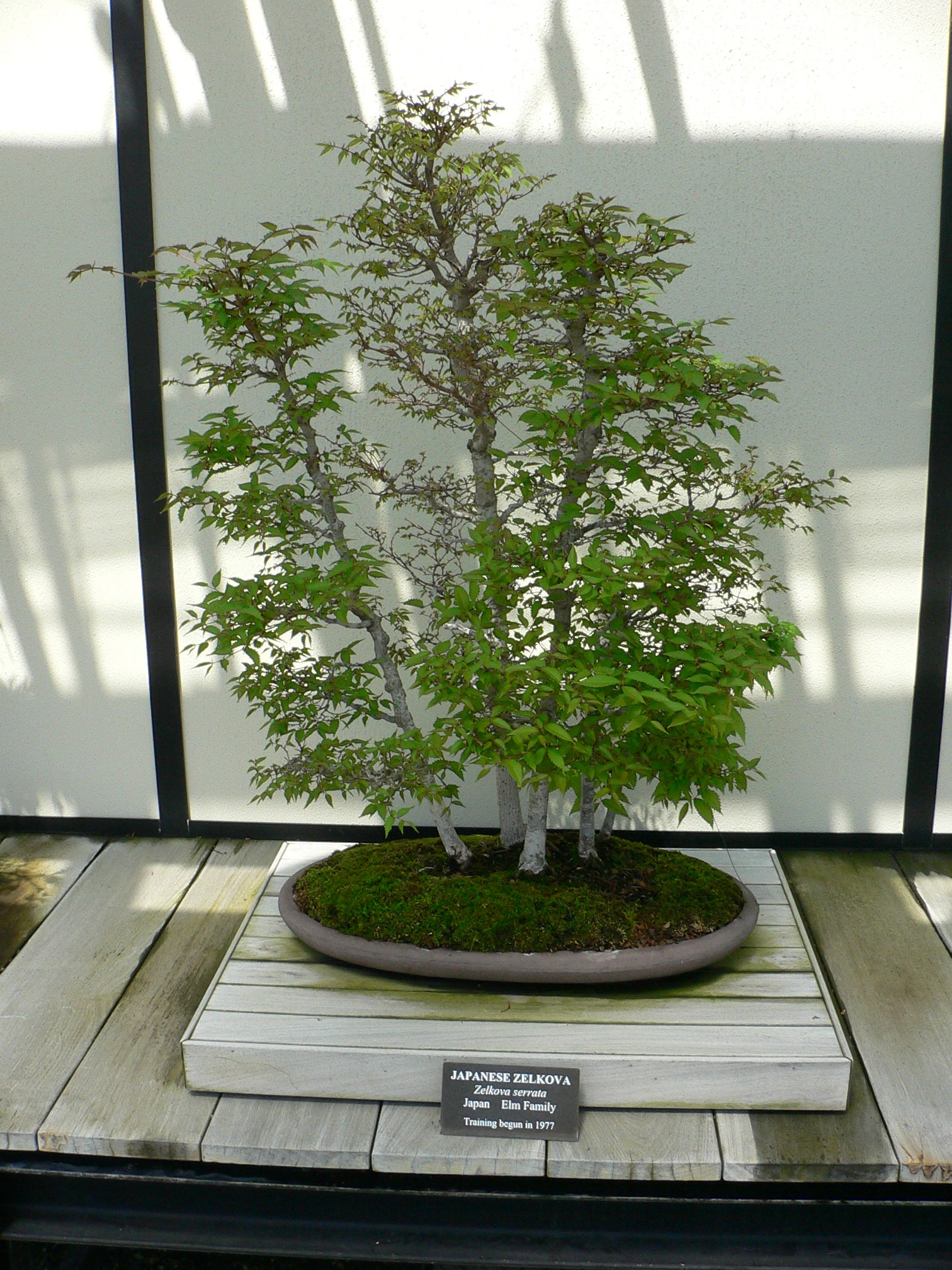
A Japanese zelkova (Zelkova serrata) in full leaf, its crown divided into the fine, closely spaced branching that years of repeated pruning produce. Photographed at Longwood Gardens, Pennsylvania, in April 2009. Photo by Mark Pellegrini, CC BY-SA 2.5, via Wikimedia Commons — Source

Late May to late June: for about five weeks a year, a grower can take shears to a perfectly healthy deciduous bonsai and cut away most or all of its leaves. The Japanese name for it is hagari (葉刈り, "leaf-cutting"). Three weeks too early, or on a tree with nothing in reserve, that same cut is simply damage. Inside the window, on a tree strong enough to answer it, it is one of the few ways a grower can ask a deciduous tree to rebuild its own branch structure finer than an ordinary season would give.
Hagari is the practice of removing a healthy deciduous bonsai's leaves in early summer so the tree regrows a second, smaller flush — and, in doing so, builds denser, finer branching than it would on its own.
Leaf-cutting is for zoki, and never for pine
Hagari belongs to zoki (雑木, deciduous trees grown for their form or foliage rather than flower or fruit) — trident maple, Japanese maple, zelkova, hornbeam, beech, and the like. Japanese practice is explicit that conifers are left out of it. Pines such as kuromatsu (黒松, Japanese black pine) and akamatsu (赤松, Japanese red pine) are shortened instead by a separate midsummer technique, mekiri (芽切り, "bud-cutting," commonly called candle-pruning in English, after the young shoot it targets), which controls needle length rather than leaf count. The two share a season and a logic — interrupt the first flush of growth to force a second, more compact one — but they are not interchangeable, and which one a grower reaches for depends on what kind of foliage the tree carries.
Flowering and fruiting species sit outside the technique for a different reason. The Zen Nihon Shohin Bonsai Association's guidance is that trees grown for fruit or blossom are better left uncut, since a summer spent regrowing leaves is a summer with less sap and light going toward ripening what the tree is grown for.
The window opens only after the spring leaves harden
Timing runs from late spring through June, and it opens only once that year's first flush has fully hardened — reached size, firmed up, stopped extending — and the tree has settled into the brief pause before its next push of growth. Cutting earlier, while the spring leaves are still soft, or cutting a tree that has not yet built up reserves, asks more than the tree can supply. Japanese growers commonly work fertilizer into the soil about a month ahead of the cut, precisely so the tree is carrying the strength the second flush will draw on.
A fixed leaf budget, spread across more buds, comes out smaller
New buds begin moving within about a week of the cut, and a full second canopy — the flush growers call nibanme (二番芽, "second bud") — takes roughly a month in decent warm weather. It comes out, almost without exception, smaller than the foliage it replaced, and more even in size across the tree.
The reason is fairly direct. A tree has only so much stored energy to spend on foliage in a season, and hagari forces that budget to be spent across more growing points than the tree would otherwise have opened at once. More buds sharing the same total leaf area means each leaf comes out smaller.
Every bare node can return two shoots instead of one
That second consequence is where the technique earns its keep. A tree left alone typically extends one shoot from a growing tip; a tree pushed into a second flush can open two or more at the same node, each capable of becoming a twig in its own right. The English grower Graham Potter describes the mechanism plainly: a removed leaf comes back as a whole new shoot carrying several leaves of its own, which is why the count of branch tips climbs rather than holding steady.
Repeated over several summers, this steadily shortens the distance between forks and multiplies their number — the fine, closely divided branch structure Japanese growers prize in species like keyaki (欅, zelkova) and kaede (楓, maple), where the broom style and the bare winter silhouette both depend on exactly this kind of density. Potter puts the compression at as much as two years of development in a single season, a figure worth taking as an illustration of scale rather than a measurement, but one consistent with what Japanese and Western growers both report.
Not every species answers a full leaf-cutting the same way. Hornbeam (Carpinus), oak (Quercus) and beech (Fagus) react poorly to having every leaf removed at once, often pushing back a smaller number of larger leaves rather than the fine, multiple flush a maple or zelkova gives. On these, growers use a partial version instead: one leaf left in place at the tip of each shoot as what Bonsai4Me calls a "sap drawer," continuing to pull sap along the length of the branch, while every leaf behind it is cut away. The tree still breaks new growth at the bare nodes, gaining density without the shock of losing all its foliage at once.
Three signs tell a grower the tree can pay for it
Hagari asks a tree to build an entire second set of foliage in the middle of its growing year, and only a tree already carrying real vigor can answer that demand without harm. Potter's test for this is concrete enough to borrow. The tree should be holding good, viable leaf late into autumn. It should be drawing water out of its pot visibly, every day it is in leaf. And it should be throwing back buds on its own, unprompted. A tree that misses any of the three is not ready this year. He adds a structural condition underneath those: at least three orders of branching already in place, below which the new density has nothing to attach itself to.
Against that sit the standing exclusions, which Japanese and Western sources agree on almost word for word — trees recently repotted or heavily pruned, anything showing signs of disease or stress, young trees still establishing their first structure, and, in any given year, a tree that simply looks tired. Better to skip a season than to demand a second flush the tree cannot supply. Cut a tree that has not earned it, and the flush may come thin, or may not come at all, leaving branches bare well into autumn.
Reading vigor is the harder half of the technique
Hagari is not a shortcut. It spends a full season of ordinary growth to buy a finer branch structure the following year, and it can only be spent by a tree holding the reserve to survive the expense. The cutting itself takes an afternoon. Judging whether this particular tree, in this particular summer, has the strength to pay is the part that takes years to learn.
That judgment is also the part that disappears. A tree carries the result in its own structure long after the leaves are gone — but it carries no record of the reasoning, of a grower standing in front of it in early June and deciding to leave it alone for another year. I think the reasoning deserves keeping as carefully as the tree does. The seasonal record behind each tree we look after is built to hold it: what was done, what was declined, and on what evidence. The princess persimmon in our care is a good illustration of the second kind — a tree grown for what it carries in autumn, and therefore one this particular technique is mostly not for.
References
- Bonsai Empire — Defoliation — on defoliation timing (June for most species, after the spring growth has hardened off), its effect on leaf size and ramification, and the instruction not to defoliate weakened trees or trees still in training.
- Bonsai4Me — Improving Ramification in Deciduous Bonsai Using Partial Defoliation — on the terminal-leaf "sap drawer" technique, why hornbeam, oak and beech react poorly to complete defoliation, and how a removed leaf is replaced by a new shoot carrying multiple leaves.
- Graham Potter Bonsai — Defoliation: What You Need to Know — on waiting for the first flush to harden and stall, the three vigor signs and the three-branch-order condition, bud break about a week after leaf removal, and the "two years' development in one" effect.
- Zen Nihon Shohin Bonsai Association — Early Summer Maintenance: Leaf-Cutting and Branch Arrangement — on hagari's purpose and its late-May-to-late-June window, fertilizing about a month ahead of the cut, skipping the year on a weakened tree, and leaving fruiting and flowering species uncut.