
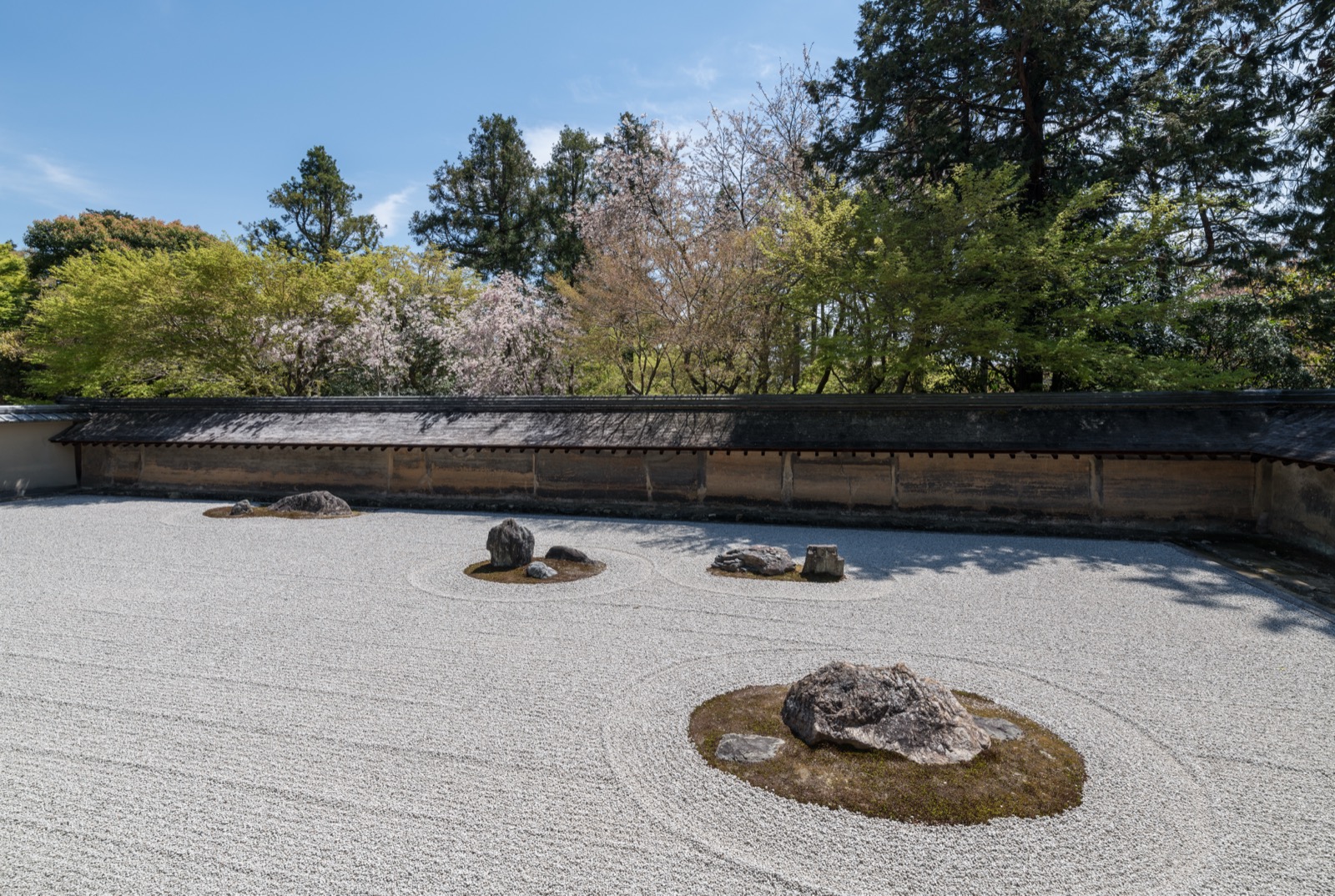
At Ryoan-ji in Kyoto, fifteen stones sit in raked white gravel, and the arrangement has one built-in rule: from every seat along the veranda, at least one of the fifteen stays out of view. It is not an oversight the temple never fixed. It is the design working as intended — no visitor gets the single, master's-eye view of the whole composition at once. A French chateau garden answers the same underlying question, how much of nature a person should be allowed to see and shape, in the opposite direction: hedges cut to a straight line, water channeled into geometric basins, a tree line clipped into a wall, so that the whole scene answers to one eye standing in one place.
A Western garden has traditionally been built to master nature; a Japanese garden has traditionally been built to take part in it. Neither habit of mind is more correct than the other — they are two different answers to the same question of how a person ought to stand next to something larger than themselves. This piece is about where the Japanese answer came from, and about the discipline it still asks of anyone who tends a living tree today.
Borrowed scenery lets the hillside decide where the garden ends
The Ryoan-ji arrangement is one version of a wider logic. A related technique, shakkei (借景, "borrowed scenery," the practice of designing a garden to incorporate a distant mountain or forest as if it belonged to the garden itself), goes further still: rather than building a wall around a finished composition, the garden deliberately leaves itself open to a hillside its designer did not plant and cannot control. The garden ends, in a sense, wherever the eye decides it does, not wherever the fence was built.
Neither approach is a verdict on the other. But it is fair to say the two traditions started from different premises about what a garden is for. One treats the garden as a stage on which nature is directed. The other treats the garden as a place where a person and the surrounding land agree, provisionally, to share a view.
A disaster-shaped history sits behind the habit
Part of why the second habit of mind took hold in Japan is geographic before it is philosophical. The archipelago sits astride the Pacific Ring of Fire, and its written history is punctuated, with grim regularity, by earthquakes, typhoons, and floods. The Great Kanto Earthquake of 1923 killed roughly one hundred thousand people in the Tokyo region in a single day — a number large enough that no theory of controllable nature survives contact with it for long. Classical Japanese literature, by some readings, records surprisingly few of these disasters directly; early writers tended to treat calamity as something closer to a judgment from heaven than an event to be described in ordinary prose, which is itself a way of declining to look nature in the eye and call it manageable.
Seismic codes are new; the deference is centuries older
A society that assumes it can eventually out-build every earthquake plans differently from one that assumes the ground will move again regardless of what is built on it. Japan's modern seismic codes, tightened after 1923 and again after 1981, are genuinely sophisticated: base isolation, reinforced framing, retrofitted timber. But the cultural habit behind them predates the engineering by centuries, and it runs on the same reasoning as the garden — not that nature can be defeated, but that a person's task is to read its behavior closely enough to live alongside it without pretending to have the last word.
The gardener still gives orders — just not to the material's nature
None of this means a Japanese garden is left untouched. A niwashi (庭師, "a professional gardener," here specifically one trained in the pruning and shaping of trees and shrubs within a traditional garden) prunes constantly, wires branches into position, and rakes gravel into a precise pattern every week. The hand is everywhere. What the niwashi does not do is decide, independent of the material, what a stone or a pine should become. The old design principle behind Japanese rock placement is to follow the request of the stone — to let a rock's own mass and grain suggest where it wants to sit, rather than forcing it into a shape drawn up in advance. A pine is pruned with the same deference to its own habit of growth, with the direction a branch was already reaching rather than against it.
The hand is active. The authority it defers to is not the hand's own.
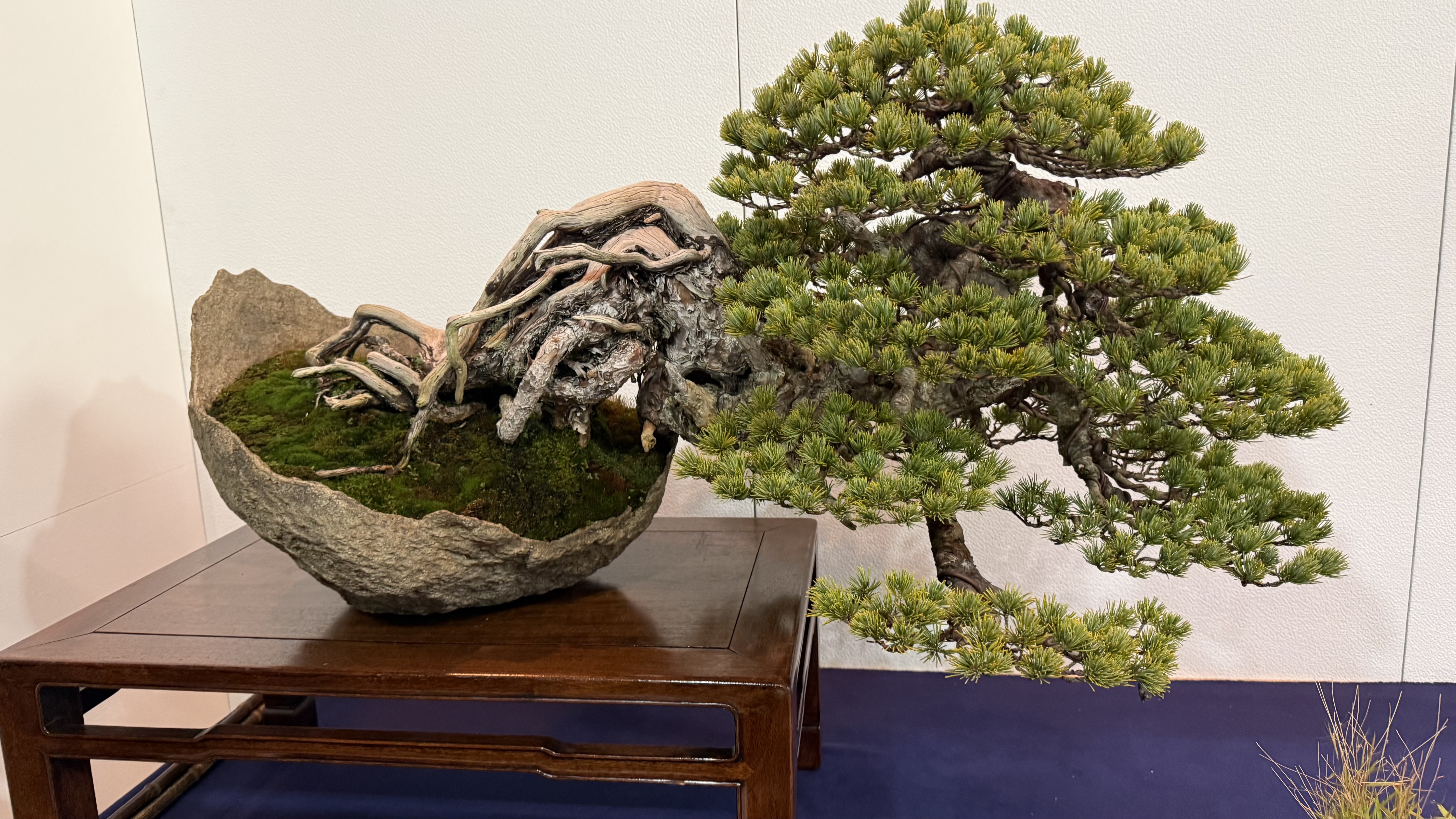
A bonsai artist reads vigor before giving any order
A bonsai artist inherits this same discipline in its most concentrated form, because a bonsai is never inert material. It is a living organism with its own preferences about light, water, and where it wants to send its next season's growth, and an artist who overrides those preferences outright will simply kill the tree or ruin its shape trying.
What an artist reads instead is jusei (樹勢, "a tree's vigor," the visible strength or weakness of its current growth). A tree pushed too hard for two seasons running shows it in thinner, paler needles before it shows it in anything more serious; a tree recovering from a hard repotting will ask, visibly, to be left alone rather than wired again too soon. Reading that vigor and adjusting the year's plan around it is not a formality before the "real" work of shaping the tree. It is the work. If you keep a plant of any kind, the practical test travels: before the next cut, the question is not what you want the plant to become, but what its recent growth is already telling you it is trying to do — and pruning to that answer, not to a shape decided in advance.
Watering is where this reading starts every single day — the soil, not the calendar, decides when a tree is given water — and it never really stops, because a bonsai, as we've written elsewhere, is never finished: there is no final form to impose, only a long conversation to keep having with what the tree is telling you this season. Even the old idea that a kami (神, "a spirit or deity in Shinto belief") might dwell within a very old tree points at the same instinct from another direction — a tree old enough commands a kind of deference no amount of technical skill overrides.
A bonsai artist prunes, wires, and repots constantly. What they never do is give the tree an order its own nature cannot carry out. That is not a limitation on the craft. It is the craft — the same one, at smaller scale, that left a stone unfinished at Ryoan-ji and kept a nation building homes that bend with the ground instead of pretending it will hold still.
References
- Borrowed scenery — Wikipedia — overview of shakkei, the technique of incorporating distant, uncontrolled scenery into a garden's design.
- Japanese garden — Wikipedia — overview of Japanese garden design principles, including the practice of placing stones according to their own character rather than a predetermined plan.
- Nippon.com — "Disaster and the Japanese Spirit" — essay on the historical and cultural relationship between Japanese society and natural disaster.
- National Geographic — "Japan spent decades making itself earthquake resilient. Here's how." — reporting on Japan's seismic building codes and disaster-preparedness culture since the 1923 Great Kanto Earthquake.