
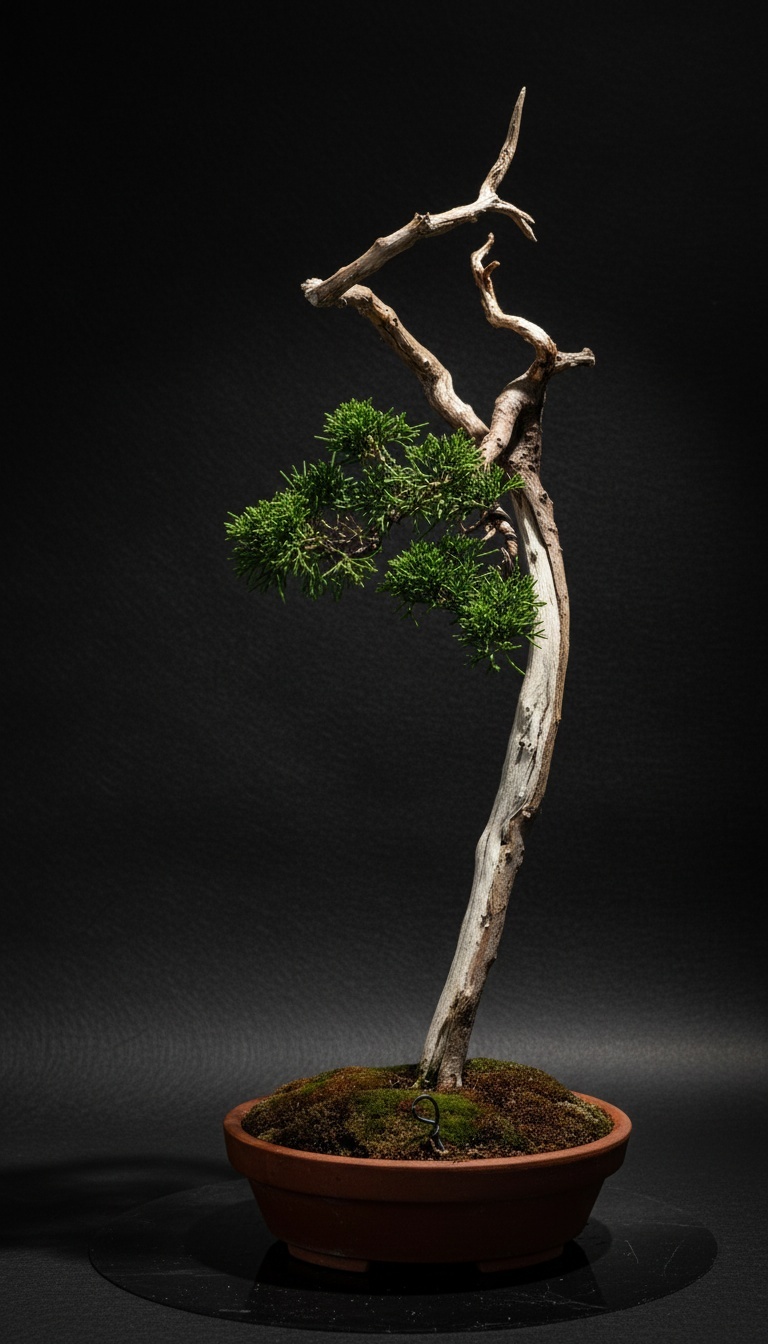
Just after New Year last year, I started going to a bonsai garden in Edogawa, on the eastern edge of Tokyo — the Shunkaen BONSAI Museum, where more than a thousand trees stand inside one set of walls. I went first as a visitor. I now go as an enrolled student of the garden. What surprised me was not how much there was to learn about trees, though there is. It was how fast the rest of the day went quiet once I was standing in front of one. Nobody inside those walls asks you to decide anything. The phone stays in the pocket. For someone who spends the working week between screens and other people's deadlines, the strangeness of that silence was the first real lesson.
Bonsai care asks nothing of the mind except to be there: no argument to win, no message to answer, no decision beyond how much water today. For the few minutes that takes, there is, for once, nothing else to think about.
Outsiders tend to describe bonsai care as a set of techniques — pruning schedules, watering rules, the right soil mix for a given species. All of that is real, and none of it is wrong. But people who stand in front of the same tree for years describe the daily minutes differently: not as a task to finish, but as the one stretch of the day that asks nothing back except to be present for it. This piece is about that hour — what it does to the mind, and why it matters most on exactly the days there seems to be no time for it.
The task is small on purpose
Pour water on a plant, and there is very little to decide. Turn the pot to check for dry soil, and there is nothing to argue with. Bonsai care is deliberately small in this way: a few minutes, once or twice a day, spent on a single living thing that has no opinions to share and no news to deliver. That smallness turns out to be measurable. In a 2011 study, Dutch researchers put allotment gardeners through a stressful task and then had them spend thirty minutes either gardening or reading indoors. Both activities lowered the stress hormone cortisol, but the drop was significantly larger after gardening — and mood recovered fully only in the gardening group; the group that sat and read continued, on average, to feel worse. A separate Japanese study measured something closer to bonsai itself: elderly rehabilitation patients who spent one minute simply looking at a small potted cypress showed a measurable shift toward parasympathetic — "rest and digest" — nervous activity, and reported feeling more comfortable and relaxed than a matched group who looked at nothing at all. One minute of looking at a small tree, and the nervous system changes gear. Daily bonsai care is a plainer version of both experiments, repeated for years.
Mushin is an unfixed mind, not an empty one
There is a Japanese term for the state this small task tends to produce: mushin (無心), literally "no mind." The word does not mean blankness. It names a mind that has stopped fixing on any one thought — the way the Zen priest and swordsmanship teacher Takuan Soho described it, a mind that "neither congeals nor fixes itself in one place," free to move as circumstances require rather than caught on a single worry. Mushin is best known from swordsmanship and archery, where a mind still chasing a plan is a mind a half-second too slow. But it does not require a sword. It shows up any time a task is simple enough, and repeated enough, that the mind stops narrating and simply does — and a tree, which offers no argument and asks for no reply, is an unusually good place for that to happen. This is what I keep rediscovering at Shunkaen: standing in front of a tree long enough, you run out of things to think about it quickly, and what is left is looking. I had read about mushin for years before I understood that it is not something you achieve. It is what remains when the task is too simple to hide inside.
The tree trains whoever tends it
None of this happens in a single sitting. A tree kept for ten or twenty years is not tended by one long session of attention; it is tended by several thousand short ones, each so ordinary it is barely worth remembering on its own. Japanese culture has a word for practices built this way — shugyo (修行), sustained training — used for everything from martial arts to the tea ceremony to, as we wrote in "Zen Is Something You Do," the daily chores of a Zen monastery, where sweeping a garden is no less a form of practice than sitting in meditation. Bonsai asks for the same repetition without romanticizing it. There is no decisive afternoon on which the tending is mastered, only years in which the eye slowly learns to read a leaf's color or a branch's give — the old saying mizuyari sannen (水やり三年), "three years for watering," says it for the humblest task of all. The tree does not change quickly enough to reward impatience. What it rewards is returning.
If you keep a tree yourself, this suggests the right way to judge the daily hour: not by what visibly changes in the tree, because day to day nothing does. Judge it by which of you is calmer when it ends.
The fullest days owe this hour the most
It would be reasonable to assume a demanding job leaves no room for a ritual this slow. The evidence points the other way. Psychologists Rachel and Stephen Kaplan described a state they call directed attention fatigue: the tiredness that builds specifically from the sustained, effortful focus that fills a modern workday — screens, deadlines, decisions, other people's demands. Their Attention Restoration Theory holds that recovery from this particular fatigue requires the opposite kind of attention, a "soft fascination" that asks nothing deliberate of the mind: watching leaves move, checking soil, noticing how a shoot has extended since yesterday. A day spent entirely on directed attention is exactly the day this soft attention answers. I notice it in my own calendar — the weeks when the garden feels hardest to get to are, reliably, the weeks it does me the most good. The bonsai does not care how full the schedule was before it, or after. It asks for the minutes in between.
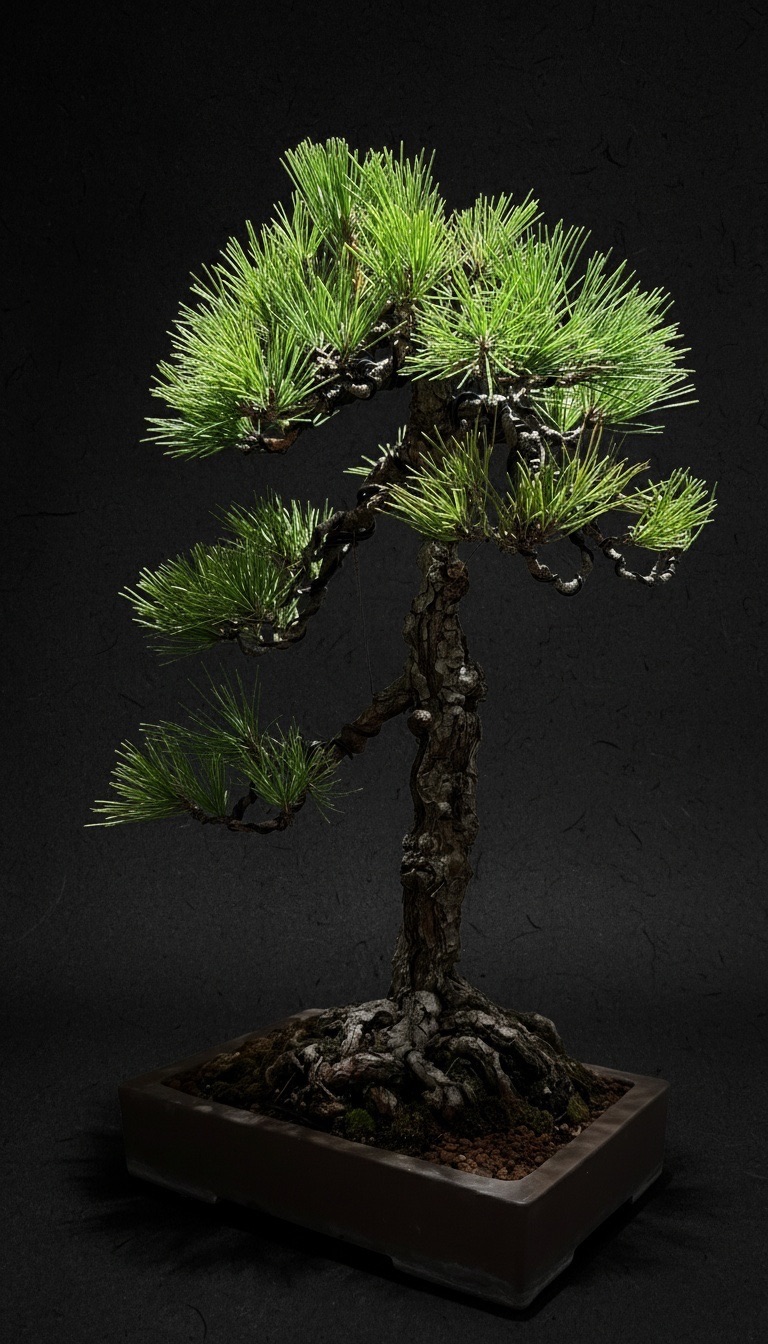
A black pine kept the same way for years: not one decisive session, but thousands of small, unhurried ones.
Where my own hour happens
I should be honest about the shape of my practice: the wordless hour I have been describing does not happen on my balcony. It happens in someone else's garden, standing in front of trees I do not own, learning from people whose whole working lives are this. That division is not a compromise — it is how serious bonsai has long been organized in Japan, where important trees live in professional gardens and the people connected to them come and go. Azukari is built on the same shape. A tree stays in Japan under an artist's daily hand; its owner, perhaps nine time zones away, receives the record of those hours season by season — the watering, the turning, the small unhurried attentions that never make the news. The hour still gets kept, every day, by someone who has kept it for decades. Having spent the past year and a half standing in a garden watching professionals keep that hour, I can say the record an owner receives is a photograph of something real.
References
- Gardening Promotes Neuroendocrine and Affective Restoration from Stress — Van Den Berg & Custers, Journal of Health Psychology (2011) — field experiment showing stronger cortisol recovery and full mood restoration after gardening compared with reading.
- Physiological Effects of Viewing Bonsai in Elderly Patients Undergoing Rehabilitation — Song et al., International Journal of Environmental Research and Public Health (2018) — measured increase in parasympathetic nervous activity and self-reported relaxation after one minute of viewing a bonsai.
- No-mind — Wikipedia — overview of mushin as a Zen and martial-arts concept, including Takuan Soho's teaching on an unfixed mind.
- Attention restoration theory — Wikipedia — summary of Kaplan and Kaplan's theory of directed attention fatigue and restorative, softly fascinating attention.
- Shunkaen BONSAI Museum — Kunio Kobayashi — the garden in Edogawa, Tokyo, where the author studies.