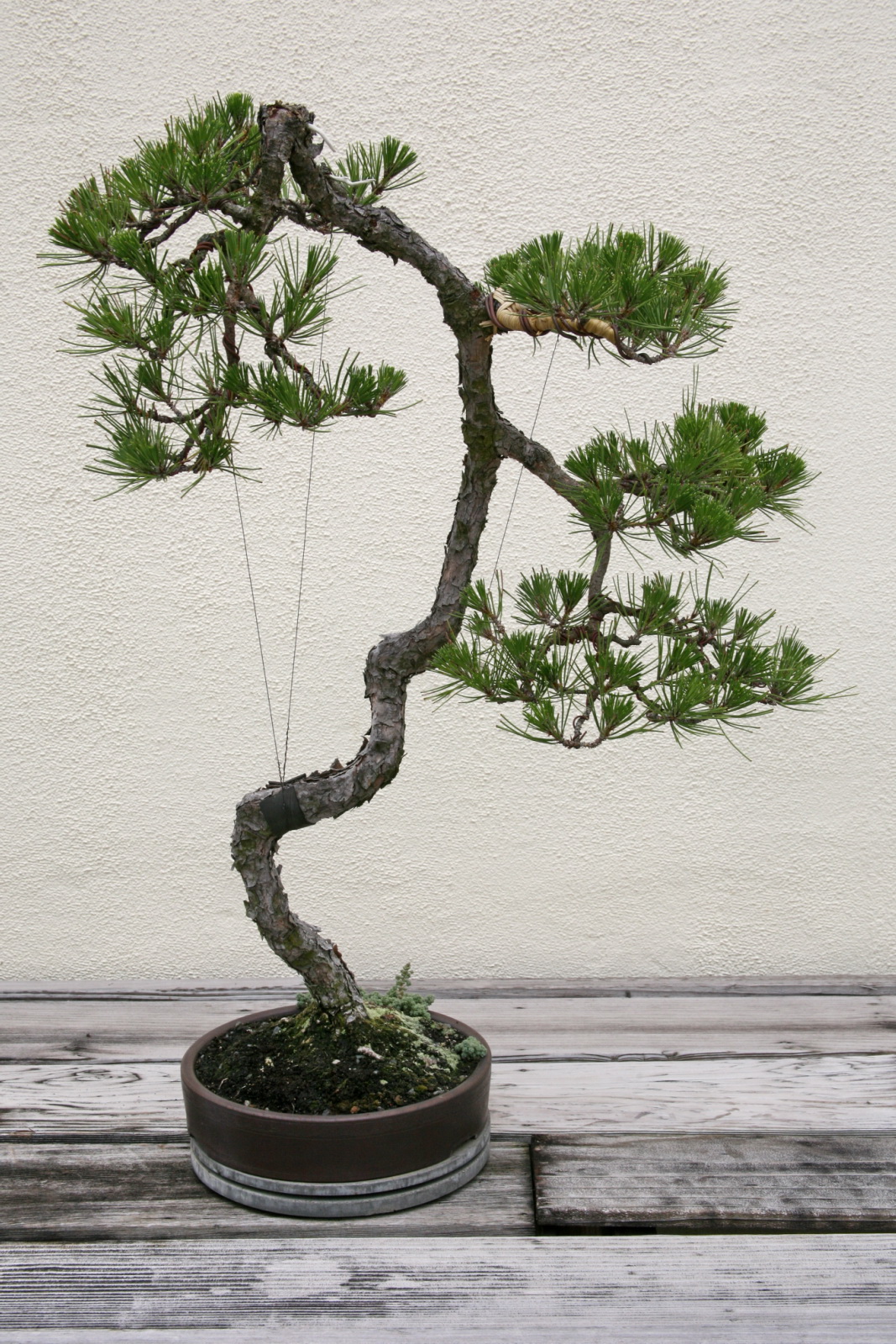
Photo by Cliff (Arlington, Virginia), CC BY 2.0, via Wikimedia Commons — Source

There is no single date for either job. When to put wire on depends on the species and the season — conifers generally take it from early spring, deciduous trees a little later, once the coldest weeks have passed. When to take wire off depends only on the branch: always before the coil starts cutting into the bark, which in practice runs anywhere from a few months to about a year. The calendar sets the starting window. The branch itself sets the deadline.
Applying wire: a seasonal window, not a fixed day
Harigane (針金, "wire") goes on once a tree is healthy and actively growing, not while it is weak, stressed, or freshly repotted. Within that condition, timing follows the species. Conifers such as pines and junipers are commonly wired from around the start of spring, when growth is picking up but the wood is not yet at its most tender. Deciduous trees are handled a little differently, and practice varies by tradition: some growers wire deciduous branches while they are still bare in late winter, when the structure is easiest to see and shape; others wait until the new season's shoots have hardened, closer to late spring or early summer, so the wire has healthy, flexible wood to work with. Both approaches agree on the same exception — the deepest, coldest weeks of true winter are avoided across almost every species, since dormant wood in a hard freeze is the most brittle wood a tree has all year.
None of this is about ceremony. It is about choosing a window when the branch can absorb a bend without splitting, and when the artist has enough of the growing season ahead to watch the wire do its work.
The removal principle: off before it bites in
Wire that stays on too long stops being a tool and starts being a wound. As a branch thickens through the growing season, a coil that once sat loosely around it begins to press inward, and if it is not caught in time, it cuts a spiral groove into the bark and the wood beneath. Light marking can grow out again within a year or two; a deep, old scar from wire left on too long usually does not disappear. That single fact is the entire rule: wire comes off the moment a branch holds its new position on its own, and always before the coil starts biting into the growing wood — not after.
This is also why wire is cut away with cutters, turn by turn, rather than unwound. Unwinding puts sideways torque on a branch that has only just learned to hold a new shape, and can undo months of patient bending in a single careless motion. Cutting the coil into short pieces protects the very shape the wire was put on to create.
A guideline: months, not a season, not a single spring
Growers describe the range roughly the same way, and it is wide on purpose, because it depends on how fast a given branch is thickening. A vigorous deciduous branch wired in spring can set into its new position in as little as a few weeks; the same species wired later in the season, into slower autumn growth, may need a few months to hold. Fast-growing tropical species can cut in quickly enough that they need checking often. A heavy conifer branch, especially on an older pine or juniper whose wood thickens slowly, is a different case again — wire is commonly left on for the better part of a year, sometimes carried over a full winter, and a stubborn line in an older branch can call for more than one round of wiring, removal, and rewiring before it finally holds unaided. Most general guidance settles on a window of roughly six months to a year as a starting expectation, with faster growth cutting that window shorter and slow, mature wood stretching it longer. None of these numbers replace the actual check.
Leaving no scar is the mark of skill
An experienced grower is checking wired branches every few weeks once growth resumes, watching for the earliest sign that a coil is starting to press into the bark rather than waiting for the mark to appear. Catching that moment early enough that no trace is left behind — no spiral groove, no flattened patch of bark — is treated less as a footnote and more as a measure of an artist's attention. A tree can be exhibition-worthy in every other respect and still be marked down for old wire scars a careless season left behind. The wire is never meant to be visible in the finished tree. Judged by that standard, restraint and regular checking do more for a bonsai's long-term form than the bending itself.
For the full technique — how the wire is wound, why raffia and guy-wires protect older bark, and why a bend is set in one decisive motion — see Wiring: A Dialogue with the Branch. The same seasonal judgment applies to when to prune and to the slower, subtractive discipline behind pruning as subtraction: in both cases, the right moment is read from the tree, not from a fixed date circled on a calendar.
None of this changes at a distance. At Azukari, checking a coil before it marks a branch, and cutting it free the week it is no longer needed, is one of the small, unglamorous judgment calls that fills a Japan-based artist's working year — recorded, season by season, so an owner elsewhere can see not just that a tree was wired, but when it was set free again.
References
- Bonsai Empire — Wiring Bonsai Trees — on wire staying on only until a branch holds its new position and before bark damage occurs, with a general window of roughly six to twelve months depending on growth speed and species, and on deciduous trees often being easiest to wire in late winter while bare.
- Bonsai4Me — Wiring Bonsai — on wire "biting" into branches and leaving coiling scars as a branch thickens, light marking growing out within a year or two versus heavy marking being permanent, wire removal by cutting rather than unwinding, and species-driven variation from a few weeks (fast-growing deciduous branches) to a full winter (conifers).
- Kindai Shuppan — Bonsai Beginner's Course: Wiring — on seasonal timing by species group in Japanese practice: conifers around March, deciduous trees around May–June, and deep midwinter avoided for wiring.