
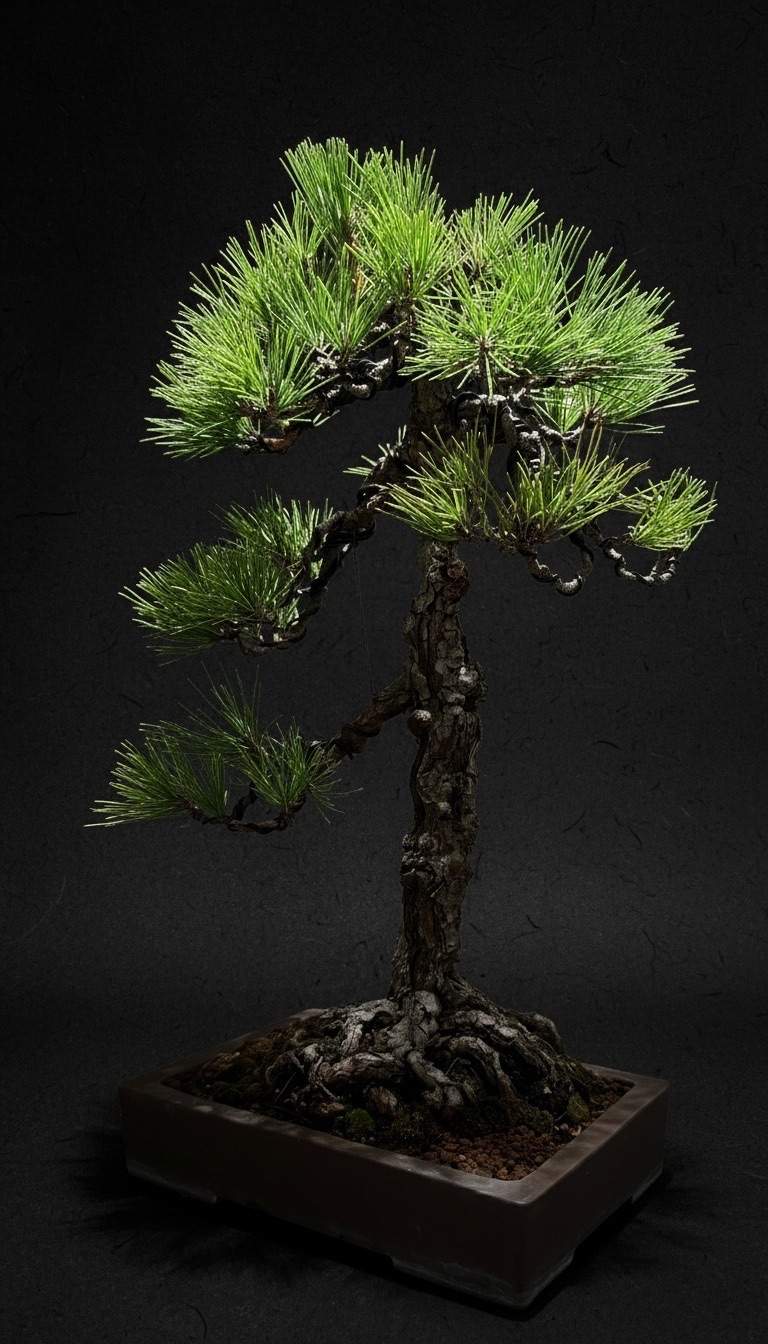
There is no single date on a calendar. Structural cuts are made at the edge of dormancy — late winter into very early spring for most deciduous trees, a narrower window in late spring and early summer for pines and junipers — while light, shaping trims continue through the growing season. The species decides the calendar; the tree's own bud swell decides the exact week.
Different trees, different calendars
The instinct to ask for one rule is understandable, but bonsai species do not share a single pruning season. Deciduous trees such as maples are generally cut hardest in late winter, just before the buds swell, so the wound begins healing the moment growth resumes; once the leaves are out, that same tree only takes light shaping cuts through spring and summer. Pines run on a different clock entirely. A black pine's new shoots, or "candles," are shortened by hand in the growing season, usually through May and June and sometimes into mid-July, and the tree's shape is actually built across the whole year in stages — green-shoot picking in spring, candle work in early summer, thinning old needles from autumn into winter — not finished in one sitting. Junipers are trimmed with scissors, in two or three passes through the season, rather than pinched with fingers the way many other conifers are. Flowering species add a further wrinkle: azaleas, for instance, are best pruned soon after they finish blooming, because cutting earlier removes the flower buds before they open.
Which branches earn a cut
Timing decides when to prune; the tree's own structure decides what. A few configurations come up again and again in growers' guidance as branches that usually do not earn their place: a branch that crosses the trunk or another branch, one growing straight up or straight down from where it emerges, two branches sitting opposite each other at the same height on the trunk (keep one, remove or shorten the other), and shoots bunched together at a single point, where only one or two are worth keeping. None of this is a rigid checklist to apply mechanically — a branch's role in the tree's silhouette matters as much as its angle — but these are the shapes an experienced eye checks for first, on almost any species, before a single cut is made.
When in doubt, don't
Growers who work on the same trees year after year describe a habit that saves more branches than it loses: step back from the tree after every cut, before making the next one, to look at the whole outline rather than just the branch in hand. When a particular branch's fate genuinely isn't clear, the safer move is usually to leave it a little longer than planned rather than shorter — cutting a branch you were unsure about cannot be undone, while a branch left slightly too long is a decision you can revisit next season with a clearer eye. This same caution, and the deeper reasoning behind why a cut is treated as final rather than provisional, is explored at length in Pruning: The Art of Subtraction.
A year-round plan, not a constant clip
It is a common misconception that a well-kept bonsai should look tidy every week of the year. In practice, growers deliberately let a tree run — sometimes for three or four months of relatively free growth — before cutting it back again, because new shoots repeatedly produced and removed in quick succession drain a tree's energy faster than it can replace through its leaves. One hard structural prune at the end of winter, timed to push new growth outward into the shape the tree is meant to hold, does more for a tree's development than constant light trimming spread across the whole year. Pruning, seen this way, is less a weekly habit than an annual plan with a handful of deliberate appointments on it — timed to each species' own season, and, alongside wiring and repotting, one of the small number of moments each year when a tree's structure is actually allowed to change.
Closing
None of this is knowledge a grower reaches for once and then sets aside. The same questions — is this the right week for this species, does this branch still earn its place, has the tree had enough free growth since the last cut — return every year the tree is kept, in roughly the same order, for as long as it lives. At Azukari, that yearly rhythm is exactly what an artist in Japan keeps to on a tree's behalf, cut by cut, season by season, with each pruning entered as a dated record its owner can see.
References
- Bonsai Empire — "Bonsai maintenance calendar" — on structural pruning at the edge of dormancy for deciduous trees, candle-pinching pines by hand in May–June, and trimming (not pinching) junipers with scissors two or three times through the season.
- wabonbiyori — "ミニ盆栽の剪定方法|時期・切り方・樹種別のコツ" — Japanese-language guide on structural pruning falling roughly between leaf-fall and bud-break, adjusting the plan if buds have already swollen, species differences between black pine, white pine, and maple, and stepping back from the tree after each cut to judge the whole balance before removing a doubtful branch.
- Bonsai Today — "Pruning" — on identifying branches to remove, including those crossing the trunk, growing straight up or down, sitting opposite each other at the same height, or bunched at one point, and on major pruning occurring at the end of winter with lighter ramification cuts in spring.
- Bonsai4Me — "Bonsai Myths Part Three: Continually Trimming Your Bonsai" — on why repeatedly trimming new shoots drains a tree's energy faster than constant light clipping can replace, and on allowing several months of freer growth before a planned, harder prune.
- Bonsai Empire(日本語版) — "盆栽の剪定の方法" — on the distinction between structural pruning near the start or end of dormancy and maintenance pruning throughout the growing season, and on specific guidelines for choosing which branches to remove.