At the United States border, the line between an antique and ordinary merchandise is a number. Heading 9706 of the Harmonized Tariff Schedule covers antiques of an age exceeding one hundred years, and the customs regulation built on it, 19 CFR § 10.53, admits such an article free of duty only when the Customs officer concerned is satisfied that it is of the requisite age. The same regulation closes the loop at the other end: an article entered for sale as an antique and later found unauthentic picks up an additional duty. Age gets an object considered. Everything after that turns on whether the claim holds up when someone checks.
A bonsai and a fine antique are judged by the same underlying logic: age alone earns a category, but only a verifiable record earns real standing, and that standing survives every change of owner as long as the record survives with it.
Age Opens the Category. The Record Decides the Rest.
Appraisers in the antiques trade are direct about the limits of a birth year. The trade press states the rule plainly — "age alone does not dictate value" — and lists what does the deciding: authenticity and verified maker attribution, condition and originality of materials or finish, rarity or limited production, and provenance with a documented ownership history. The point comes with an example that undercuts any simple ranking by age: a rare object in poor condition may be worth less than a more common example in exceptional condition.
Bonsai works by the same rule. We've written elsewhere that age is the one quality no technique can substitute for, and it remains a precondition rather than a conclusion. A wild tree that has stood on a mountainside for three centuries is not yet a bonsai — let alone a meiboku (銘木, "a celebrated, named tree") — until someone has trained it, tended it, and can say who did.
A Record Outlives Every Owner Who Adds to It
Antiques move. Through estate sales, dealers, auction houses, sometimes a museum and back again. Each holder's name becomes one line in a longer history. A bowl passed through five collections over a century and a half belongs, in the ordinary sense, only briefly to each of them, while its documented history keeps accumulating regardless of whose shelf it currently sits on.
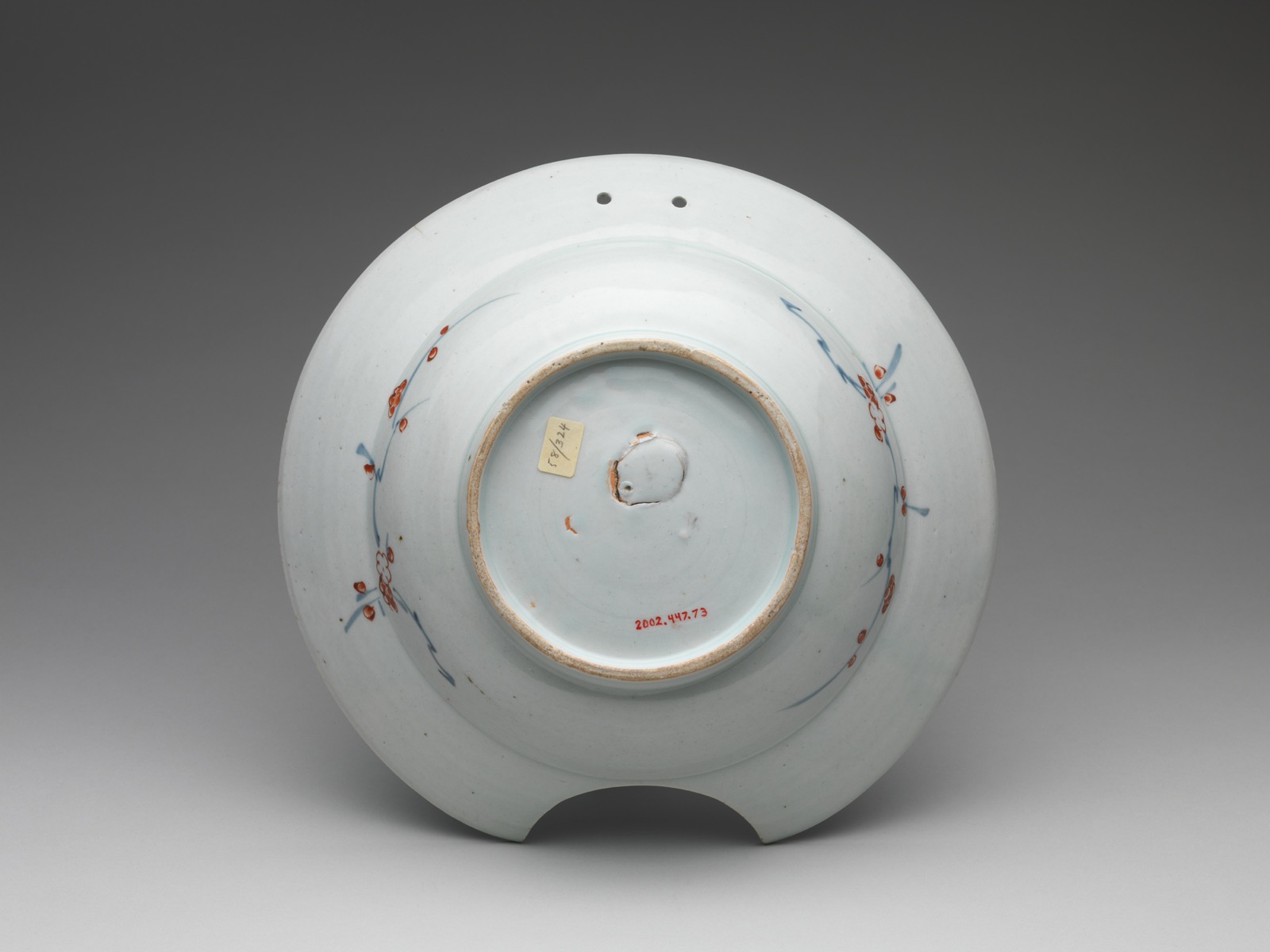
The reverse of a Japanese porcelain barber's bowl made in the late 17th or early 18th century, in the Hizen kilns' Ko-Imari style. The foot carries a painted accession number and a small pasted inventory label: the object's own record, written on the object. (Metropolitan Museum of Art, accession 2002.447.73, CC0.)
A bonsai's record works the same way, a point we go into more closely in why a bonsai's value lives in its record. Japanese bonsai culture calls this traceable line a keireki (経歴, "a tree's record of who has shaped and held it"): a chain that runs through every owner and terminates at none of them. What changes hands is custody of a single stretch of it. What stays is the chain. That continuity is what lets an object's standing carry across a transfer, the same way a documented painting keeps its history when a new owner hangs it.
Japanese Law Already Treats Custody as a Filing Requirement
The antiques trade treats authentication as a discipline in its own right, separate from valuation — the first of those four factors, verifying that the object is what it is said to be and made by whom it is said to be made.
Japan has formalized part of this at the level of ordinary commercial law. The country's law governing dealers in secondhand and antique goods, the kobutsu eigyo-ho (古物営業法, "the Secondhand Articles Dealer Act"), requires a dealer receiving an item to confirm the address, name, occupation, and age of the person handing it over (Article 15), and to enter the transaction in a ledger: the date, the item and quantity, its distinguishing features, the counterpart's details, and which of the permitted identity-checking measures was used (Article 16). That ledger stays at the place of business for three years from its last entry (Article 18). The law exists mainly to keep stolen goods from moving invisibly through the market, and it has a second effect besides: for any antique that passes through a licensed dealer, the chain of custody becomes a matter of dated record rather than memory.
Bonsai has built something structurally similar for trees judged significant enough to warrant it — the Nippon Bonsai Association's kicho bonsai (貴重盆栽, "a bonsai formally registered as a tree of documented value") registration, discussed in more detail elsewhere. The instinct behind both is identical: a spoken reputation and a record an outsider can check are different kinds of claim.
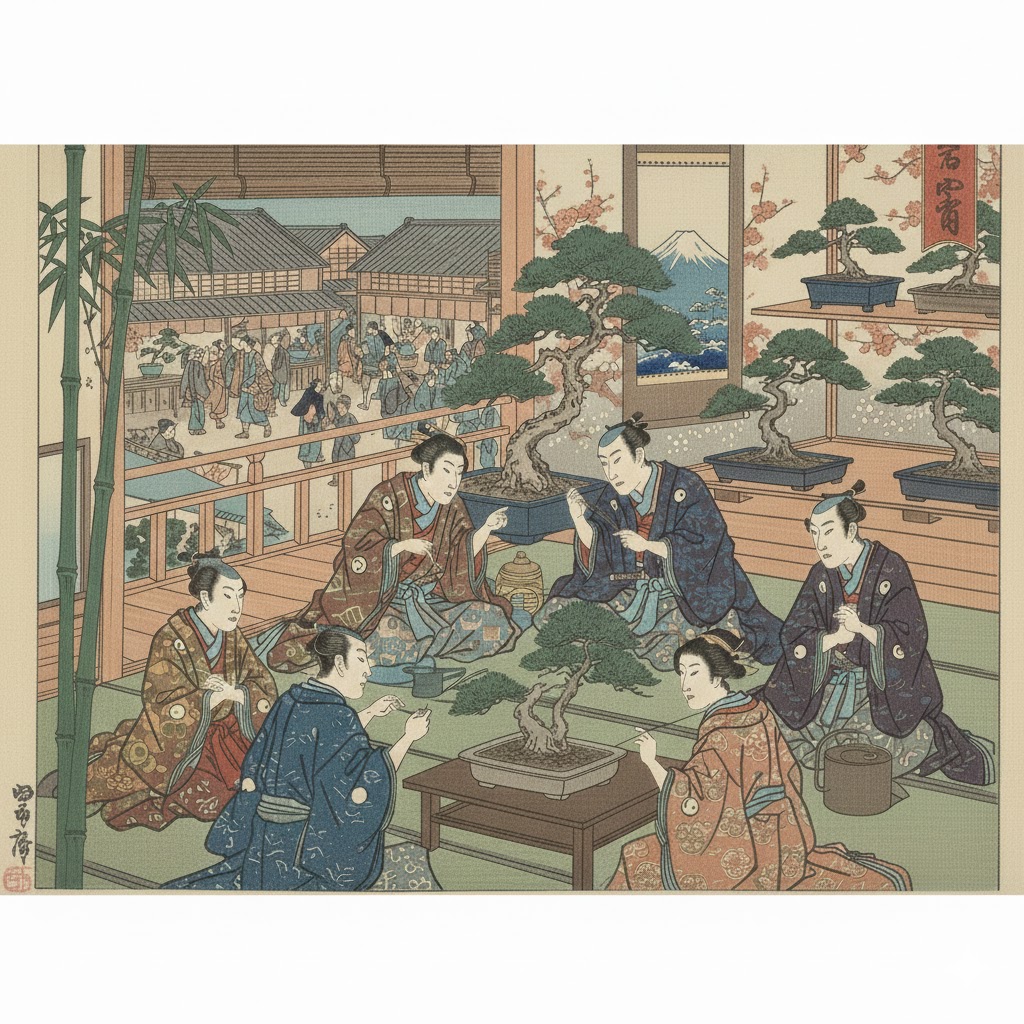
A stylized scene of connoisseurs gathered to examine a tree together — the same kind of scrutiny an appraiser brings to a bowl, a scroll, or any object presented as an antique.
A Bonsai Has to Keep Earning the Word "Authentic"
Here is where a bonsai and an antique in the ordinary sense part ways. A porcelain bowl, once authenticated, is essentially finished; its task from then on is to survive intact. Careful handling and stable storage are what protect its standing. The object itself can be entirely passive about it.
A bonsai has no such option. The National Bonsai Foundation describes the job of curating the National Bonsai & Penjing Museum as holding in your care "priceless works of living art kept alive for decades, even centuries" — a phrase that is exact about the paradox. Priceless in the way an antique is priceless, and kept alive, which nothing sealed in a display case ever has to be. A tree that stops receiving water, light, and seasonal attention loses more than luster. It dies, and the record ends with it: unstorable, unrestorable, gone.
So for a bonsai, "authentic" has to carry one more condition that no static antique ever has to meet: proof that the care itself continued, season after season, without a gap long enough to lose the tree. Where the object came from is half of it. The other half has to keep being written for as long as the tree is alive to keep it going.
Ask When the Last Entry Was Written
None of this makes a bonsai a financial instrument, any more than an antique in a museum case is one. The parallel is about how an object's worth becomes legible and verifiable through its record, and it says nothing about where a price might go.
It also changes nothing about an ordinary morning in a nursery — water, light, wire, the same teire (手入れ, "daily care") a tree has always needed. What it changes is how seriously that work has to be remembered once it is done. So when a tree is presented to you with a history attached, there is one question worth asking before any other: when was the last dated entry made, and by whom? An antique's file can sit closed for a decade and lose nothing. A living one that goes quiet for a season is telling you something about the care behind it.
Azukari is built around keeping that file open. A tree continues its ordinary seasons in Japan under an artist's care, and each season's work — watering, wiring, repotting, recovery from a hard winter — is entered as a dated record, so that whoever is entrusted with the tree next inherits a documented history. The antiques world has always asked that much of what it takes seriously. A living antique asks for it again every season.
References
- Cornell Law School, Legal Information Institute — 19 CFR § 10.53, "Antiques" — U.S. customs regulation tying duty-free antique entry to subheading 9706.00.00, conditioning it on the Customs officer being satisfied the article is of the requisite age, and imposing an additional duty where an article entered as an antique is later found unauthentic.
- Journal of Antiques and Collectibles — "Understanding Antique Value" — on authenticity, condition, rarity, and provenance as primary drivers of an antique's value, and on age alone not dictating it.
- Hourei.net — 古物営業法 (Secondhand Articles Dealer Act), Articles 15, 16 and 18 — full text of Japan's law requiring dealers to confirm a counterpart's identity, record each transaction in a ledger, and keep that ledger for three years from its last entry.
- National Bonsai Foundation — "The Museum" — describing the curator's charge at the National Bonsai & Penjing Museum as caring for "priceless works of living art kept alive for decades, even centuries."