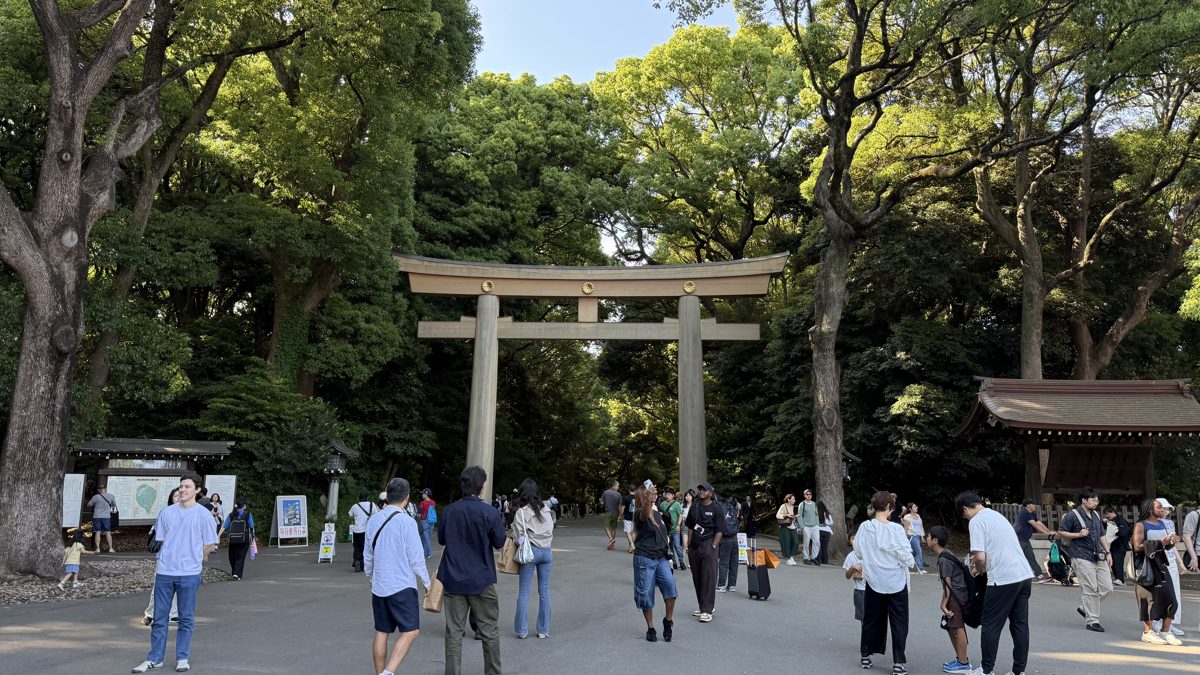
In a 2019 survey run for NHK's Broadcasting Culture Research Institute, 36 percent of Japanese respondents said they belonged to a religion; 62 percent said they did not. In the Institute of Statistical Mathematics' own long-running "National Character Survey" (日本人の国民性調査, Nihonjin no Kokuminsei Chosa), conducted every five years since 1953, the no-religion figure has topped 70 percent. Ask the same population a different question — does anyone in your household visit a shrine at New Year — and the number nearly flips. Inoue Nobutaka, professor emeritus at Kokugakuin University's Faculty of Shinto Studies, puts hatsumode (初詣, the year's first shrine or temple visit) participation at roughly seven in ten, and says most of the people doing it do not experience it as a religious act at all.
Those two figures are not a contradiction. They are answers to two different questions — one about identity, one about behavior — and Japan has kept both true at once for as long as anyone has been asking.
The same rhythm repeats every year without anyone treating it as an exception: shrines packed at New Year, families back at the ancestral grave for Obon (お盆, the midsummer festival for ancestral spirits), most funerals still conducted by Buddhist priests. None of it registers, to the people doing it, as a lapse into belief they'd otherwise deny holding. It is just what a year in Japan looks like.
The Same Population Is Answering Two Different Questions
The gap is not a paradox so much as a mismatched instrument. A survey asking about shukyo (宗教, "religion") is asking about a category — an institution one joins, a creed one affirms. Scholars of Japanese religious life have pointed out for decades that this question imports a line, native to Abrahamic tradition, between religious and secular life that Japan's own history never drew in the same place. Ask "do you have a religion" inside that frame, and a country that never organized its life around creed-versus-no-creed will answer "no" in large numbers, whatever it does every January.
Practice Runs Far Ahead of the Label People Choose
Inoue has spent decades studying that exact gap. In a recent interview, he estimated that at most two in ten Japanese could accurately be called non-religious in the sense the survey question intends — and he was careful to flag the number as an impression, not a count: no formal statistic captures this, he said, so the figure reflects his own reading of years of survey work rather than a tally anyone has run. That leaves roughly eight in ten carrying what he calls a faint, largely unconscious religiosity — present in what they do, absent from what they would write on a form. His clearest example is hatsumode itself: about seven in ten make the visit, by his estimate, and most do not consider it out of the ordinary — widespread behavior that rarely gets called religious.
The Calendar Keeps Custom Alive by Not Asking for Belief
Once the frame shifts from belief to practice, the year looks less like contradiction and more like continuity. Hatsumode opens the calendar at a shrine. Setsubun (節分, the early-February ritual marking the change of season) scatters beans to drive out misfortune. Ohigan (お彼岸, the twice-yearly Buddhist observances at the spring and autumn equinoxes) and Obon bring families back to the grave. Shichi-Go-San (七五三, a rite of passage for children aged three, five, and seven) takes children to a shrine in formal dress. Christmas, imported in the twentieth century, now sits on the same calendar as a family holiday, displacing nothing older.
None of these observances asks the participant to affirm a doctrine. What they ask for is attendance. Researchers describe this layer as minzoku shukyo (民俗宗教, folk religious practice) — custom that predates, and now simply coexists with, the formal categories of "Shinto" and "Buddhism" that outside observers reach for first. The two traditions have shared shrine grounds and household altars long enough — a historical fusion called shinbutsu-shugo (神仏習合, the syncretic blending of Shinto and Buddhist practice) — that a single home can keep a kamidana (神棚, a small household altar for Shinto deities) for everyday protection and a butsudan (仏壇, a household altar honoring ancestors) for family memory without either one reading as a statement of faith. Each practice does its own separate work — marking a season, honoring a specific ancestor, giving children something to look forward to — and none of them requires the household to pick a side.
A Shrine Asks for Attention, Not a Verdict on the Unseen
If the customs do not ask for belief, what do they ask for? Something closer to attention. Standing in a shrine's inner precinct, under old cedars or beside a sacred rope marking a stone, most visitors are not weighing a truth claim about a deity's existence. They are registering that the place differs from the street outside it — quieter, ordered, worth a small bow and a coin in the offering box.
A shrine forest, a mountain, an old tree can each carry the sense of kami (神, spirits or sacred presences associated with natural phenomena and specific places) — and this is close to what Shinto has long called kannagara (惟神, living in accordance with the way of the kami): a disposition toward certain places and moments as worth a different kind of attention, with no proposition attached that the visitor is required to accept. The visitor need not hold any settled position on what a kami actually is for the feeling to register. It arrives first, and for most people, it is also where the matter ends.
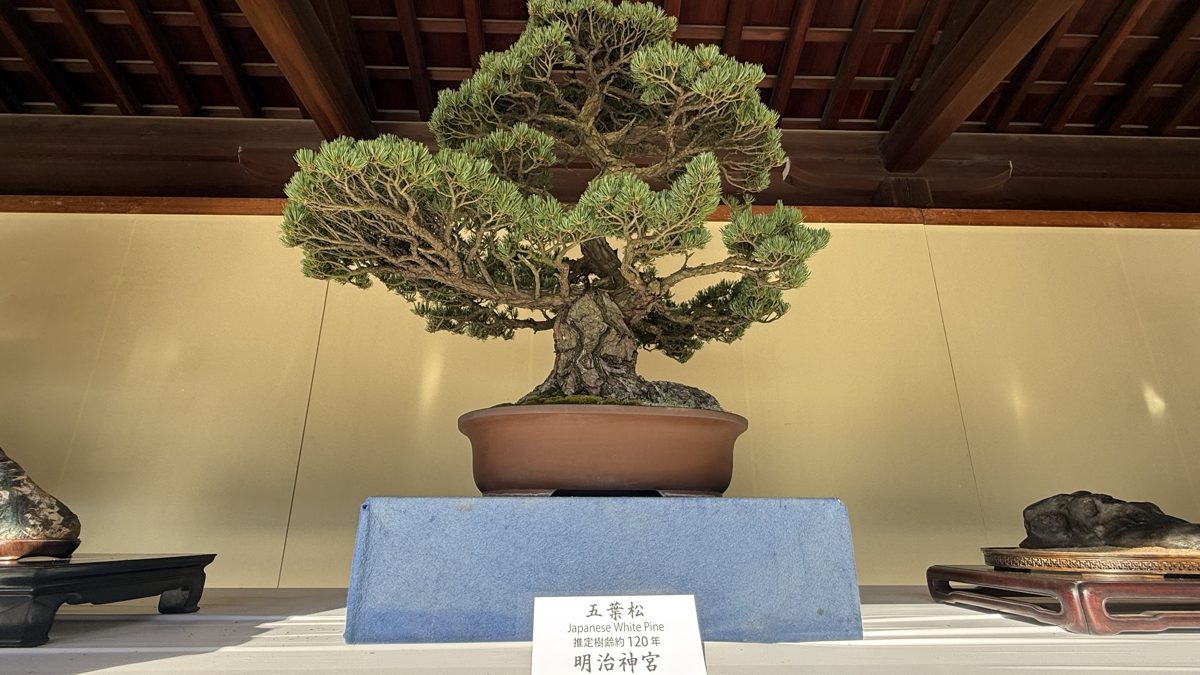
A pine tended on shrine grounds in Tokyo. Trees kept within a shrine precinct are cared for as part of the site itself — not worshipped, but given the same quiet attention as the shrine buildings around them.
Outside Categories Assume a Split This Country Never Made
Visitors from societies where religious identity is fixed and singular — Catholic, Muslim, atheist, categories that do not overlap — tend to find this the most disorienting feature of Japanese life. The shrines themselves aren't what unsettles them; those read easily enough as historic architecture. What unsettles them is discovering that the people bowing beside them at New Year would, an hour later, write "none" on a form asking about religion, and mean it sincerely.
The disorientation fades once belief is dropped as the wrong measure. Judge a custom by what it does for the people repeating it rather than by what they'd tick on a form, and the 62 percent stops looking like a puzzle. It becomes the clearest local version of something that shows up anywhere care outlasts belief: a country that has kept its religious customs largely intact by unhooking them from religious identity — free to practice, revised by no committee, carried forward less as dogma than as the shape of a year.
That same instinct — attention paid to a place or a practice without a doctrine required to justify it — is what keeps a Japanese garden raked, a broken tea bowl mended rather than discarded, and a bonsai tended for a hundred years by owners who never meet one another. Azukari runs on the same reading: a tree stays in Japan, tended through the seasons by an artist its owner may never meet, and the arrangement asks for no statement of faith — only the sense that the tree, and the attention it receives, are worth continuing. The label says no religion. The practice says otherwise. Bonsai, kept this way, runs on the practice.
For more on the sensibilities behind this kind of attention, see "What Is Ma?" and "Why Japan Avoids Symmetry." Our field letter from the Meiji Jingu Bonsai & Suiseki Exhibition looks at a shrine forest and its bonsai in more detail.
References
- The Institute of Statistical Mathematics — "Japanese National Character Survey" (日本人の国民性調査) — overview of the ongoing survey series, run every five years since 1953, tracking Japanese values and religious attitudes over time.
- Toyo Keizai Online — "The Truth Behind the Belief That Japanese People Are Non-Religious" (「日本人は無宗教」と信じる人が気づいてない真実) — cites the Institute of Statistical Mathematics' 2013 survey (over 70% report no religious faith) and the 2019 NHK/ISSP survey (62% report no religion), and questions what the "non-religious" label is actually capturing.
- J-Stage / NHK Broadcasting Culture Research Institute — Kobayashi Toshiyuki, "How Have Japanese Religious Consciousness and Behavior Changed" (日本人の宗教的意識や行動はどう変わったか), Studies of Broadcasting and Media, Vol. 69, No. 4 (2019) — ISSP international comparative survey findings showing the share of Japanese who claim a religious affiliation has held roughly steady even as religious feeling and the frequency of practice have weakened.
- Mynavi Career Research Lab — interview with Inoue Nobutaka, Professor Emeritus, Kokugakuin University Faculty of Shinto Studies — Inoue's own estimate, offered as personal impression rather than formal statistic, that at most two in ten Japanese are without any religious sensibility, and that roughly seven in ten make a New Year shrine visit without regarding it as religious.