Once every four years, bonsai's international community packs its demonstration tools, its catalogs, and in some cases its own trees, and travels to a different host country. The gathering is called the World Bonsai Convention, and it is the closest thing this quiet, tree-by-tree art form has to an Olympics — not because it crowns winners, but because it is the one recurring occasion when growers from dozens of countries stand in the same room.
Bonsai has an international convention of its own, and it has been circling the globe since 1989.
Where the idea began
The convention did not appear out of nowhere. Its roots trace back to Expo '70 in Osaka, where the coordinated effort behind Japan's bonsai displays left a lasting impression on the growers who organized them — among them Saburo Kato, a bonsai master who spent much of the following two decades developing an idea he called "world peace through bonsai." Kato, together with bonsai leaders from Japan, Korea, and the United States, spent years building the relationships that idea required before it became an organization.
That organization, the World Bonsai Friendship Federation (WBFF), was formally established around the first World Bonsai Convention in 1989. Its founding mission was straightforward: treat bonsai as a living art belonging to all peoples, keep enthusiasts around the world in contact with one another, and sponsor a World Bonsai Convention every four years to make that contact concrete rather than theoretical. Today the WBFF is organized into nine regional bodies — spanning Japan, Asia/Pacific, China, Australia/New Zealand, Europe, North America, Latin America, Africa, and South Asia — each sending its own national societies into the fold.
A convention that changes address every four years
The first World Bonsai Convention was held in Omiya, a bonsai-growing district that is now part of Saitama City, just north of Tokyo. Over four days in 1989, it drew a reported 1,200 participants from 32 countries — a striking number for an art form still widely assumed, at the time, to be a private Japanese pastime.
What followed was not a one-off. The WBFF has kept its four-year promise ever since, and the convention has since traveled to Orlando (1993), Seoul (1997), Munich (2001), Washington, D.C. (2005), San Juan (2009), Jin Tan (2013), Saitama again (2017), and Perth (2022, held virtually because of pandemic travel restrictions — the first time the event moved online rather than skip a cycle). The tenth edition is scheduled for Kuala Lumpur in August 2026, hosted by the Asia-Pacific region under the theme "Unity in Diversity."
Read as a single list, those cities say something the individual events cannot: bonsai's center of gravity is no longer fixed to one country. A hobby that began the twentieth century almost entirely inside Japan now has enough depth of practice on every continent to host, staff, and fill a multi-day international event in its own right.
What actually happens there
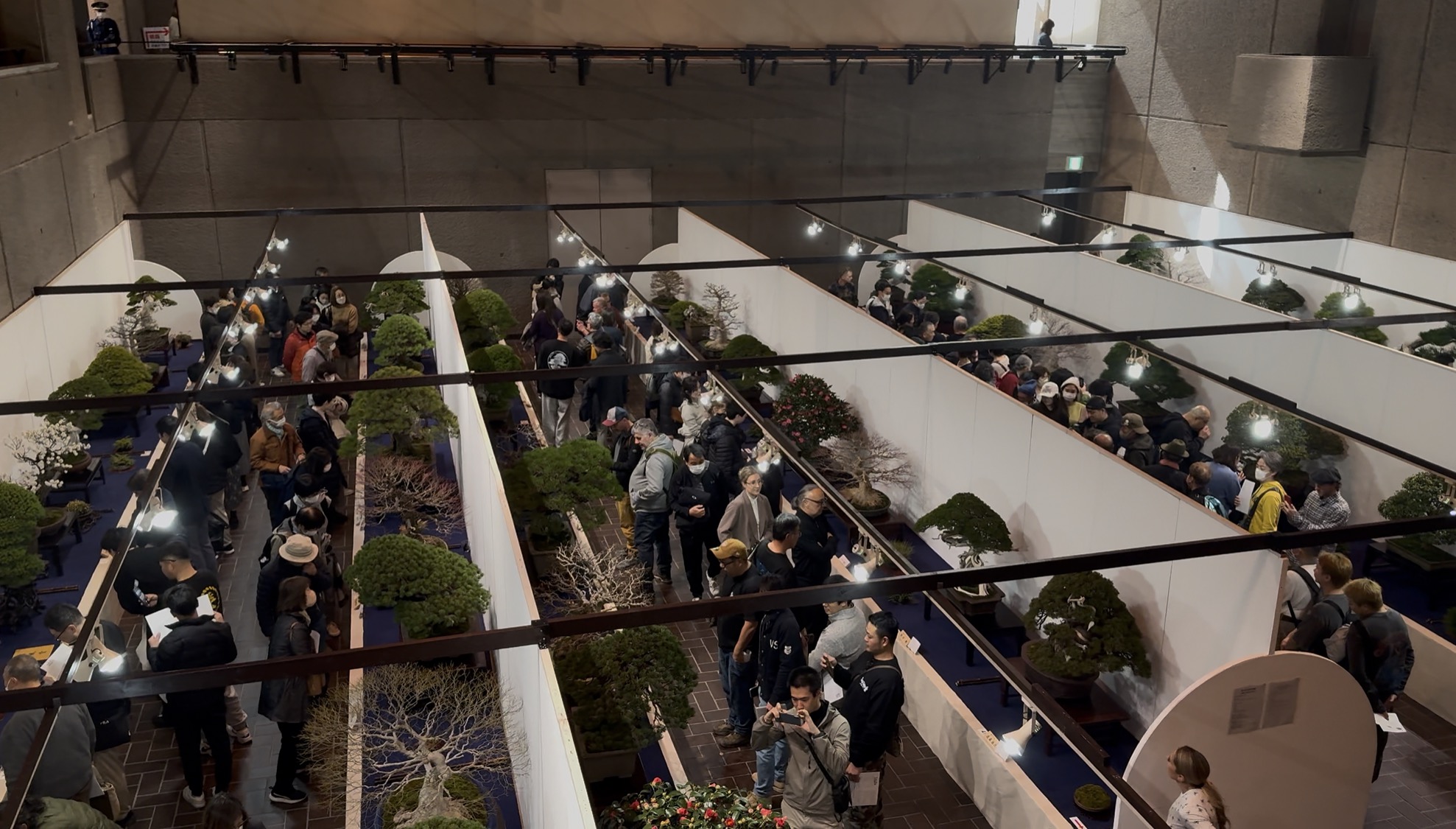
A World Bonsai Convention is less like a trade show and more like a shared workbench spread across several days. Master growers give live demonstrations, working a tree in front of an audience the way a master class works a piece of music. Exhibition halls display trees brought by collectors and professional gardens, often including species and styles specific to the host region rather than Japan alone. Vendors sell tools, pots, and trees. And delegations from each WBFF region meet formally to plan the cycle ahead, including where the next convention will be held.
None of this requires a shared first language. Wiring a branch, judging the taper of a trunk, and reading the health of a root system are skills that translate through the hands before they translate through speech — which is part of why a convention built around demonstration, rather than lecture, has managed to hold together enthusiasts from several dozen countries for more than three decades.
Saitama, twice
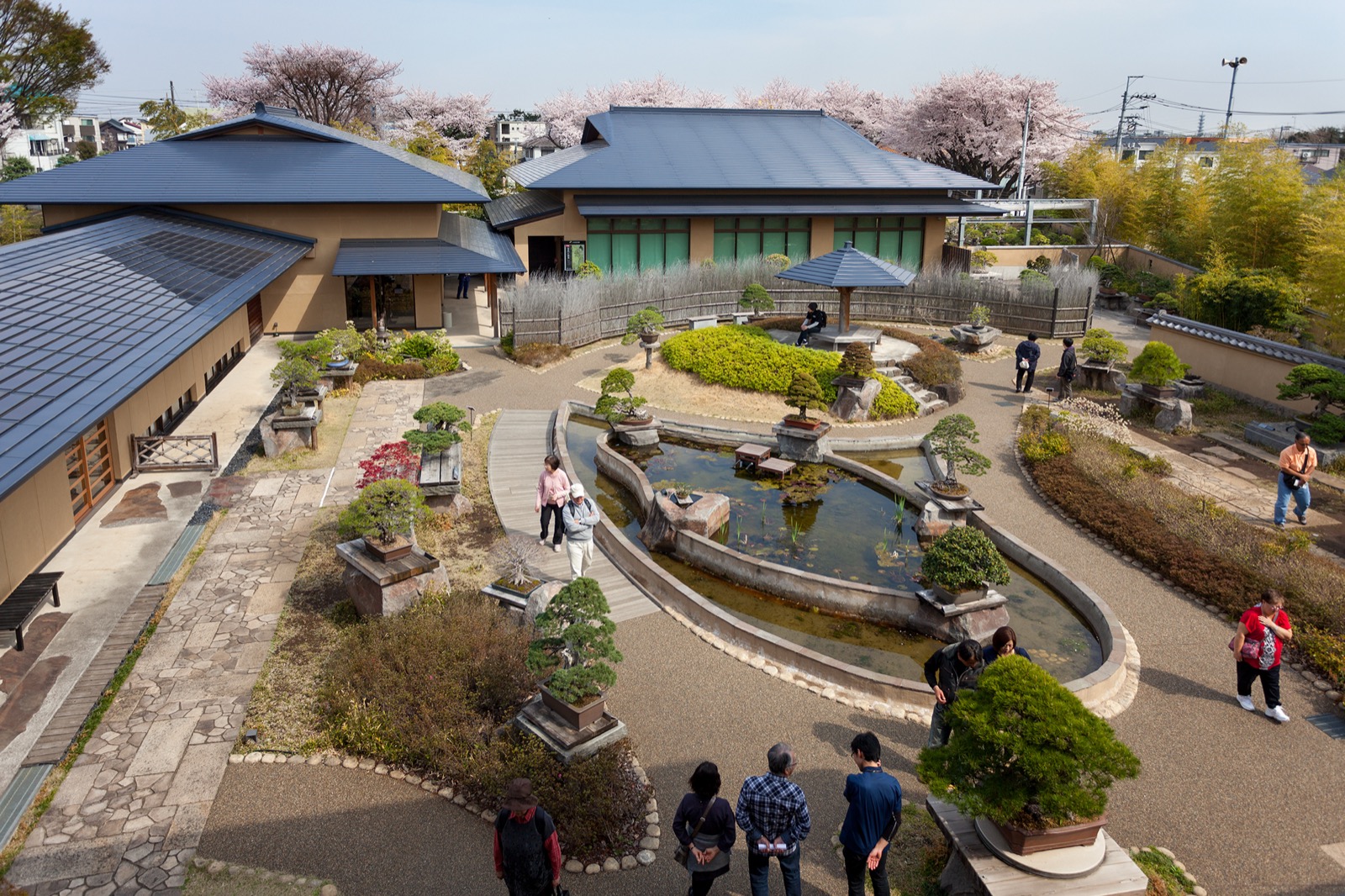
The garden of the Omiya Bonsai Art Museum, in the district where the first World Bonsai Convention was held in 1989. Photo by TypeZero, CC BY-SA 4.0, via Wikimedia Commons — Source

Saitama is the one city to have hosted the convention twice, and the gap between those two visits says something about how much changed in between. When the eighth World Bonsai Convention returned to Saitama in April 2017, twenty-eight years after the first, it filled the Saitama Super Arena rather than a single exhibition hall. Organizers and local reporting put total attendance across the convention and its related public exhibitions at a reported figure near 120,000, drawn from more than 40 countries and regions — figures that vary somewhat by which concurrent events are counted, but that agree on one point: what had been a gathering of a little over a thousand delegates in 1989 had grown, within a single generation, into a public event on an entirely different scale.
That is not a story about Japan rediscovering bonsai. Japan never stopped practicing it. It is a story about how many more people, in how many more countries, now have a reason to travel toward it.
A hobby that no longer needs a passport to belong to
None of this means bonsai has become placeless. Every one of these conventions still gathers, in the end, around trees that were shaped in Japan and around techniques that were refined there over centuries — a fact reflected in how often the event returns to Japanese soil, and in how central Japanese demonstrators and reference trees remain even when the venue is Munich or Perth. What has changed is who gets to stand in the room. We look at that wider picture — the clubs, climates, and species that have taken root well beyond Japan — in Bonsai Around the World. And for a sense of what a flagship exhibition inside Japan itself looks like, distinct from the traveling international convention, our report on the 100th Kokufu Bonsai Exhibition covers Kokufu (国風, "the customs of a nation") — Japan's own annual show, held every year on home ground, rather than once every four years on a rotating one.
The two events are not competitors. Kokufu is where Japan's most historic trees are shown to the world that comes to see them. The World Bonsai Convention is where the rest of the world takes its turn hosting the conversation.
Closing
A convention, in the end, is only a few days long. What it makes visible lasts much longer: a network of growers, several regions deep, who have spent more than three decades choosing to keep meeting in person rather than let bonsai stay a set of isolated national hobbies. Most of the actual work still happens the rest of the time, in quiet gardens, one tree and one season at a time — in Japan and, increasingly, everywhere else the convention has ever landed.
Azukari is one way to stay close to that quiet, everyday work even between conventions — a single tree, still growing under a Japanese artist's care, with its owner kept in touch through the seasons rather than through a once-every-four-years trip.
References
- WBFF — History of WBFF — founding context, and the full list of World Bonsai Convention host cities from 1989 through the 2026 Kuala Lumpur edition.
- WBFF — World Bonsai Friendship Federation — WBFF's mission, its nine regional bodies, and the four-year World Bonsai Convention cycle.
- Omiya Bonsai Village — History — attendance and country figures for the first World Bonsai Convention (Omiya, 1989) and the eighth (Saitama, 2017).
- Prairie State Bonsai Society — 9th World Bonsai Convention — details on the 2022 Perth-hosted convention held virtually because of pandemic travel restrictions.
- WBFF — 2026 10th World Bonsai Convention — dates, venue, and host region for the upcoming Kuala Lumpur convention.