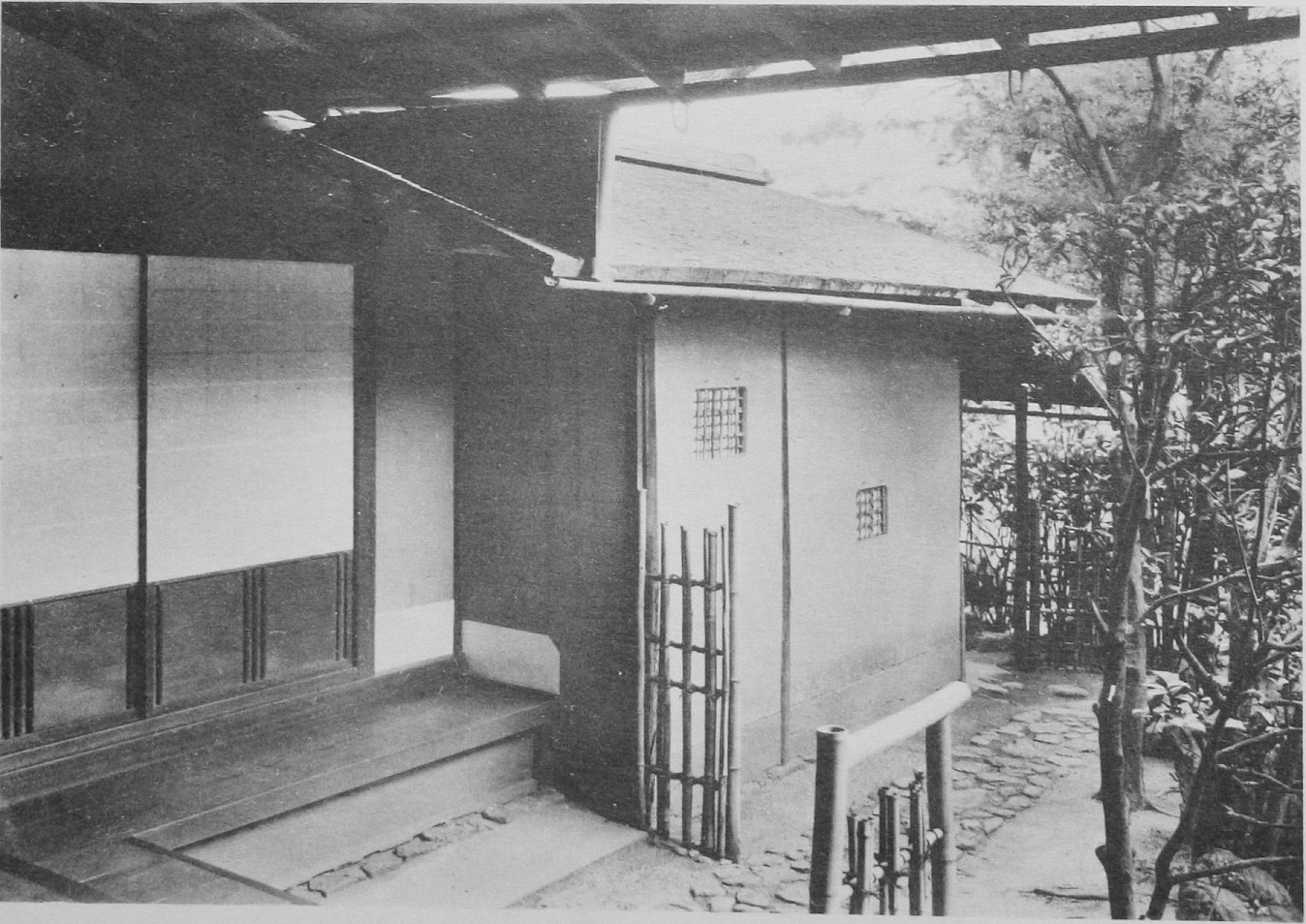
At Myokian, a modest Zen temple on the border between Kyoto and Osaka, stands a tea room named Taian. It measures two tatami mats — roughly the footprint of a large closet. It is the oldest surviving tea room structure in Japan and one of only three tea rooms designated a National Treasure, and it is the only one of the three that can be believably attributed to Sen no Rikyu, the sixteenth-century figure who did more than anyone else to define what a Japanese tea ceremony is. Visitors today can only look in through its low entrance; the interior stays closed to foot traffic, preserved rather than used.
Rikyu had every resource a larger room would have required. He built a two-mat room anyway.
Rikyu chose the size on purpose
By the late sixteenth century, tea gatherings among Japan's ruling and merchant classes had already produced grand rooms — four and a half mats was an established standard, and some patrons built far larger. Rikyu served as tea master to the warlord Toyotomi Hideyoshi and had access to whatever a bigger room would have cost. Temple tradition holds that Hideyoshi first had Rikyu build a two-mat tea room in the castle town near Yamazaki after his decisive victory there in 1582, for the tea gatherings held in the campaign's aftermath; the structure was later moved to its present site at Myokian. The two-mat size came from Rikyu's own decision to remove rather than add — the same instinct that decides, on a wholly different scale, how far to let a branch grow or where to end a trunk.
A patron with Hideyoshi's means could easily have afforded a bigger room. His tea master chose to build a smaller one. That gap, more than anything else in the story, is worth sitting with before the room itself is even considered.
Every remaining element becomes the room's whole subject
Once a space is reduced this far, almost nothing in it is accidental. A four-and-a-half-mat room leaves a guest room to sit at a polite distance from the host, space for a second alcove, some visual slack. Two mats leave none of that: the host kneels at the hearth, the principal guest kneels at the mat's edge, and the distance between them is fixed by the room itself, not by anyone's choice on the day.
What Rikyu kept, in that reduction, was the same handful of elements every tea room needs — a hearth, a place for the scroll and flower in the tokonoma (床の間, a recessed alcove where a hanging scroll or seasonal arrangement is displayed), a wall, a guest, a host — concentrated into a space with room for nothing else. Strip a room down to two mats and each of those elements becomes close to the room's entire subject. Taian's mud-plastered walls, left rough and unevenly finished rather than smoothed to a uniform surface, are usually read the same way: a decision to let the texture of the material itself stand as one of the room's few remaining things to look at.
The entrance strips away rank before it strips away a sword
The best-known feature of a room in this tradition is its entrance. Rikyu is closely associated with popularizing the nijiriguchi (躙り口, a small crawl-through entrance set low in a tea room's wall, through which a guest must stoop and bend to pass), and Taian is the oldest surviving example of a tea room built around one. It is small enough — well under a meter in either dimension — that no one can walk through it upright, and no one can carry a long sword through it at all.
That second fact mattered more in Rikyu's Japan than the first. A guest arriving at a tea gathering in the late sixteenth century might be a samurai of considerable rank, accustomed to entering most rooms with a sword at his side and a retinue announcing his status ahead of him. None of that fits through the nijiriguchi. The sword stays outside. The retinue stays outside. What is left is a person on hands and knees, head lowered, entering a room built for two — where a merchant host could outrank his samurai guest in every way that mattered inside those walls. The doorway did the work on its own: a body that has to crawl to enter cannot carry its rank in with it.
A small room concentrates instead of shrinking
A bonsai in a small pot is often mistaken for a shrunken tree, as if the smallness were a limit the tree had failed to grow past. Taian suggests a different way to judge it: judge a small form by what it has been made to carry. A large garden holds a mountain, a river, a stand of trees, spread across enough ground that the eye takes them in one at a time. A bonsai holds the same elements — trunk, branch, root, the weathered bark of age — inside a container a person can lift with two hands, where every one of those elements has to be legible at once.
The next time you come across something that looks too small to matter — a room, a pot, a plan — ask what it has been forced to keep. That question tells you more than counting what it left out. Two tatami mats did not make Rikyu's tea ceremony smaller than it deserved to be; they made the ceremony the only thing left in the room. A bonsai makes the same wager every time it holds a large tree's whole character inside a pot built to sit on a shelf: not a smaller version of the tree, but the tree with nothing left to hide behind.
For more on the discipline of removing rather than adding, see "Bonsai Is Not a Small Tree," and on the deliberate use of empty space that a room this size depends on, "What Is Ma."
References
- Kyoto Prefecture — "National Treasure" (Visit Kyoto Yamashiro) — official prefectural tourism page confirming Taian as one of three National Treasure tea rooms, its two-tatami interior, and its attribution to Sen no Rikyu.
- Tai-an — Wikipedia — overview of Taian's location at Myokian in Yamazaki, its 1582 construction, two-tatami design, and National Treasure designation.
- Oyamazaki Tourist Information — Myokian and the Taian tea room — local history of Myokian temple, the Battle of Yamazaki, and the tradition that Hideyoshi had Rikyu build the two-tatami tea room later moved to the temple.
- Kyoto Prefectural Tourism Federation — Myokian (National Treasure "Taian") — official listing of Myokian and Taian as a National Treasure site in Kyoto Prefecture.
- Wikimedia Commons — Category:Tai-an — public domain historical photographs of Taian at Myokian, including the images used in this article.