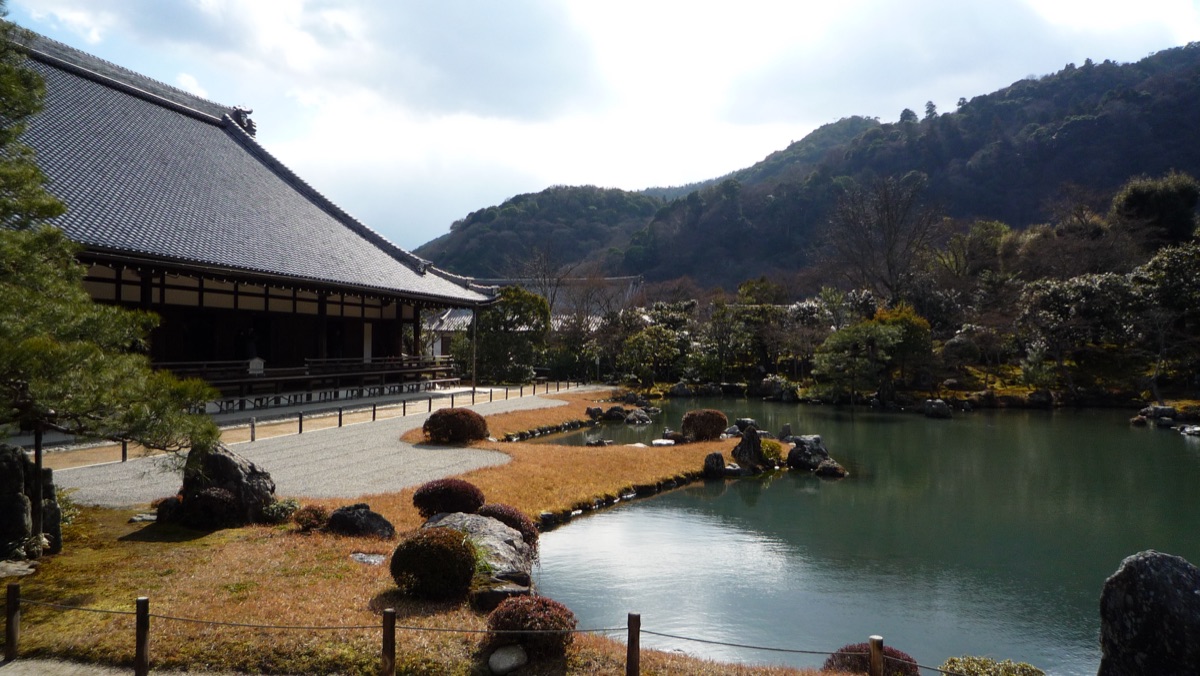
Stand at the edge of the pond in Tenryu-ji's Sogenchi Garden in Kyoto and the far bank is closed off by Mt. Arashiyama and Mt. Kameyama — two mountains the temple has never owned so much as a slope of. The record of that borrowing reaches back to the Kamakura period (1185–1333), before the technique that explains it even had a name.
That technique, shakkei (借景, "borrowed scenery," designing a landscape outside a garden's boundary into its composition), rests on an unusual premise: the most decisive element in a garden is very often something the garden does not own.
Most garden traditions treat a boundary as a fixed fact — a wall gets a trellis, a hedge gets trimmed, and the eye is expected to stop where the property stops. Shakkei rejects that premise. It works from the assumption that a garden's real edge is wherever the eye actually stops looking, and that this edge can be pushed past the fence, past the road, past the town, all the way out to a mountain whose deed the garden's owner will never hold.
A mountain nobody owns is doing the garden's real work
At Tenryu-ji, the temple's own account of the garden confirms exactly this. The Sogenchi Garden, it explains, "employs 'borrowed scenery' (shakkei), in which nearby mountains are used to give the garden a sense of added depth." Whatever line separates temple land from everything past it plays no role in how the garden actually reads to a visitor. The mountains stay on the far side of that line. The view they produce does not.
A designer working in this tradition is not primarily choosing plants. The plants are foreground — a means of arranging where a viewer's eye is allowed to land before it travels on to a peak the garden could never have built for itself.
Being taken in alive is not the same as being borrowed
It is tempting to read shakkei as borrowing in the ordinary sense — as if a garden were quietly using a neighbor's view, the way one might borrow a cup of sugar and mean to give it back. The older Japanese name for the technique makes clear that this isn't quite right.
Before shakkei became the standard term, the practice was known as ikedori (生け捕り, "taking alive," as in capturing a wild animal without killing it). According to the Yuanye (園冶), the seventeenth-century Chinese garden treatise where the concept of borrowed scenery first appears in writing, and the design tradition that carried it into Japan, ikedori claims something stronger than "we can see the mountain from here." It claims the mountain itself is captured — alive, whole, unaltered — into the garden's composition. Not purchased. Not moved. Taken in, the way a falconer takes in a hawk and later lets it fly.
That is the discipline the technique enforces: nothing may be built, planted, or bought to manufacture the borrowed view. The mountain has to already be there. A designer's entire contribution is the foreground — a pond's edge, a line of trees, the height of a hedge — arranged so a viewer's eye is walked, without noticing the walk, from the garden's own soil to a slope the garden will never touch. At Tenryu-ji, the borrowing of the Arashiyama hills was reportedly already part of the garden's design in the Kamakura period, long before the word shakkei came into use. The technique reached its widest currency in temple gardens of the Muromachi period (1338–1573) and continued through the Edo period (1603–1868), always on the same terms: the view is composed, never possessed.
The hedge decides whether the boundary disappears
The craft of shakkei is, in practice, mostly the craft of hedges, walls, and sightlines — deciding exactly what a garden's edge is permitted to show and to hide.
Entsu-ji, in northern Kyoto, is one of the clearest surviving demonstrations. Its garden — a flat expanse of moss set with some forty stones — was laid out in the early Edo period on the site of a former imperial villa built for the retired Emperor Go-Mizunoo. Kyoto's own tourism authority describes it as a shakkei garden that draws Mt. Hiei into view through a foreground of trimmed hedges and the temple's own veranda pillars. The hedge is not decoration. It is calibrated to two conflicting demands at once: low enough that Mt. Hiei's gentle ridgeline reads as a continuation of the garden's own contours, and high enough to hide the roads, houses, and rooflines sitting in between. Cut a few centimeters differently, and the same mountain turns back into scenery on the far side of a fence. Cut this way, it becomes the garden's own far edge.
That sensitivity to a manufactured boundary is also why shakkei is so fragile in practice. A borrowed mountain stays borrowed only for as long as nothing new rises between the garden and the peak, which is reportedly why Kyoto has at points restricted building height and rooftop design around gardens like Entsu-ji's. Remove the framing, and the same mountain reverts to being just a mountain, with no garden pulling it into a composition. A few meters of unplanned construction can undo what centuries of hedge-cutting built.
This is the test worth carrying out of the garden and into anywhere else the same trick gets attempted: look for the seam where what is owned ends and what is borrowed begins. A shakkei garden succeeds exactly to the degree that you cannot find it.
A pot can borrow a landscape that was never real
A bonsai runs on the same instinct, folded inward. A garden borrows a real mountain standing somewhere past its wall. A bonsai borrows a landscape that stands nowhere at all — a coastal cliff, an alpine ridge, a forest edge worn by decades of wind — and asks a viewer to supply it, unbuilt, around a single tree in a container a few centimeters wide.
Look at a well-trained kengai (懸崖, "cliff-hanging," a cascade style in which the trunk falls below the rim of the pot), and the pot itself all but disappears from consideration. What holds attention is the cliff the tree implies: the drop of the trunk reads as the drop of a rock face, and the pot's rim reads as the edge the tree hangs from, not as a container. Nobody built that cliff. It exists only because the trunk's angle and the thinning of the branches toward the tip borrowed it into being — the same maneuver a trimmed hedge performs on a mountain's silhouette, worked in wood instead of leaves.
A garden's designer arranges a hedge so a real mountain reads as belonging to the garden. A bonsai artist arranges a trunk and its branches so an imagined mountain, forest, or shoreline reads as belonging to a single tree. Both spend years training a viewer's eye to complete a landscape neither of them built.
We write more about how a bonsai paints a landscape inside its pot in Bonsai Is Not a Small Tree, and about the imagination that completes it in What Is Mitate.
An Azukari tree borrows in the mirror direction. It stays on soil its owner will likely never set foot on, tended daily by an artist the owner may never meet, and what crosses that distance is not the wood or the pot — it is the record of the view, arriving season by season. Four centuries of shakkei practice make the same case about a mountain: a view held this way is not a lesser kind of holding. It can be the most decisive one there is.
References
- Tenryu-ji Temple, Kyoto — "Precincts" — the temple's own account of the Sogenchi Garden's use of shakkei to bring nearby mountains into the composition.
- Wikipedia, "Borrowed scenery" — on the term's origin in the Chinese garden treatise Yuanye, its use at Tenryu-ji dating to the Kamakura period, and its spread through Muromachi and Edo-period gardens.
- Kyoto City Official Travel Guide — Entsu-ji — municipal tourism authority description of Entsu-ji's shakkei garden borrowing Mt. Hiei through hedges and its founding in the early Edo period.
- Bowdoin College, "Japanese Gardens — Elements: Borrowed Scenery" — academic overview of shakkei as a design principle and Kyoto's mountain-ringed geography as its natural setting.