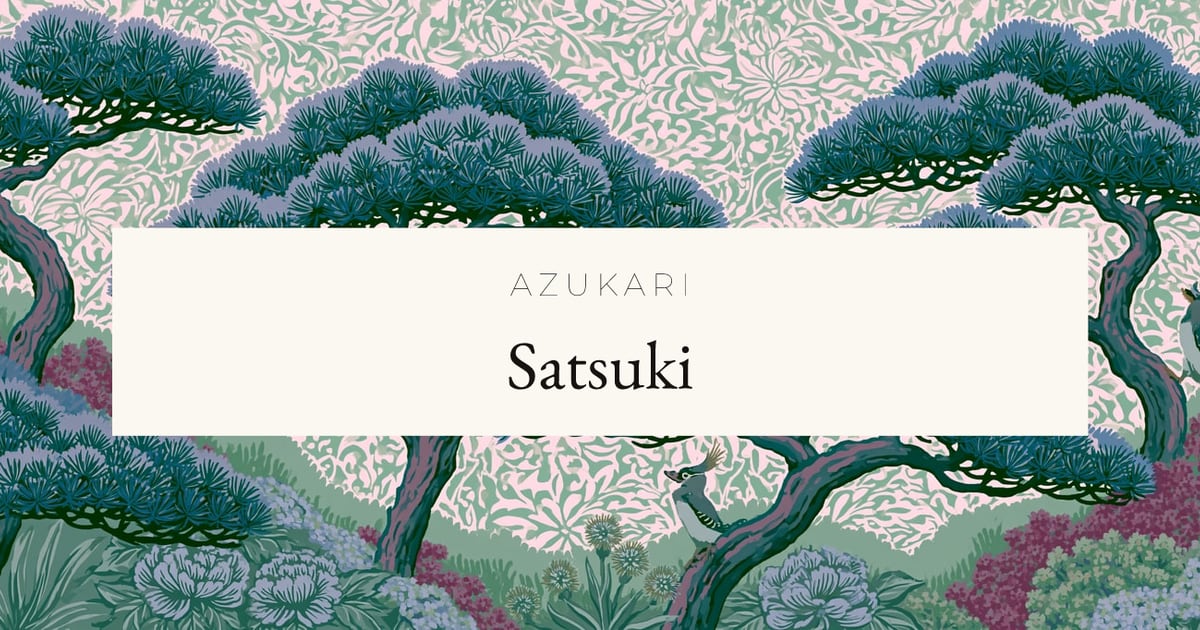
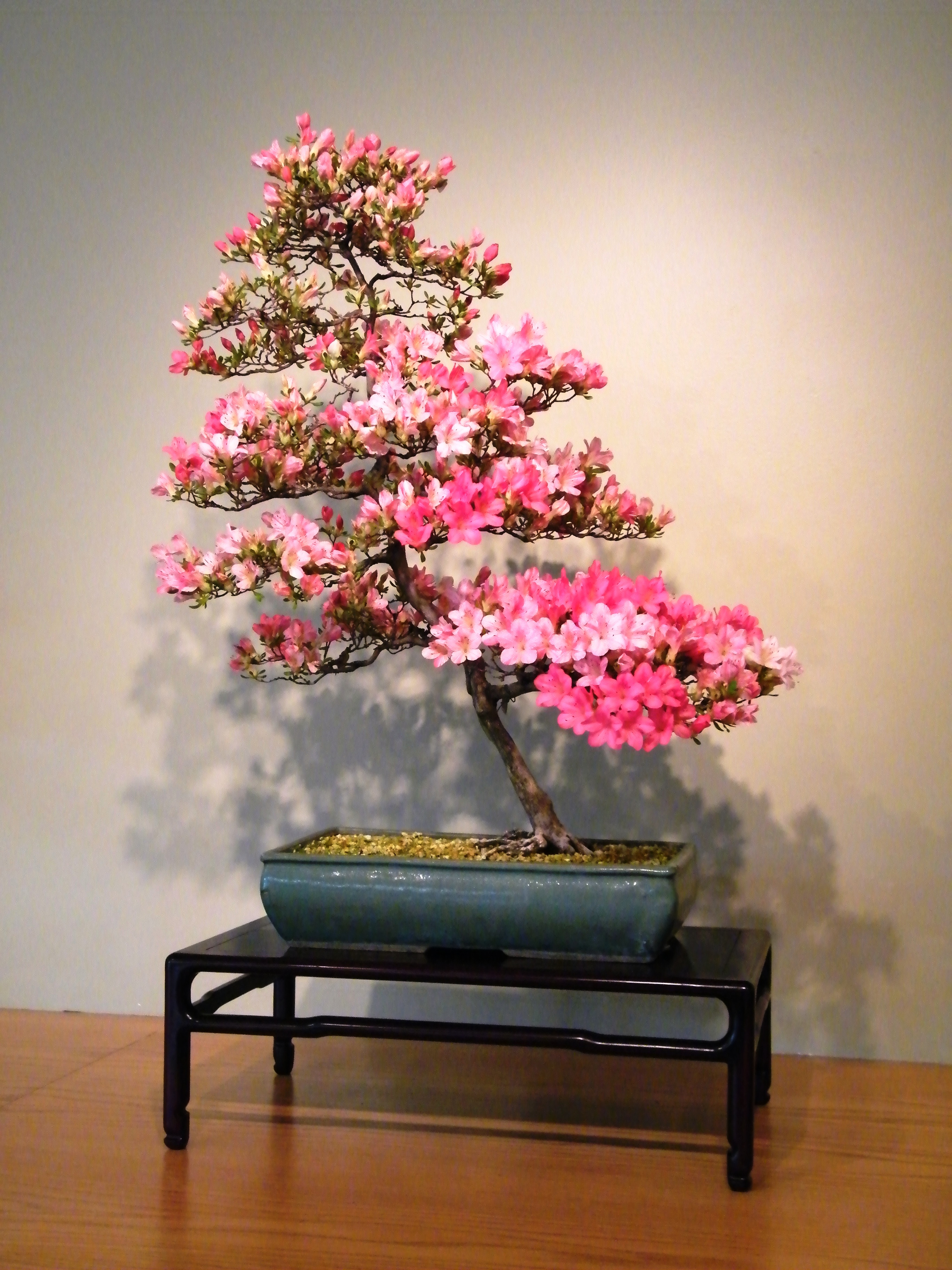
A satsuki azalea bonsai in full bloom. Photo by Sarah Stierch, CC BY 4.0, via Wikimedia Commons — Source

Walk past almost any hedge in a Japanese neighborhood in early summer and there is a good chance you are looking at the same plant that, a few streets over, is being trained on a display stand with the kind of care usually reserved for centuries-old pine. This is satsuki (皐月, "the fifth lunar month," the name given to the plant for its late bloom), a group of evergreen azaleas that occupies a place in bonsai unlike almost any other tree.
Satsuki is less a single species than a horticultural category built largely by amateurs, carrying more documented flower varieties than any other bonsai subject, capable of opening more than one color from the same branch, judged each year at exhibitions built for no other tree, and standing more openly than any other bonsai subject on the line between the ordinary hedge and the display bench.
A name from horticulture, not botany
Satsuki belongs to the genus Rhododendron, and botanists generally trace the group's origin to natural hybrids of two related mountain species, Rhododendron indicum and Rhododendron tamurae. But "satsuki" itself is not a strict botanical rank. It is a horticultural grouping, defined less by ancestry than by habit: unlike most other azaleas in the same genus, which flower before or alongside their new leaves, satsuki opens only after its new spring growth has already emerged, typically from May into June or July of the old lunar calendar — which is exactly where the name comes from. Japanese growers have refined the group for at least five hundred years, according to the Azalea Society of America, long enough for "satsuki" to have become less a description of one plant than a name for an entire cultivated tradition.
More cultivars than any grower will see in a lifetime
That tradition shows most clearly in sheer number. Sources differ on an exact count — Wikipedia describes "thousands of different varieties," while Japanese satsuki dictionaries are said to catalogue roughly a thousand cultivars per volume, and one long-running Japanese bonsai reference puts the current total above two thousand named varieties. What the sources agree on is who bred them. The great majority, by most accounts, were not the work of professional nurseries but of amateur enthusiasts working in their own gardens, several bonsai guides note that in Japan two or three periodicals are devoted to satsuki alone, and that some hobbyists grow nothing else. The scale of that hobbyist attention peaked in the boom years of the early 1970s, when Japanese production is reported to have reached roughly three million plants a year — a wave of amateur breeding that no other bonsai species has seen.
One branch, more than one color
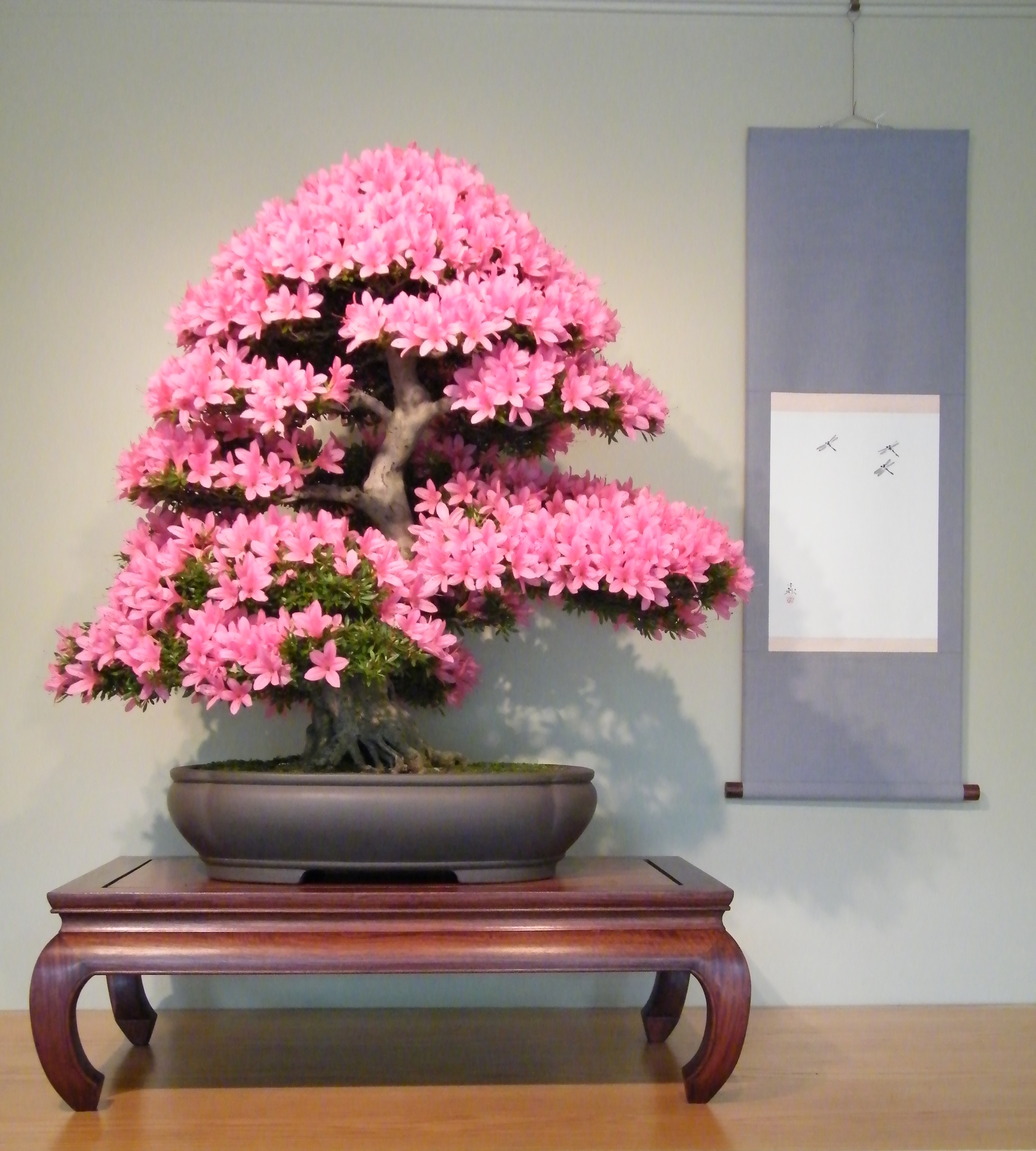
A satsuki azalea from the National Bonsai & Penjing Museum's Japanese Collection, donated by Shogo Watanabe. Photo by Sarah Stierch, CC BY 4.0, via Wikimedia Commons — Source

Part of what keeps that breeding culture active is a genuine biological oddity. Many satsuki cultivars descend from mixaploid parent plants — specimens whose growing tip carries more than one chromosome count in different cell layers — which leaves the plant prone to what growers call "sporting," a spontaneous shift in flower color or pattern that can appear on a single shoot without any cross-breeding at all. Depending on where and when the shift occurs, the result can be a solid new color across an entire branch, a striped or fleck-patterned bloom, or a white-throated flower with a picotee edge. Japanese growers have their own word for the most striking version of this, sakiwake (咲き分け, "flowering in different colors" — the same plant, and sometimes the same branch, opening two or more distinct colors in a single season). It is not something a breeder designs so much as something a grower waits for, which is part of why individual satsuki, not just cultivars, can become locally famous for what they do in a given year.
A show built for nothing else
That waiting has its own calendar event. Every May, the Japan Satsuki Association stages the Satsuki Festival at Tokyo's Ueno Park and the adjoining Ueno Green Club, an exhibition devoted entirely to satsuki in bloom; the 2026 edition, held over five days in mid-May, is reported to be the 78th in the festival's history, which would place its origins in the years just after the Second World War. A companion autumn show, held without flowers and focused purely on trunk and branch structure, follows later in the year. Smaller, regional versions of the same idea exist down to the neighborhood level — one long-running satsuki club in Tokyo's Setagaya ward has held its own exhibition at a local temple for years. None of this overlaps with Japan's broader bonsai calendar, built around shows such as the pine- and conifer-heavy Kokufu-ten. Satsuki, in effect, runs its own season.
Where the hedge ends and the bonsai begins
All of which points to the same underlying fact: satsuki has never fully left the garden for the display bench. Its tolerance for hard, repeated shearing is exactly what makes it useful as clipped hedging and rounded shrub massing throughout ordinary Japanese landscaping, the same trait that makes it possible to build dense, fine-branched bonsai canopies. The two uses share one plant, one set of techniques, and — because so much of the cultivar development happened outside professional bonsai circles — much of the same amateur community. Few other bonsai species are, at once, this common along a suburban street and this closely studied at a specialist show.
Closing
None of this is unusual for satsuki. It is what the plant has always been asked to do — hold a shape under the shears, carry a name earned by its bloom, and occasionally surprise the person tending it with a color no one planted on purpose. What is unusual is how much of that history was written not by professional ateliers but by ordinary growers, season after season, patiently recording which branch did what.
At Azukari, that same attentiveness applies regardless of species. Flower bonsai more broadly call for a kind of seasonal watching that conifers rarely demand, and satsuki asks for it more than most — a reminder that not every valuable tree needs to be rare to reward the years spent with it. Some Azukari readers first meet flowering bonsai through easier, forgiving species like chojubai; satsuki is simply where that same patience is asked to go further.
References
- Wikipedia — Satsuki azalea — parentage from Rhododendron indicum and R. tamurae, at least 500 years of hybridization in Japan, "thousands of different varieties," the name's origin in the fifth lunar month, and same-plant color pattern diversity.
- Azalea Society of America — Satsuki Azaleas — parentage confirmation, roughly 1,000 cultivars catalogued per Japanese satsuki dictionary, and description of solid, striped, flecked, and picotee color patterns.
- Bonsai Science — "Mysterious Mixaploids: Satsuki Azaleas and Their Mixed Up Flowers" — the mixaploid genetic basis of satsuki flower-color sporting, the role of transposons, and how solid, striped, and flecked patterns form.
- Bonsai4Me — Rhododendron Species / Azalea Bonsai — Japanese periodicals devoted solely to satsuki and enthusiasts who grow satsuki exclusively.
- Kimi no Mini Bonsai Biyori — "The Appeal of Satsuki" — over 2,000 named cultivars mostly bred by amateur enthusiasts, the early-1970s production boom of roughly three million plants a year, satsuki as a horticultural (not strictly botanical) designation, and the sakiwake same-plant color-mixing phenomenon.
- Tokyo Fesuta — "The 78th 2026 Satsuki Festival" — the Japan Satsuki Association as organizer, the festival's 78th edition in 2026, and its Ueno Park and Ueno Green Club venues.