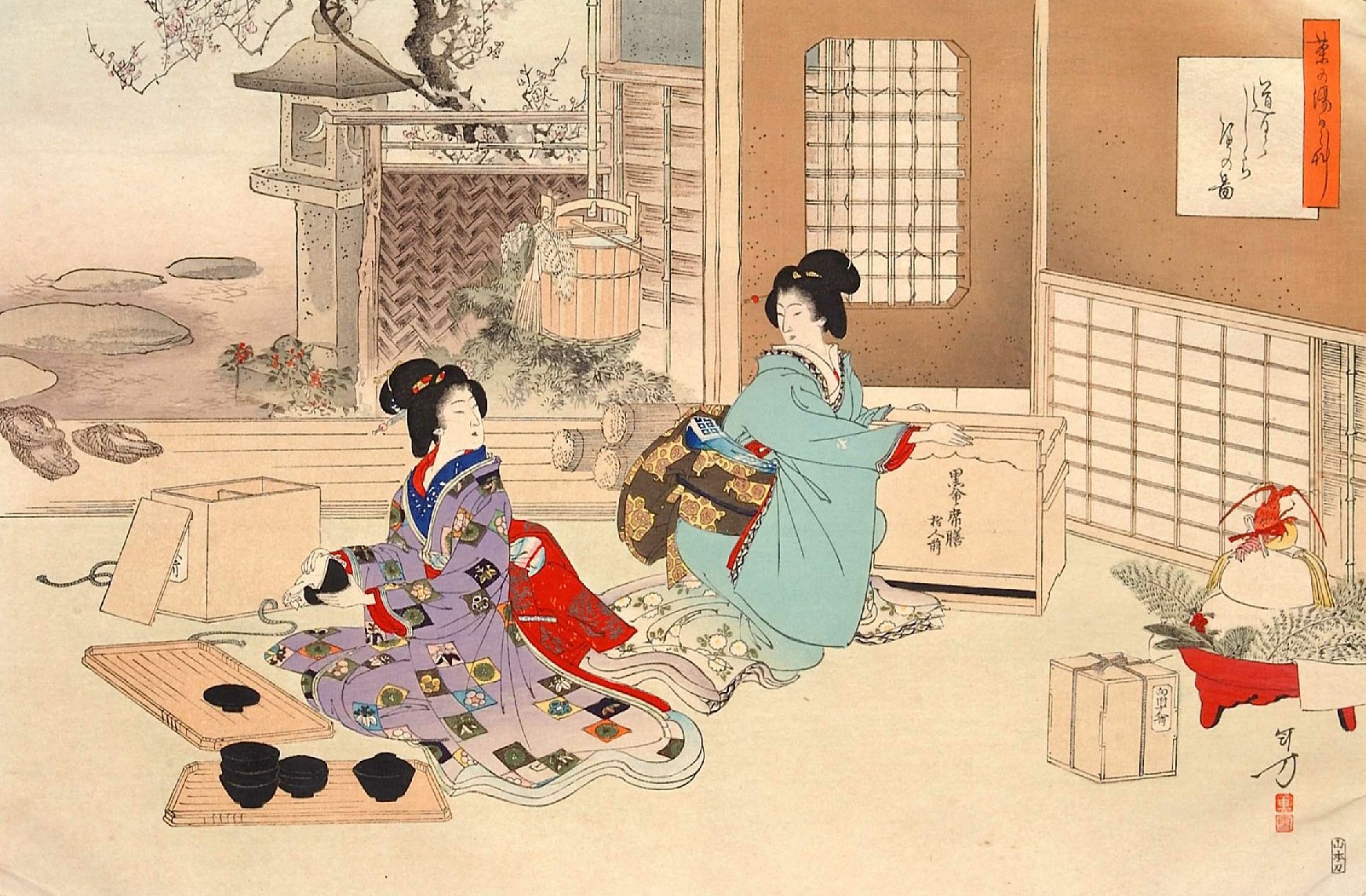
Twenty years. That is roughly how long it takes a student at Urasenke, one of the three main lines of the Sen family of tea, to move from first initiation to full transmission of the school's practice. No single teacher lives to watch that span run its full course for every apprentice who walks through the door. Something has to hold the form steady across the gap between one teacher's working life and the next. In tea ceremony, flower arranging, and Noh theater, that something has a name: the iemoto (家元, literally "the origin of the house," the hereditary head of a school of art).
The iemoto system is a piece of institutional engineering: a fixed point that lets a form hundreds of years old pass from one generation to the next without drifting away from itself.
The title looks, from outside, like something close to a guild master, and the title is real. Its purpose sits closer to conservation than to status. Tea ceremony, ikebana, and Noh have each carried a recognizable form across four centuries and more, through war and the remaking of Japanese society. That continuity happened because someone, generation after generation, was made responsible for it.
Four schools converged on the same design
Every one of Japan's major traditional arts — tea ceremony (chado, 茶道, "the way of tea"), flower arranging (ikebana, 生け花, "living flowers"), Noh theater, calligraphy, the incense ceremony (kodo, 香道, "the way of incense"), and several schools of dance and music — organized itself, by the Edo period, around a single hereditary head. Historians trace precursors as far back as the Heian period, but the system as practiced today consolidated during the Edo period's long peace, when Tokugawa social stratification gave such schools both patrons and structure, reaching essentially its current form by the mid-eighteenth century. These art forms did not so much copy the idea from one another as arrive at the same design under the same pressure: a form worth centuries of preservation needs one line of succession made accountable for keeping it intact.
The iemoto's job is to transmit the form, not to author it
The iemoto's role is narrower than "leader" suggests. They hold the school's inherited techniques, rule on what counts as correct practice, and authorize who may teach. A school runs through an iemoto who has taken on the obligation of handing down what was inherited, largely intact, to whoever holds the position next — which is why the twenty-year span at Urasenke exists at all. A form this detailed cannot be transmitted faster without something being lost along the way.
Ikebana followed a related path to the same discipline. The oldest lineage, Ikenobo, traces its association with flower offerings back to the Muromachi period; from it, the Edo period saw new schools open to teach evolving styles, and it was in that expansion that the iemoto structure took hold across the discipline. Noh organized into five schools of lead actor — Kanze, Hosho, Konparu, Kongo, and Kita — each headed by its own iemoto lineage, with Kanze recognized by the Tokugawa shogunate as foremost among them. Each school still guards its own style of movement, chant, and choreography as its inheritance, passed on the same way tea's twenty years are: person to person, with no shortcut built in.
Guarding the form is what makes breaking it mean something
A form preserved this rigorously might look like the enemy of invention. It is invention's precondition.
An artist who wants to depart from convention needs a convention stable enough to depart from. If every school's version of a tea gathering or a Noh chant drifted year to year, "breaking the form" would carry no meaning: there would be no fixed form to measure the break against, and no audience trained closely enough to recognize what had been altered, or why. The iemoto system's insistence on an authoritative standard is what gives a later departure its meaning. A tea master's radical simplification reads as radical only against centuries of documented practice that the iemoto lineage kept legible.
This is, in effect, a division of labor across generations. The iemoto and the certified teachers beneath them hold the line on correct practice, so that a student who has already absorbed the form completely has room, later, to press against it.
A certificate makes decades of practice portable
A student's progress inside this system is not measured by opinion. It is documented, stage by stage, through certificates.
In tea ceremony, a menjo (免状, a certificate of proficiency issued for reaching a defined stage of study) marks each level of advancement, and the more advanced certificates take years of combined study — not only of the tea procedure, but of related disciplines such as kimono, calligraphy, and ceramics. Once a certified student is authorized to teach, that further credential is called a natori (名取, literally "taking a name," the license to teach and, in some schools, to use a name granted by the school). The same structure, menkyo (免許, a license to practice or teach), appears across calligraphy, painting, and the martial arts: a staged sequence of licenses that makes a student's accumulated skill legible to people who never witnessed the years behind it.
Read one way, this looks like paperwork. Read correctly, it is a trust mechanism. A certificate issued by a lineage with a known standard tells a prospective student, or a hiring patron, something raw self-report cannot: that this level of practice has been checked against the same criteria applied to everyone who holds the same certificate, going back generations.
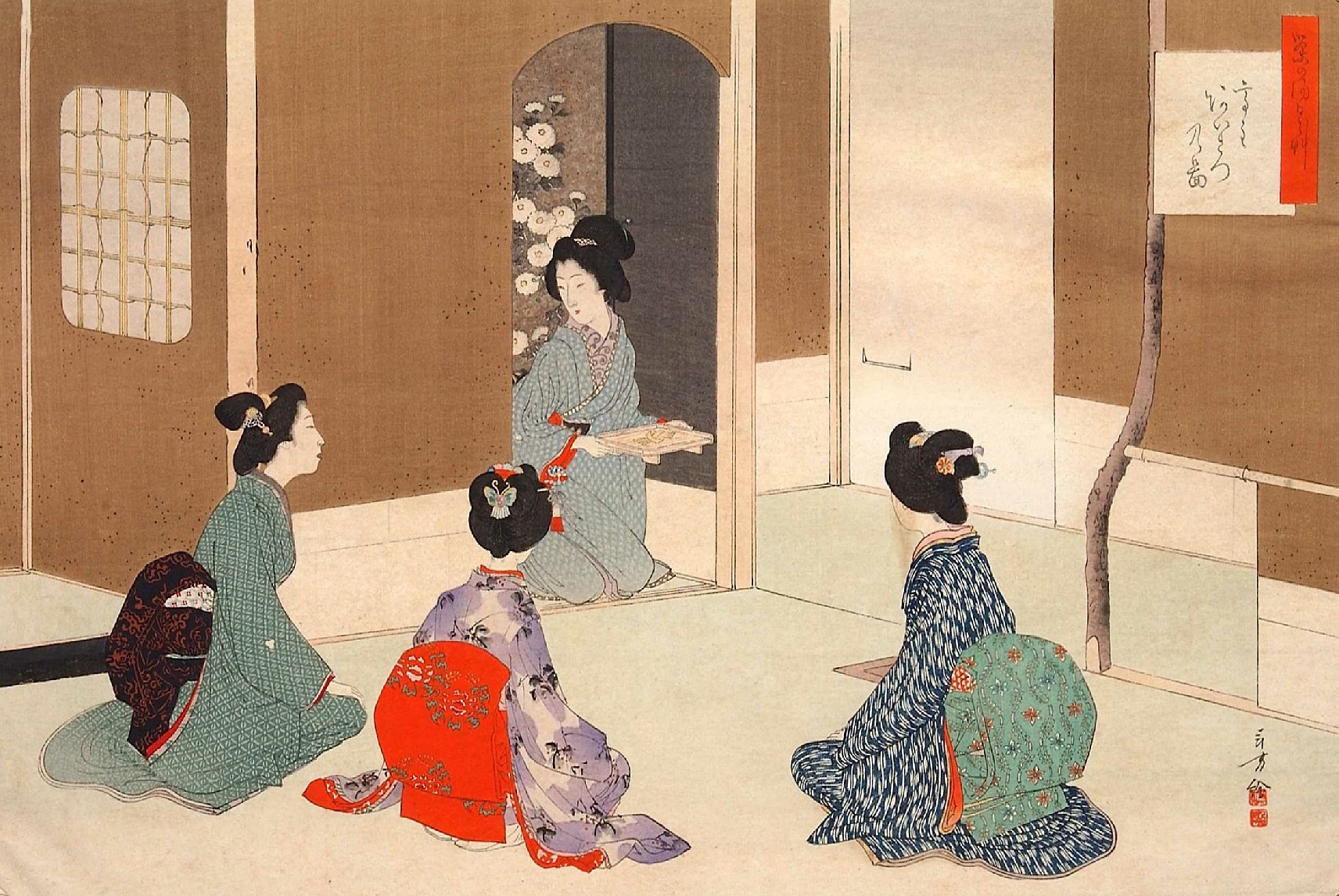
A host greets guests according to established form, from the same 1896 series. The gesture is prescribed — and precisely because it is prescribed, a trained eye can see when, and why, a particular host chooses to vary it.
Bonsai solves the same problem without a head family
Bonsai never developed an iemoto system. There is no single hereditary head presiding over the discipline nationally, no menjo for advancing stages of technique, no equivalent of a Kanze or an Urasenke claiming authority over the whole art. The comparison has a real limit.
What bonsai has instead is a garden-by-garden version of the same problem, solved more locally. Skill passes from a master to an apprentice inside a single nursery, over years of daily work — pruning, wiring, watering, reading a tree's health by eye — long before the apprentice is entrusted with shaping trees of consequence on their own. A nursery's particular way of styling a black pine, or its judgment about when a tree is ready to be shown, is passed down much as a Noh school passes down its choreography: carried in the accumulated judgment of people trained by people trained by others before them, with no manual required. The institution differs — no head family, no formal license — but the underlying structure is the one the iemoto system was built to solve: how to move a demanding, partly tacit form from one generation's hands to the next without degrading it in transfer.
What to check before trusting any lineage
The test travels beyond tea rooms and bonsai nurseries. Before trusting that a workshop, a school, or a family business is free to innovate, check who is charged with keeping its baseline correct first. A tea master's boldest simplification reads as boldness only because Urasenke kept the standard fixed enough to measure it against. A nursery's judgment about a black pine carries weight only because someone upstream refused to let that judgment drift for decades. Freedom to depart from a form is not the opposite of guarding it — it is what guarding it eventually buys someone.
A bonsai entrusted to a nursery is shaped, in this sense, by more than one artist. It arrives already carrying the judgment of whoever trained the current artist, and it will likely pass, one day, to hands trained in turn by them — the same transfer iemoto schools manage with certificates, run instead through years standing at the same bench. Japan built more than one answer to the question of how to keep a demanding tradition intact across centuries. The iemoto system is the most visible of these. A nursery's quieter lineage of apprenticeship is another, and it is the one still shaping, this season, whichever tree Azukari looks after next.
For more on how a fixed form and individual expression coexist in Japanese practice, see "What Is Kata?," our earlier piece on "The Last Generation of Japanese Masterpiece Bonsai," and our search for a second artist to carry a tree's lineage forward, Seeking the Second Artist.
References
- Iemoto — Wikipedia — overview of the iemoto system's definition, historical development from the Edo period, and its role across tea ceremony, ikebana, Noh, calligraphy, and related arts.
- Greetings from Iemoto — Urasenke Konnichian official website — official Urasenke tea school account of hereditary succession to the position of iemoto and the transmission of tradition across generations.
- History of Ikebana — Sogetsu official website — official Sogetsu school history of ikebana's development, including the Edo-period emergence of new schools and the iemoto system.
- Menkyo — Wikipedia — explanation of the menkyo licensing structure, including menjo certificates and the natori teaching license, across tea ceremony, calligraphy, painting, and martial arts.
- the-noh.com — Shite-kata (lead actor schools) — official Noh reference site describing the five lead-actor schools, each headed by its own lineage and each preserving a distinct style of movement and chant.