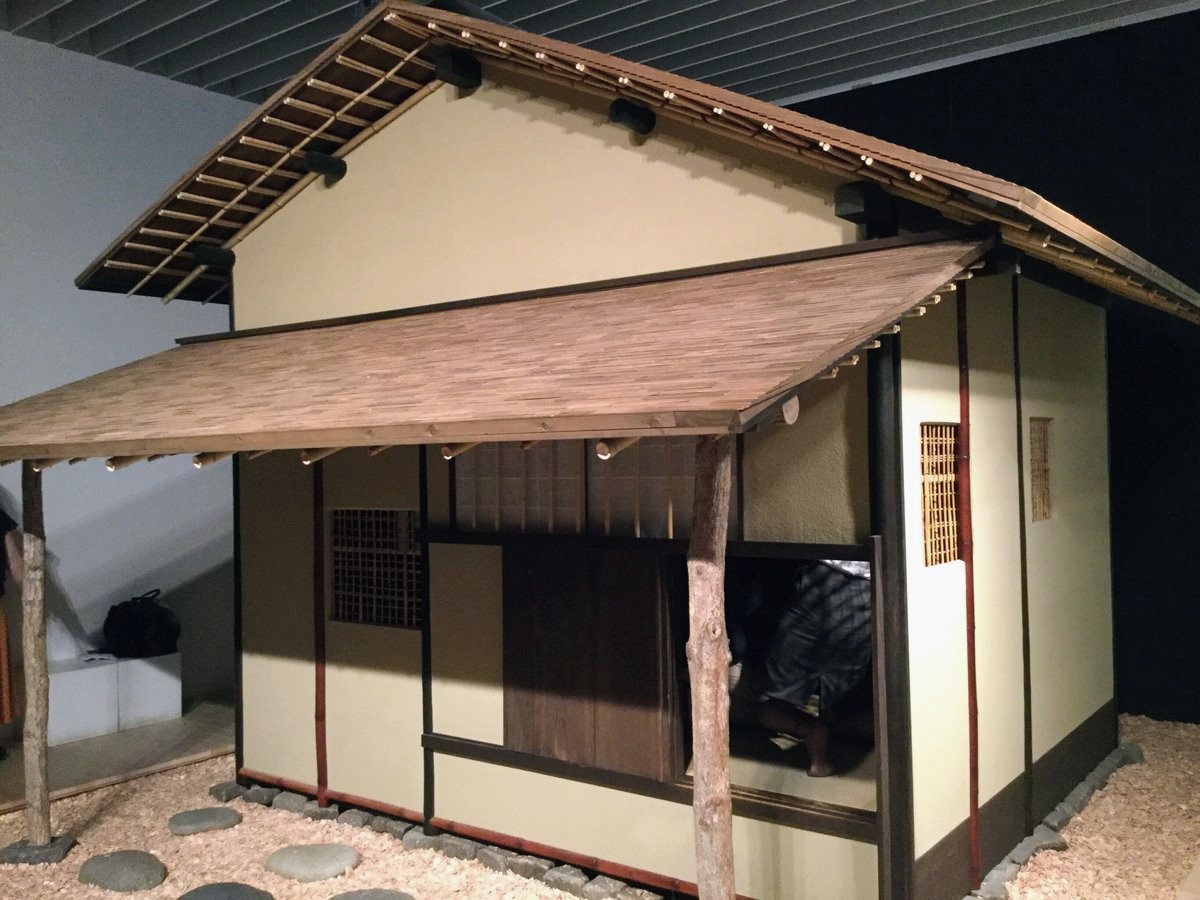
Tai-an, the tea room attributed to Sen no Rikyu (1522-1591), is two mats. That is small enough to put host and guest within arm's reach of one another, with no room for anyone to hang back. A room built to that scale makes its argument before a word is spoken: what happens here happens once, among these people, and will not be staged the same way twice. Tea practice gave that argument a name in the sixteenth century — ichigo ichie (一期一会), "one lifetime, one meeting."
The rule tea named in that room governs any arrangement made to be looked at: this exact combination of scroll, stone, and branch is up for a limited stretch, and will not be reassembled quite this way again.
A student wrote down what the master never fixed on paper
The words survive because a disciple thought them worth recording, not because the master wrote them himself. Yamanoue Soji, a student of the tea master Sen no Rikyu, set down his teacher's instruction in the Yamanoue Soji Ki (山上宗二記), a set of notes on tea practice compiled in the late sixteenth century. Among them is a line describing how a guest should approach a gathering: with the reverence due "a meeting that occurs only once in a lifetime." The idea belongs to Rikyu. It reaches us because a student wrote it down.
An elder of the shogunate gave the phrase its final shape
The words had not yet settled into the four-character form now familiar, ichigo ichie, when Soji recorded them. That took roughly two and a half centuries more, and an unexpected author: Ii Naosuke, the Tokugawa shogunate's chief minister, remembered by most historians for signing the treaties that opened Japan to foreign trade in the 1850s. Naosuke was also a serious student of tea under the name Sokan. In his treatise Chanoyu Ichie Shu (茶湯一会集, "A Collection on the One Encounter of Tea"), drafted around 1845 and completed close to 1858, he placed ichigo ichie at the very opening of the text, beside a second idea, dokuza kannen (独座観念, "sitting alone in reflection" once the guests have gone). Naosuke did not invent the phrase. He gave it the shape and the standing it has kept ever since.
Host and guest agree to set aside the idea of a next time
A tea gathering is approached as an encounter that exists exactly once.
This is not a claim that the same two people will never share tea again; they may, often, across many years. What ichigo ichie insists on is narrower, and in a way harder to hold onto: that this particular gathering — this room, this season, these guests, this state of mind in host and visitor alike — will not recur. The water drawn today is not the water of any other day. The scroll chosen for the alcove reflects a moment of thought that will not be repeated identically. Naosuke's Chanoyu Ichie Shu takes this as the starting premise of the whole practice: a host and guest may sit together many times in a lifetime, and every one of those sittings is still, in its particulars, unrepeatable. Treating an ordinary, perhaps frequent, occasion as unrepeatable is a deliberate act of attention. Both sides are asked to give up the comfort of assuming there will be another chance to get it right.
Nothing is saved for the next sitting
Because the gathering will not come again, nothing is held back for later. A host's obligations under this idea are practical rather than sentimental: choosing utensils suited to the day, attending to the charcoal and the water, arranging the room so that nothing feels careless, whether or not a guest of unusual importance is expected — because this gathering, ordinary as it may look from outside, deserves the same seriousness as any other. A guest's part is quieter but no less demanding: arriving with full attention, undistracted by the gathering that came before or the one that might come after. Naosuke's dokuza kannen extends the same care past the moment itself: after the guests leave, the host sits alone and turns the gathering over once more before letting it go. The attention given to the day does not end when the day does.
A display is arranged the same way, and for the same reason
This is the part of keido I did not expect to matter so much. Nobody at Shunkaen arranges a scroll, a stand, and a branch believing the combination will stand indefinitely. It is built for the stretch of time it is up, judged during that stretch, and then taken apart. The point of the discipline is not the tree and not the scroll on their own — it is the relationship between them, on this day, under this light, which is precisely the kind of thing that cannot be filed away and reused. A display arranged with real attention is, without anyone at Shunkaen ever using the phrase, a small chaji (茶事, "a formal tea gathering, with a full meal and multiple courses of tea") staged for whoever is standing in front of it.
The tree itself keeps the same condition even outside any formal display. What is in front of you today — this exact silhouette, this season's foliage, this particular fall of light and shadow across the trunk — will not exist in that form tomorrow. A branch thickens by some fraction. A bud opens, or a leaf falls. An artist's next pruning cut removes a line that has shaped the tree for years and will not return. We wrote about this continuous, never-finished quality in an earlier piece, "Bonsai Is Never Finished." Ichigo ichie gives that same fact a name borrowed from a different room. Keido gave me a way to see it as a discipline rather than a fact to accept: the deliberate work of arranging around a tree so that a viewer notices the unrepeatable moment instead of missing it.
If you keep a tree, or arrange anything around one, this suggests the right way to judge the day: not by what visibly changed in the tree, because most days nothing does, and not by how the display photographs afterward. Judge it by whether you treated the hour as though it would not come again.
What a season of arranging changes about looking
I go to Shunkaen some evenings, put a scroll and a branch a few centimeters this way or that, and then, within days, take the arrangement down. No version of it reconvenes. There is no folder where that exact combination waits to be reused. Tea practitioners had a phrase for this before there was a bonsai to apply it to, and a discipline of display built entirely on that phrase. Keido did not teach it to me first. It taught it to me a second time, on a tree, which is often what it takes for an idea heard once to actually change how a person looks.
For more on the aesthetic sensibility running alongside this one — appreciating things precisely because they are aging and impermanent — see our earlier piece, "What Is Wabi-Sabi."
Azukari is built on the same premise without needing to name it. A tree stays in Japan under an artist's daily hand, and what its owner receives each season is not a status update on a holding that sits still. It is the record of a series of arrangements, each of which existed exactly once.
References
- Ichi-go ichi-e — Wikipedia (English) — overview of the phrase's origin in the Yamanoue Soji Ki and its later four-character formulation by Ii Naosuke in Chanoyu Ichie Shu.
- 一期一会 — Wikipedia (Japanese) — the Yamanoue Soji Ki passage ("路地ヘ入ルヨリ出ヅルマデ、一期ニ一度ノ会ノヤウニ...") attributed to Sen no Rikyu, and the role of Ii Naosuke's Chanoyu Ichie Shu in popularizing the four-character idiom.
- 茶湯一会集 — Wikipedia (Japanese) — details on Ii Naosuke's authorship, the text's composition between roughly 1845 and 1858, and its central concepts of ichigo ichie and dokuza kannen.
- 茶湯一会集 — Kotobank — reference-dictionary summary confirming Ii Naosuke's authorship (tea name Ii Sokan), the text's dating, and its aim of returning to the spirit of Sen no Rikyu's era.
- Tai-an — Wikimedia Commons category — the tea room attributed to Sen no Rikyu, a National Treasure at Myoki-an temple in Kyoto.