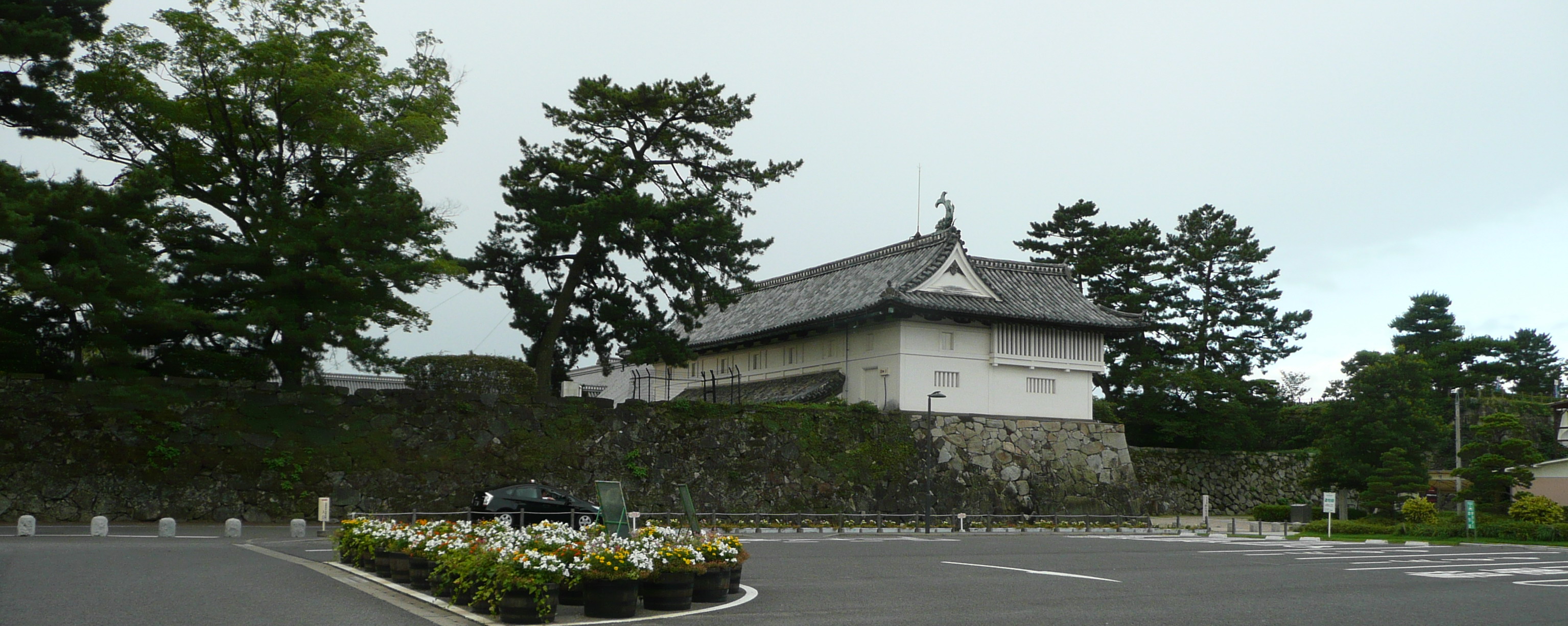
Stone wall of Saga Castle, seat of the Nabeshima domain where Yamamoto Tsunetomo served. Photo by 上条ジョー (Joe Kamijo), public domain, via Wikimedia Commons — Source

In 1700, Nabeshima Mitsushige, the second lord of Japan's Saga domain in Kyushu, died. Custom told his retainer Yamamoto Tsunetomo to follow him in death — the practice called junshi (殉死, following one's lord in death) — but the domain had already banned it. Tsunetomo retired to a hermitage instead, and years later dictated a book of counsel to a younger colleague. Its most quoted line — "the way of the samurai is found in death" — has since traveled far from that hermitage, and usually arrives with the hermitage left out.
Thinking of death, in this text, is not a wish to die. It is a discipline for living each day with full attention.
Read inside the book it comes from, the line is not a celebration of dying. It is advice for a warrior living through decades of peace, on how to keep his conduct sharp when no battle will test it. Hagakure (葉隠, "hidden among the leaves") is the record of that advice, and this piece puts the famous line back where Tsunetomo left it, to see what a soldier's meditation on death still has to say once the battlefield is gone.
Written for one domain's retainers, not for a battlefield
Hagakure was never meant for a general audience. Between 1709 and 1716, the young samurai Tashiro Tsuramoto visited Tsunetomo at his hermitage and wrote down what he said — reflections on loyalty, conduct, and the meaning of serving a lord in an age with no wars left to fight. The result, eleven scrolls in total, was compiled as private counsel for Saga retainers, not published for the wider world. For nearly two centuries it circulated quietly within the domain. Its fame is a later, and separate, story.
Settling with death frees the mind from calculation
The phrase usually rendered as "the way of the samurai is death" sits at the very start of the text, and it is easy to misread on its own. Tsunetomo's actual argument runs differently: because death can come at any moment, a samurai who has already made peace with that fact — who has settled his kakugo (覚悟, resolve, a readiness of mind) — is free to act without hesitation, free of the small calculations that fear of death usually produces. The counsel that follows in the text is mostly about ordinary conduct: courtesy, composure, how to speak to a lord, how to carry oneself in disagreement. A warrior class with no war to fight still needed a discipline, and Tsunetomo located that discipline in a settled relationship with mortality rather than in swordsmanship alone.
It is worth being direct about how this line was later used. In the twentieth century, Hagakure was revived and promoted by Japan's wartime military establishment, and its rhetoric of readiness for death was invoked in the training of soldiers, including kamikaze pilots. Historians who have studied this episode are clear that it was a selective and distorting use of the text — an eighteenth-century retainer's private reflections on peacetime conduct, repurposed centuries later to serve a militarist state's demand for sacrifice. That history is part of why the line needs its original context restored, not erased. Read on its own terms, Hagakure is a document about bushido (武士道, the way of the warrior) as an ethic of daily bearing, not a text that glorifies death or endorses how it was later used.
Rehearsing the day's end sharpens the day itself
One of the book's more striking pieces of counsel is procedural: it advises beginning each day by, in effect, settling one's affairs as if it might be the last — imagining, calmly and without drama, the day's various ways of ending. The purpose is not morbid rehearsal for its own sake. It is closer to what later Western writers would call memento mori (Latin, "remember that you must die") — a discipline that uses the fact of mortality to strip away the smaller frictions of the day: the vanity, the grudge carried too long, the task postponed out of comfort. A person who has already faced the day's worst outcome each morning is, paradoxically, freer to attend fully to what the day actually holds. If a habit like this makes you careless with your remaining time, you have misread it; if it makes you finish what is in front of you, you have read it the way Tsunetomo meant it.
The discipline is about how you live, not how you die
It is tempting to describe this outlook as an aesthetics of death, but that gets the emphasis backwards. What Hagakure is actually proposing is an aesthetics of life conducted under the awareness of its limit. Composure in an argument, generosity toward a rival, care taken over a small duty — the text repeatedly returns to conduct, not to the moment of dying itself, as the place where this philosophy shows itself. A samurai who has made peace with mortality is, in Tsunetomo's account, better able to be patient, courteous, and undistracted by status or self-interest — qualities that belong to living, not to death. Stripped of its feudal setting, this is a familiar move in ethical thought across cultures: a reminder of finitude used not to induce despair, but to raise the standard for how the time that remains is spent.
A limit, once accepted, concentrates a day instead of emptying it
That same logic runs through more than one thread of Japanese aesthetic life. It is close to what animates hanami (花見, cherry blossom viewing) — Japan's attachment to the falling of the cherry blossom as much as to its bloom, a subject we explored in "Why Japan Loves Falling Cherry Blossoms." It is close, too, to ichigo ichie (一期一会, "one time, one meeting"), the tea-ceremony principle that a single encounter is worth full attention precisely because it will not recur in the same way twice, an idea explored further in "Ichigo Ichie." Hagakure's meditation on mortality belongs to the same family of thought.
A bonsai kept under a Japanese artist's care lives inside this same sense of time, tended through a season that will not return and watched for signs that appear once a year and then are gone until the next turn of the calendar. Azukari is built around that same discipline of attention: a tree's owner receives seasonal records not as a substitute for presence, but as a way of staying attentive to a living thing whose time, like the retainers Tsunetomo counseled, is finite and worth noticing while it lasts.
References
- Hagakure — Wikipedia — overview of authorship, compilation between 1709–1716, the "way of the samurai is death" passage and its context, and the wartime-era reappropriation of the text by Japan's military establishment.
- 佐賀市観光協会「葉隠発祥の地」(Saga City Tourism Association — "Birthplace of Hagakure") — the Kanritsu hermitage where Yamamoto Tsunetomo retired after Nabeshima Mitsushige's death in 1700, and where Tashiro Tsuramoto recorded his teachings.
- 文化遺産オンライン「葉隠」(Cultural Heritage Online — "Hagakure") — details on the eleven-scroll structure, the 1716 (Kyoho 1) completion date, and the Yamamoto family manuscript bearing the Saga domain's official seal.
- 佐賀県立佐賀城本丸歴史館「葉隠と忠臣蔵」特別展 (Saga Castle History Museum — "Hagakure and Chushingura" exhibition) — museum context on Hagakure's historical background and its place in debates over bushido during Japan's peacetime Edo period.