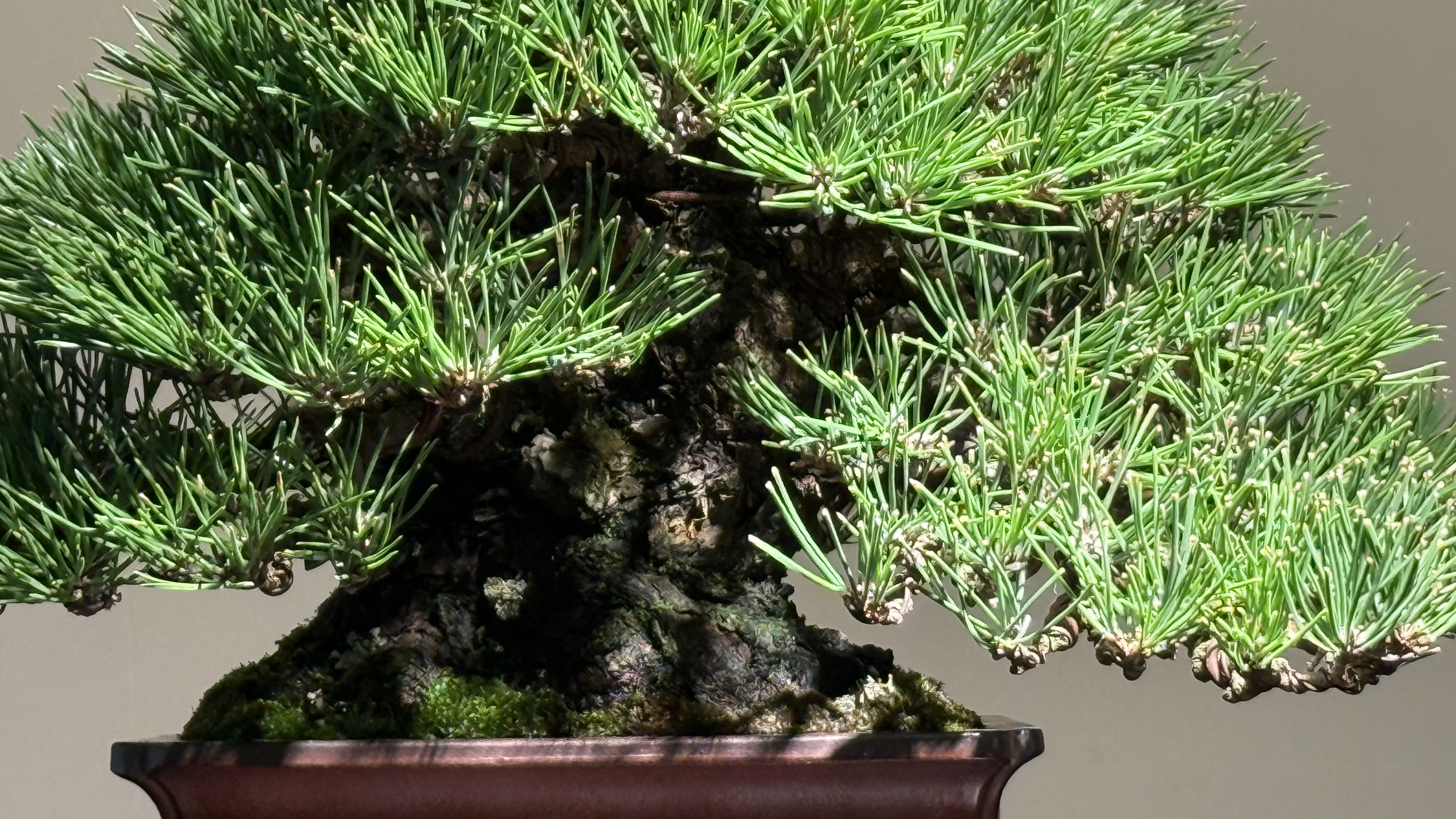
A Japanese black pine, its foliage divided into flat, layered pads and its trunk carrying decades of bark texture. Nothing here happened by accident — every pad, every gap between them, was decided.
A potted plant is grown. A bonsai is composed. The same species, in the same size pot, can be either one — the difference isn't in the tree at all. It's in whether a person is deliberately designing a miniature landscape, on purpose, year after year, or simply letting a plant live in a container.
It isn't about the species, the pot, or the size
Put a juniper in a small ceramic pot and water it for a decade, and you will end up with a small, old juniper in a pot. You will not automatically end up with a bonsai. Bonsai Empire makes this point plainly: bonsai "are not genetically dwarfed plants" and any tree species can, in principle, become one. Nothing about the plant itself makes it bonsai. What makes it bonsai is what a person has decided to do with it, and kept doing, season after season.
This is why the question "is my potted tree a bonsai" doesn't really have a size- or species-based answer. A nursery-grown ficus on a windowsill and a 40-year-old black pine on a training bench can both be, technically, potted trees. Only one of them is being actively designed.
Four things that separate the two
A potted plant is grown; a bonsai is composed toward an image. A houseplant is kept alive and left largely to its own shape — you water it, you might pinch back a wayward stem, but you are not holding a picture in mind of what the whole plant should eventually look like. A bonsai grower is. Every cut, every wire, every year of shaping is aimed at an intended form — what we've written about elsewhere as bonsai's real project: composing a landscape inside a pot, not just keeping a small tree alive.
Whether a landscape is intended, not just a plant. What is bonsai, really comes down to this: the grower is trying to make a viewer see something larger than the object in front of them — a windswept hillside, a lone tree clinging to a cliff, a grove seen from a distance. A potted plant asks to be enjoyed for its own leaves and flowers. A bonsai asks the viewer to imagine a scene the pot is too small to literally contain.
Whether the roots and branches are being designed, not just left to grow. This is the most concrete, checkable difference. Bonsai growers deliberately cultivate nebari (根張り, "the surface roots that flare out at the base of the trunk"), a feature Bonsai Empire describes as central to a tree's visual balance — built up over years by pruning downward-growing roots at each repotting so the lateral roots thicken instead. Above the soil, the same intent applies to branches: regular pruning is used to "maintain and refine the shape of a tree," redirecting growth toward the inner and lower branches so the canopy fills in as a considered structure rather than the tree's own default outline, as Bonsai Empire's pruning guide explains. A potted plant's roots are pruned only when they threaten to burst the pot, and its branches are trimmed only when they get in the way. A bonsai's roots and branches are edited on purpose, toward a shape decided years in advance.
The boundary sits on the human side, not the tree's. Because none of this depends on the plant, the same tree can cross the line in either direction. A neglected bonsai, left unpruned and unrepotted for a few seasons, drifts back toward being an ordinary potted tree — its wild, undirected growth erasing the composed shape underneath. Conversely, an ordinary nursery plant, once someone starts pruning its roots at every repotting and shaping its branches toward an intended silhouette, is on its way to becoming a bonsai. The tree doesn't decide which one it is. The person tending it does.
Why this distinction matters more than it sounds
It matters because it answers a question people ask constantly online without quite phrasing it this way: "can I just call my potted ficus a bonsai?" The honest answer is that nothing is stopping you — but the label describes an ongoing practice, not a category of object. A tree becomes less of a bonsai the moment its owner stops making design decisions about it, and it becomes more of one the moment someone starts. This is also why age alone doesn't settle the question. An old, untouched potted tree is still just an old potted tree. What separates it from bonsai is years of intent, not years of survival.
It also explains why bonsai can never really be "finished" the way a sculpture is. A sculptor stops chiseling and the work is done. A bonsai grower never stops — the moment they do, the tree stops being composed and simply starts growing again, on its own terms, back toward a potted plant.
What this looks like in practice
At Azukari, the trees in an artist's care are never left to just grow. Roots are pruned at each repotting to build and maintain nebari. Branches are pruned and wired toward a shape the artist is holding in mind, revisited every season. What separates one of these trees from an ordinary potted plant isn't its pot, its age, or its species — it's that someone is still deciding, this year and every year after, what landscape it is meant to show.
References
- Bonsai Empire — "Definition and meaning of Bonsai" — on bonsai not being genetically dwarfed plants, any species being usable, and bonsai as an intentional blend of horticulture and art rather than ordinary potted-plant care.
- Bonsai Empire — "The visible or surface roots of Bonsai (Nebari)" — on nebari as a deliberately cultivated design feature, built over years through root pruning at repotting.
- Bonsai Empire — "Pruning Bonsai, cutting branches to shape the tree" — on maintenance pruning being used to maintain and refine an intended shape, redirecting growth rather than leaving it to the tree's own tendencies.
- Bonsai Empire — "Repotting Bonsai, how to repot your tree" — on root pruning during repotting as a recurring, deliberate act that keeps a tree's growth balanced and constrained to its intended form.
- Wikipedia — "Bonsai" — on bonsai as miniaturized, container-grown trees shaped through pruning, root reduction, and grafting toward the form of mature trees, kept for contemplation rather than as ordinary houseplants.