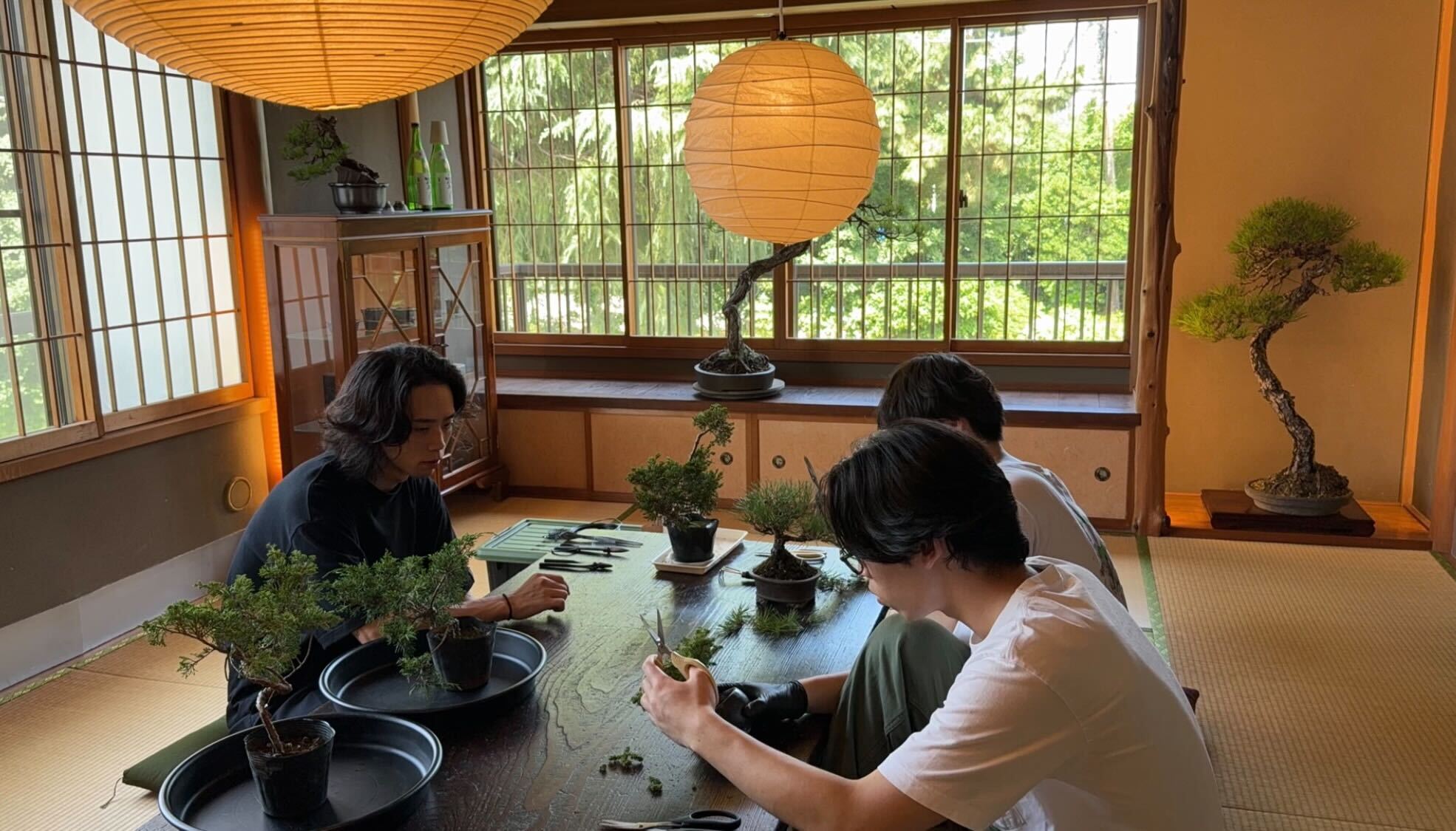
You need exactly one tool to begin: a good pair of bonsai pruning shears. Concave cutters, wire pliers, root hooks, and the rest of a full kit can wait until a tree in front of you actually asks for them — buying a complete set on day one usually means paying for tools that sit unused for a year or more.
Start with one pair of shears
A single pair of bonsai shears — sometimes sold as setto-basami (雪蹄鋏, "snow-hoof shears," named for the curved shape of the handle loop) — covers nearly everything a beginner's first tree needs: trimming new shoots, removing a crossing twig, cutting back growth after a spring flush. Ordinary garden pruners work in a pinch, but their blades are thicker and their tips blunter, so they crush stems rather than cutting them cleanly, and a crushed cut heals slower and scars worse than a clean one.
What matters most at this stage is not the brand but the habit the shears create: pausing, looking closely at the branch, and making one deliberate cut instead of several careless ones. That habit protects a tree more than any tool does, and it is also the first thing we cover in your first bonsai — choosing one hardy tree and spending the early months watching it rather than working on it. Shears are the one tool that early, watchful stage of ownership calls for.
The kit grows with the tree, not before it
A second tool usually earns its place only once a specific job appears. A concave cutter — a pruner with a hollow-ground jaw — is worth adding when a branch needs removing at the trunk, because it leaves a shallow, saucer-shaped wound that calluses flush with the bark, rather than the raised knot an ordinary cut leaves behind. Wire and a pair of wire pliers follow once a branch needs to be bent into a new direction instead of just shortened. A root hook or root cutters appear at repotting, still a few seasons off for most beginner trees. Angled tweezers, useful for weeding moss and picking spent needles, are often the cheapest tool in the kit and the last one anyone regrets buying.
One well-known bonsai club's tool guide lists six tools most practitioners eventually settle on — scissors, a concave pruner, wire cutters, wire pliers, root cutters, and tweezers — and is explicit that they are meant to be acquired in that order, as a specific job demands each one, not bought together in a single starter box. A cheap eight-piece set can feel like the responsible move, but most of what is in the box sits in a drawer for a year or two before a tree gives it a reason to be used.
Good tools are bought once
Bonsai tools sit at the higher end of garden tools for a reason that has less to do with marketing than with steel. A well-forged pair of shears, kept clean and lightly oiled, can outlast the person who bought it; a soft, mass-produced pair dulls within a season and is thrown away. Japan's own tool-making tradition grew out of exactly this expectation of permanence. The twin cities of Tsubame and Sanjo, in Niigata, trace their metalworking back to the early Edo period, when local artisans developed techniques for forging Japanese-style nails; those same forging skills were carried forward into the blacksmithing trade that still supplies much of the country's bonsai tools today, alongside the cutlery — including, by some accounts, the knives used at the Nobel Banquet — that carries the region's name abroad.
That same expectation — that a tool, once well made, should not need replacing — runs through the wider idea of the shokunin (職人, "a craftsperson whose skill and standards are inseparable from the work itself"), which we look at more closely in our piece on shokunin philosophy. A blacksmith forging bonsai shears and an artist training the tree those shears will prune are working from the same premise: that something built to be used for decades is worth the extra time it takes to make properly, and the extra price it takes to buy.
There is a real pleasure in the tools themselves
Not every reason to own a good pair of shears is practical. Bonsai tools have their own quiet appeal — the weight of forged steel in the hand, the particular click of a hinge worn in by years of use, a handle shaped by a maker who has done nothing else for decades. Some people come to bonsai through a tree they wanted to keep; a smaller number come to it through a tool they wanted to own, a well-made pair of shears or a pot that led them, eventually, to a tree worth using them on. Both paths arrive at the same table.
Either way, the tool itself becomes part of the practice. A pair of shears used carefully for twenty years carries its own small record of the seasons it has worked through — not unlike the tree it has spent that time shaping.
Closing
A beginner does not need a case of tools to start; a tree does not ask for one either. What it asks for is one good pair of shears, used with attention, and the patience to add the next tool only when a specific branch or a specific season calls for it. The rest of the kit, like the tree itself, can be built up one season at a time.
Azukari is built on that same pace. A tree stays in Japan under an artist's ongoing care — shears, concave cutter, wire, and all the rest of a trained hand's kit already at work on it — while its owner follows the seasons through a dated record, without needing to own a single tool themselves.
References
- Bonsai Empire — "Bonsai tools and materials" — on starting with a quality concave cutter and standard shear, tool materials, and Japanese vs. Chinese tool quality.
- Bonsai Society of Portland — "Six Essential Tools for Bonsai" — on the six core tools (scissors, concave pruner, wire cutters, wire pliers, root cutters, tweezers) and building a kit gradually as specific jobs arise.
- Japan Travel (JNTO) — "Tsubame-Sanjo" — official tourism-board page on Tsubame-Sanjo's metalworking history from the early Edo period and its cutlery, including reported use at the Nobel Banquet.
- SUWADA — Official site — Niigata blacksmith workshop founded in 1926, on tools built to bring "enjoyment and satisfaction throughout their user's lifetime."