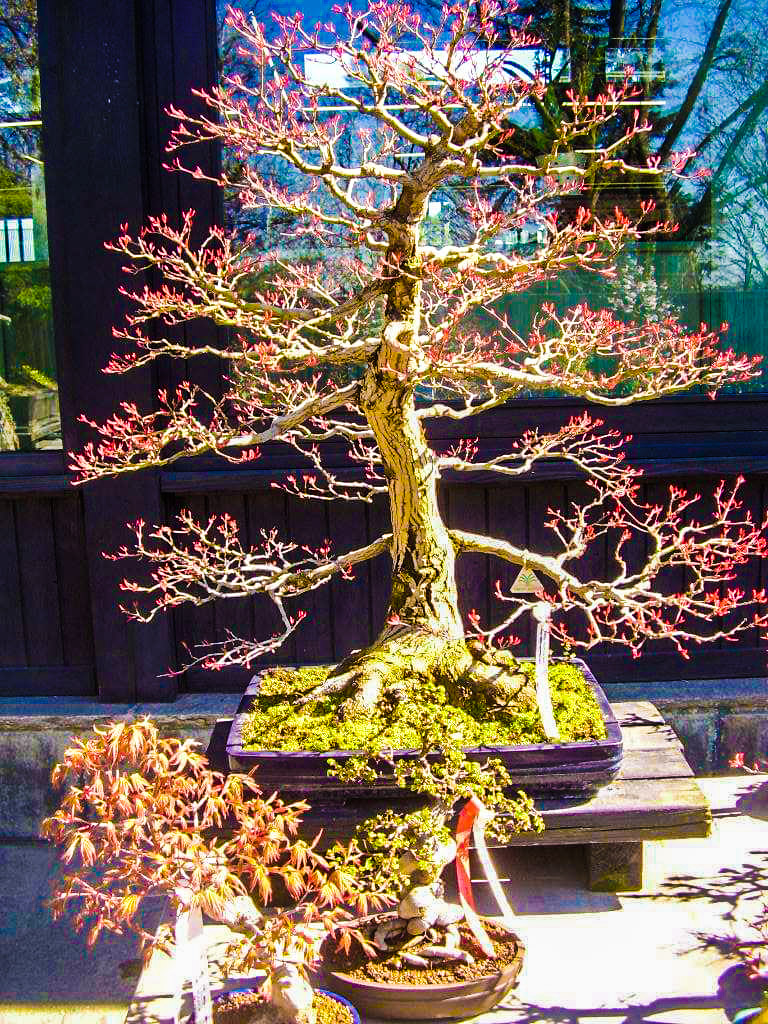
Photo by Ivan Stesso, CC BY-SA 4.0, via Wikimedia Commons — Source

Bonsai reached Europe long after it reached America, yet in some respects the European scene has grown deeper roots. It is not simply an audience for Japanese work. Italy and Spain support two of the densest club networks outside Japan, Belgium hosts a show widely described as the continent's largest, and Mediterranean growers have quietly built an entire practice around a tree that never grew wild in Japan at all: the olive. Europe did not import bonsai so much as it absorbed the discipline and then applied it to its own trees, its own climate, and its own sense of occasion.
A community with real depth
The clearest evidence of Europe's bonsai depth is not a single famous collection but the sheer number of people quietly meeting, week after week, in ordinary clubrooms. According to club listings maintained by Bonsai Empire, Italy alone counts roughly 86 active bonsai clubs and Spain around 68 — more than almost anywhere else on the continent, and enough to place the two countries at the center of European bonsai activity rather than its edge.
That density did not appear by accident. The European Bonsai Association (EBA), which traces its origins to informal contacts among enthusiasts in Heidelberg in 1980, now coordinates member federations across nineteen countries, including Italy and Spain. Its stated purpose is unglamorous but foundational: to promote the study of bonsai and to help national societies run their own exhibitions and conventions. Much of what looks, from outside, like a single "European bonsai world" is in fact this quiet federation of local clubs, each holding its own meetings and shows, loosely bound together under the EBA umbrella.
An exhibition circuit of its own
Europe has also built exhibitions substantial enough to draw exhibitors from well beyond its borders. The World Bonsai Friendship Federation lists The Trophy, held each year in Belgium and organized by the Bonsai Association Belgium, as "the European largest Bonsai Exhibition." Founded in 2000 in the town of Heusden-Zolder and now staged in nearby Genk, it has grown over a quarter century from a single cultural-center hall into a multi-day event pairing competition displays with demonstrations by leading artists.
Italy answers with its own circuit centered on the Crespi Bonsai Museum in Parabiago, near Milan. Opened in 1991 by the collector Luigi Crespi, it was the world's first permanent museum built around a living bonsai collection, and today it holds roughly two hundred specimens, some more than a century old — commonly cited as the largest bonsai collection outside Japan. Since 1995 the museum has also hosted the Crespi Cup, an annual international meeting of bonsai and suiseki (水石, "viewing stones") that draws collectors and judges from across Europe and Asia. Between Belgium's Trophy and Italy's Crespi Cup, a European exhibitor can build a serious competition season without ever leaving the continent.
Olive: a tree of its own soil
Ask a European grower which species feels most like "their own," and olive comes up more than any Japanese pine. Olea europaea has been cultivated across the Mediterranean since antiquity, and the small-leaved wild form in particular — sometimes called ullastre in Catalan-speaking regions — carries the compact leaves, short internodes, and gnarled, weathered bark that bonsai growers look for in any species. Unlike a juniper or maple imported for the purpose, an olive collected from Mediterranean scrubland is already, in a sense, a tree of the region telling its own regional story.
The rise of olive bonsai says something broader about how the art has taken hold outside Japan: growers did not simply wait for suitable material to arrive from abroad. They looked at what already grew, gnarled and ancient, in their own hills, and asked whether the principles of bonsai could be applied to it. The answer, repeated with junipers in California, ficus across Southeast Asia, and olive across the Mediterranean, is consistently yes.
A style shaped by climate
Climate has shaped European bonsai as much as species choice has. Mediterranean summers run hotter and drier than most of Japan, and winters in much of central and northern Europe run colder, which means European growers have had to work out watering, winter protection, and repotting schedules largely on their own rather than translating a Japanese calendar directly. Growers in southern Spain and Italy, working with olive and other Mediterranean stock collected from harsh, sun-baked hillsides, have also tended toward material with pronounced natural deadwood and weathered trunks — a look that owes as much to the terrain the trees came from as to any deliberate stylistic school. None of this makes European bonsai a departure from Japanese practice so much as a regional dialect of it: the same discipline of restraint and yearly care, worked out against different weather.
Closing
None of this happened because Europe set out to copy Japan. It happened because a discipline built around patience, restraint, and yearly attention translates well into almost any climate and almost any tree, given growers willing to put in the years. Italy and Spain built their club networks one meeting at a time; Belgium and Italy built their exhibitions one edition at a time; and the olive became a European bonsai tree simply because someone finally looked at it the way a Japanese grower looks at a pine.
For a Japanese-grown tree, geography still draws a hard line — plant quarantine keeps most bonsai from crossing borders at all, which is part of why Azukari exists: the tree stays in Japan under an artist's care while its owner, wherever they are, follows its seasons through a photographic record. Europe's own bonsai culture and Japan's azukari (預かり, "the practice of entrusting a tree to another's care") idea are not competitors. They are two answers to the same question of how a person far from where a tree can be reached still gets to have one.
To see where else in the world bonsai has taken root, our guide to bonsai museums and collections around the world covers Europe alongside North America and Japan. And for more on growers working with trees native to their own regions rather than imported species, see our companion piece on bonsai from native trees.
References
- World Bonsai Friendship Federation — The Trophy 2026 — official listing describing The Trophy as "the European largest Bonsai Exhibition," organized by the Bonsai Association Belgium.
- Bonsai Association Belgium — The Trophy — organizer's page for the 2026 edition, held in Genk, Belgium.
- Crespi Bonsai Museum — Museum page — official page confirming the museum's 1991 opening by Luigi Crespi as the world's first permanent bonsai museum, with roughly 200 specimens.
- Crespi Cup — Information — official event page describing the Crespi Cup's origin in 1995 and its status as a major European bonsai and suiseki meeting.
- Bonsai Empire — Bonsai clubs in Europe — club directory showing club counts by country, including Italy and Spain.
- European Bonsai Association — About us — history of the EBA since 1980 and its nineteen member countries.