
Culture
Bonsai in the Age of Social Media
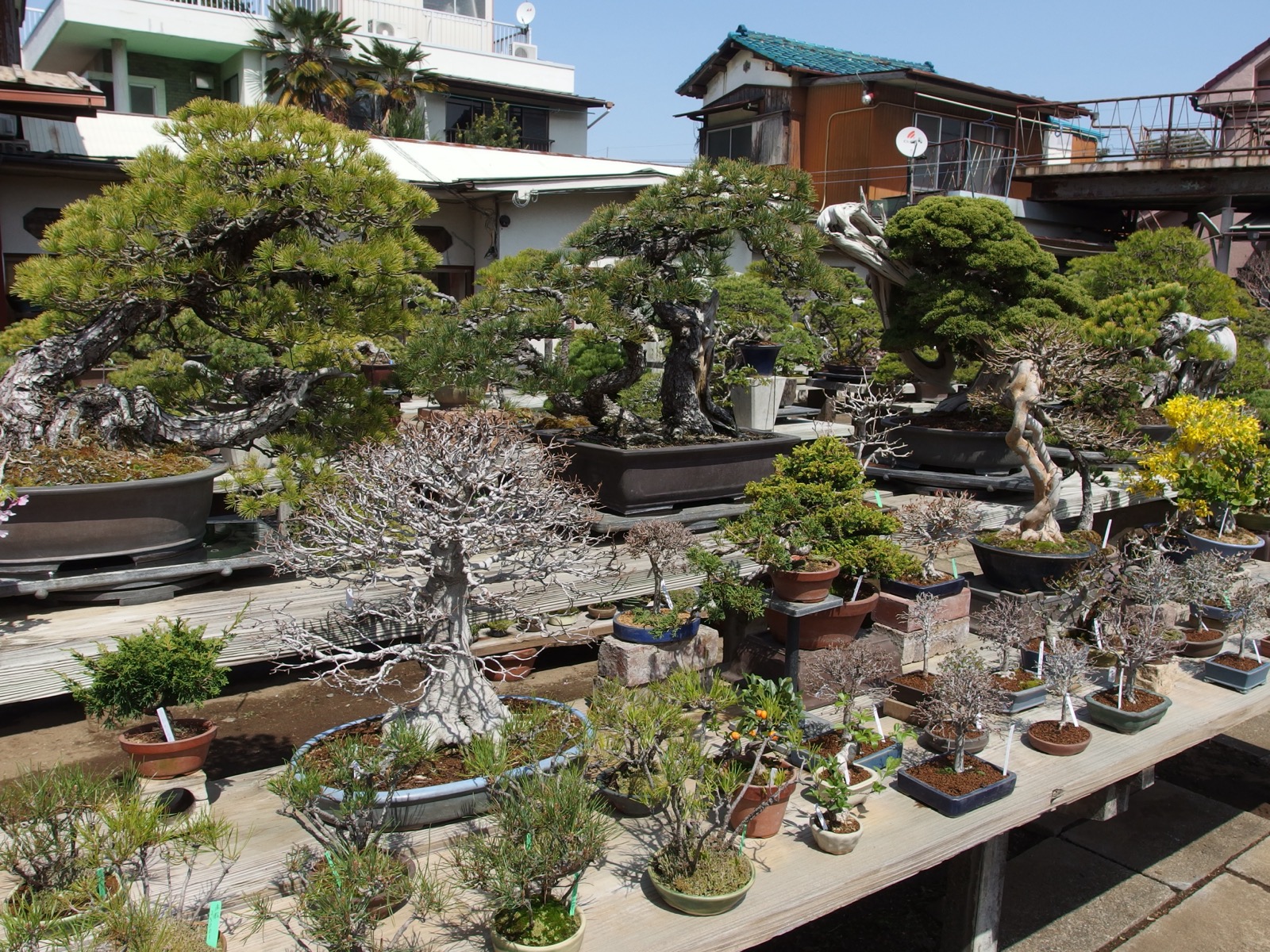
A working nursery bench in Japan — the kind of view that once belonged only to visitors. Photo: Azukari
A bench like this used to be seen by whoever happened to walk through the gate: an apprentice, a regular customer, a visiting collector. Today the same bench, or one very like it, can be watched from a phone on another continent, on an ordinary Tuesday, by someone who has never set foot in Japan.
Social media did not change what a bonsai is. It changed who gets to watch one being made.
The nursery bench, now visible every day
For most of bonsai's history, a nursery's daily work — watering, pinching, the slow adjustment of a wire — was private by default. It happened in one place, in front of a small number of people, and it disappeared into the next season without much record beyond the tree itself.
That privacy started eroding before "social media" was even a category. Bonsai Empire, now one of the largest bonsai communities online, began in December 2000 as a personal website built by a fifteen-year-old, Oscar, simply because he wanted to write about a hobby he loved. It has since grown into what its own team calls the largest bonsai platform in the world, publishing in fifteen languages and reaching millions of visitors a year. Long before short-form video, in other words, there was already a global audience quietly looking for the bench — it just had nowhere yet to find it in daily, moving images.
Technique crossing borders one video at a time
Bonsai technique has traditionally traveled through the body, not through text: a master's hands set a wire, a student's hands copy the tension, and the correction happens in the room, in real time. We wrote about this transmission in "Hands as a Common Language." Video does not replace that exchange, but it does something it could never do before — it lets a single decision, made once by one pair of hands, be watched by thousands of pairs of hands the artist will never meet.
Peter Chan, who has run Herons Bonsai in the UK since 1986 and holds a record twenty-one Chelsea Flower Show gold medals, only began posting video tutorials in 2017, more as an experiment than a plan. His channel has since grown past half a million subscribers and eighty million views, reportedly the largest YouTube following in bonsai worldwide, built almost entirely on ordinary tutorials: how to wire a branch, how to read a trunk line. In the United States, Ryan Neil's Bonsai Mirai runs a structured streaming academy with over six hundred videos and eight hundred hours of instruction across 114 species, taught by seventeen professionals rather than one — technique organized as an ongoing curriculum instead of scattered clips. The two models are different in almost every way except one: both move a decision made in one nursery into a home workshop somewhere else, still attached to the reasoning behind it.
A younger generation finds an old practice
Bonsai has long carried an association with patience earned over decades, and with practitioners who came to it later in life, often after retirement. That association is not gone, but the entry point has shifted underneath it. It is worth remembering that Bonsai Empire itself began as a teenager's project, not a retiree's — an early sign that the audience for bonsai was never as narrow as the stereotype suggested, only harder to reach.
What has changed is how a beginner arrives. Fewer people now start with a purchase from a specialist grower and a single teacher; more start by watching, searching, and asking questions in a forum or comment section before they own a tree at all. The learning still has to happen the old way, in a garden, over seasons — no feed can shorten how long a trunk takes to thicken. But the decision to begin now often starts somewhere much smaller: a video that happened to autoplay, a photograph that stopped a scroll.
Presentation becomes part of the work
In Japan, a formal exhibition such as the Kokufu-ten has traditionally been arranged to be seen once, in person, under light and staging chosen by the organizers — not to be documented and carried away. That expectation has visibly loosened. According to bonsai publisher William Valavanis's own account of the 2025 exhibition, the long-standing restriction on photography at Kokufu-ten was lifted only a couple of years earlier, likely because so many visitors were already carrying cameras in their pockets that the rule had become difficult to enforce. The exhibition did not change; the assumption about what visitors would do with what they saw did.
That shift puts a new weight on a decision bonsai artists have always made quietly: the tree's shomen (正面, "front"), the single face it is composed to be seen from, as we describe in "Finding a Bonsai's Front." A photograph taken for a feed is not a neutral record of that choice — it repeats it, extending one artist's decision about how a tree should be seen to an audience who will never stand in the actual room. Growers increasingly consider how a tree will read on a screen at the same time they consider how it will read on a stand, a concern that used to belong only to exhibition committees.
What has not changed
None of this alters the plain facts of the tree. A bonsai still needs a Japanese climate suited to its species, a season it cannot be talked out of, and a pair of hands that check on it in person, not through a screen. What has changed is the distance between that work and the people who care about seeing it happen.
Azukari sits inside that same shift, at a much smaller scale than a YouTube channel or a national exhibition. A tree stays in Japan, cared for by an artist, and its owner follows its seasons through records rather than a visit. It is not a broadcast to a wide audience — closer to a private version of the same idea: that watching a tree change, even from far away, can be part of what it means to care about one.
References
- Bonsai Empire — About Us — Bonsai Empire's own account of its founding in December 2000 by then-15-year-old Oscar, and its growth into a platform published in fifteen languages reaching millions of visitors a year.
- Herons Bonsai — About Us — nursery history since 1986, Peter Chan's twenty-one Chelsea Flower Show gold medals, and the YouTube channel launched in 2017 that has grown past 500,000 subscribers and 80 million views.
- Bonsai Mirai Live — Academy — official description of the streaming academy's library: over 600 videos, 800+ hours of instruction, 114 tree species, and seventeen contributing bonsai professionals.
- Valavanis Bonsai Blog — 2025 99th Kokufu Bonsai Exhibition, Part 1 — first-hand account noting that the exhibition's photography restriction was lifted a couple of years earlier, likely due to the spread of camera-equipped mobile phones.