Photo by Sage Ross, CC BY-SA 3.0, via Wikimedia Commons — Source

At a bonsai exhibition, the eye is trained to go straight to the tallest pot on the table. Look beside it, though, and there is often a second, much smaller container — a few blades of grass, a cushion of moss, a single miniature flower — set close enough to matter and low enough never to compete.
A shitakusa (下草, literally "undergrass," the low plant that grows beneath a larger one) is a small potted plant displayed beside a bonsai for one purpose only: to make the tree easier to see.
Not the Star of the Display
Japanese has two words for a small potted planting shown outside a garden bed. When such a planting is presented on its own, as the sole subject of attention, it is called kusamono (草もの, "a grass thing"). When the same kind of planting is placed beside a bonsai — deliberately smaller, deliberately quieter — it takes the name shitakusa, and its job changes with the name: to support, not to compete.
Traditional bonsai display sometimes follows a three-part arrangement inside a tokonoma (床の間, the alcove of a Japanese reception room reserved for art): the tree itself, a hanging scroll behind it, and a shitakusa to one side. Some accounts describe the three elements as standing for man, heaven, and earth respectively — the scroll suggesting a wider world above the tree, the shitakusa a patch of ground beneath it, and the bonsai standing, literally, in between. Whatever weight one gives that reading, the practical arrangement is not in question: three pieces together, and one of them always the smallest and quietest.
That quietness is a design requirement, not an accident of scale. A shitakusa displayed as though it were a second bonsai — tall, showy, pulling the eye its own way — fails at the one job it has. A well-chosen shitakusa is a plant a viewer notices only after the tree has already been taken in: present, but never first.
Carrying a Season Into the Room
A bonsai, once trained, tends to hold roughly the same form for months at a stretch. What changes quickly, week to week, is often the small plant beside it — and that is a large part of why one is kept at all. A shitakusa is chosen to read the current season in a way the tree cannot: a stem of grass already turning color while the tree beside it is still green, a single early flower ahead of the tree's own bloom, a patch of moss carrying the damp of a rainy month.
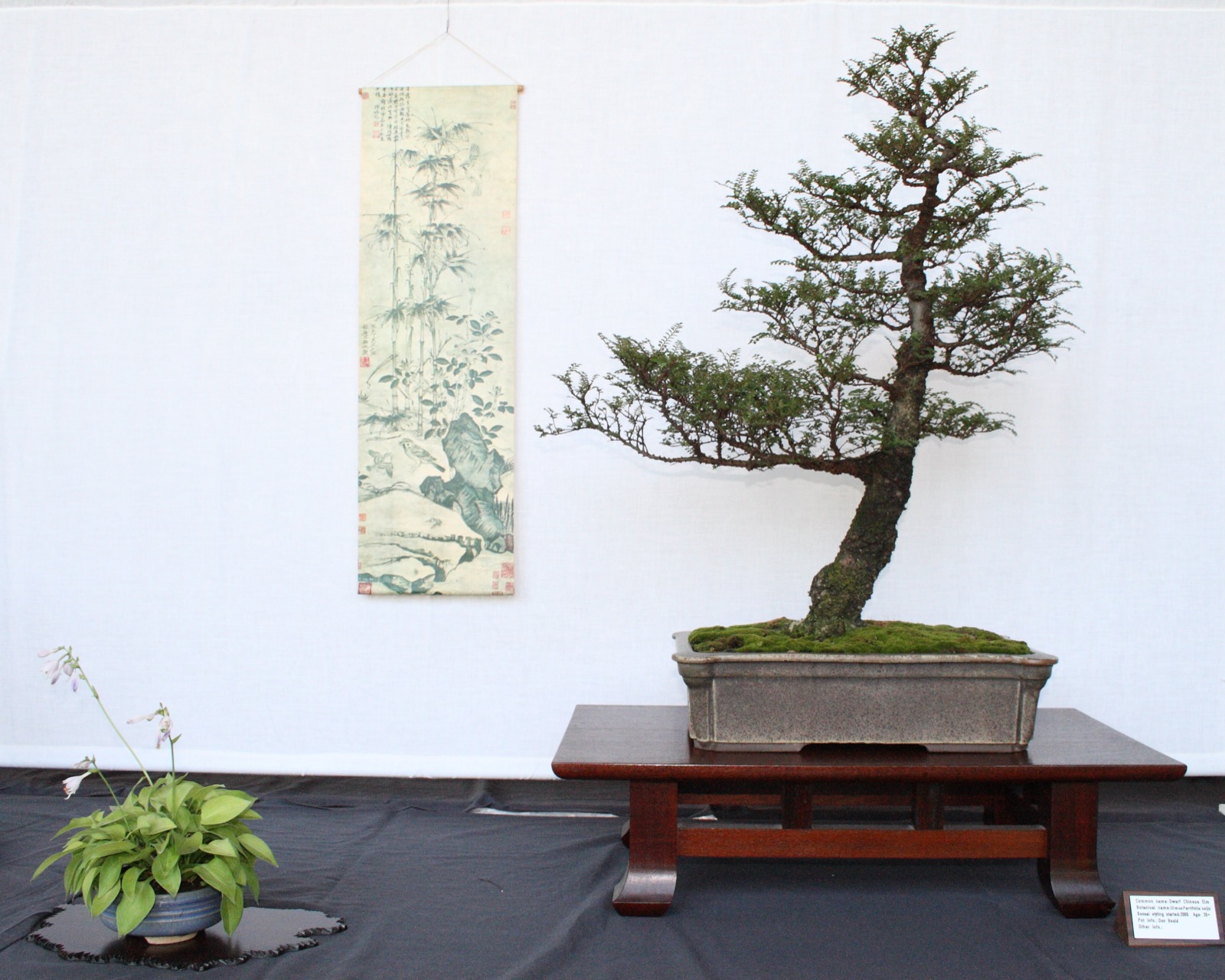
The pairing is usually built on contrast rather than repetition. A flowering or fruiting bonsai is commonly shown beside a shitakusa without flowers of its own, and a bare, non-flowering tree is often given a small flowering companion instead — so the display makes exactly one seasonal statement at a time, not two competing for the same glance. In the photograph above, a Seiju elm bonsai is shown with a miniature hosta as its shitakusa and a hanging scroll behind both: the elm supplies structure and age, the hosta a soft note of green near the ground, the scroll a suggestion of season in ink rather than leaf.
The Discipline of Leaving Room
Choosing a shitakusa is a smaller decision than shaping a bonsai, but not an easier one. One plant, in one pot, set at a careful distance from the tree — not two, not three, however tempting a fuller table might look. The empty space between the two containers is doing real work: it keeps the eye moving from the shitakusa back to the tree, rather than letting it settle on the small pot as an event of its own. We wrote about this same discipline of restraint, in a different setting, in Tokonoma: An Eloquent Emptiness — the alcove itself is judged as much by what it leaves out as by what it holds.
The plants chosen for shitakusa are, in their own way, aged before they are ever shown. Growers favor small-leafed, compact varieties, and they deliberately avoid repotting a shitakusa for years at a stretch, so that a plant only centimeters tall can still carry the settled, slightly worn look of something that has sat in its pot a long time. It is kept in half-shade, fed sparingly, and left alone far more than it is worked — patience applied to a plant that will never be allowed to grow past the size of its saucer.
Subtraction, One Size Further
Everything asked of a shitakusa — fewer flowers rather than more, one plant rather than several, years of restraint rather than a season of shaping — is the same standard we described, in The Art of Subtraction, as the logic behind bonsai pruning itself: a form arrived at by removing, not adding, until only what is necessary is left. A shitakusa simply shows that the standard does not stop at the rim of the tree's own pot. The same judgment that shapes a four-hundred-year-old pine scales down to a saucer of moss beside it, at whatever size a Japanese garden or alcove is asked to hold.
Closing
A shitakusa will rarely be the reason anyone remembers a bonsai display. That is the sign of it doing its job correctly. But the plant asks for the same unhurried attention as the tree beside it — chosen for the week's season, watered on its own schedule, left to age quietly in a pot too small to hold much more than a handful of soil.
Azukari's own trees are grown and shown in Japan under exactly this kind of attention, extended to whatever a display calls for, down to the smallest accent plant beside the largest pine. Looking closely at a shitakusa is, in miniature, a lesson in what the whole practice of bonsai asks of a person: notice the small thing first, and the large one becomes easier to see.
References
- Bonsai Empire — Kusamono, Accent and Companion Plants — distinction between kusamono and shitakusa, the tokonoma three-part display, and selection criteria (seasonal reflection, style compatibility, flowering contrast).
- Omotetoura — 奥深き下草の魅力 (The Deep Appeal of Shitakusa) — shitakusa as one of bonsai's major categories, its subordinate role to the main tree, its seasonal growth cycle, and cultivation practices (small leaves, avoiding repotting, half-shade care).
- Kusamono Gardens — Understanding Accent Plant — shitakusa as the accompanying form distinguished from standalone kusamono, and its role in establishing seasonal and spatial context.
- Kotobank — 下草 — dictionary definition confirming the word's literal meaning as low vegetation growing beneath larger trees.