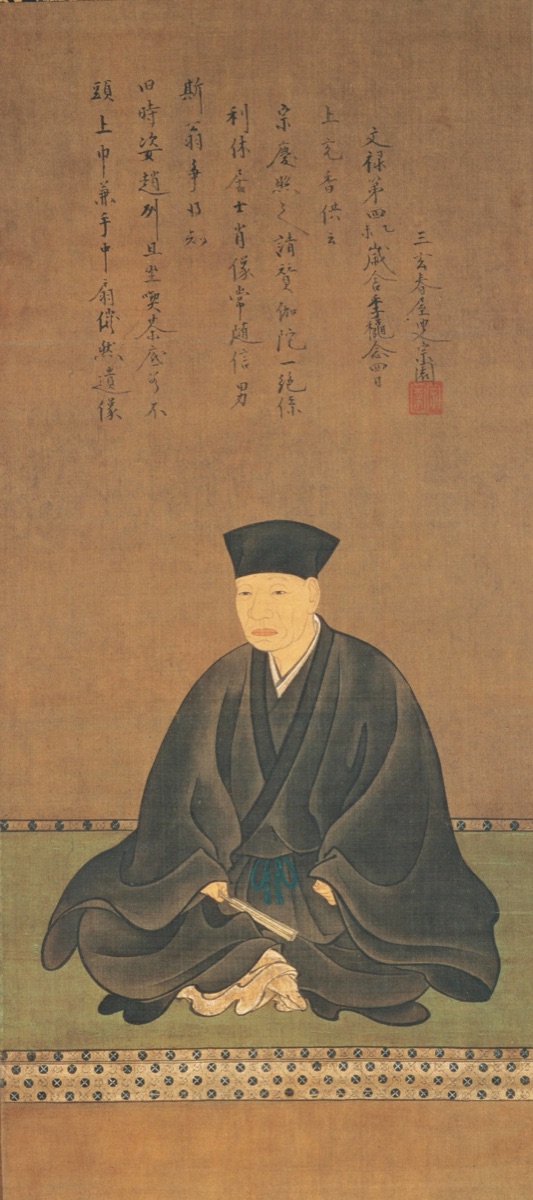
In the autumn of 1587, Toyotomi Hideyoshi opened a tea gathering at Kitano Shrine to anyone in Japan willing to show up with a kettle — samurai and commoner alike, no invitation required beyond that. The man who decided which utensils would be used, who sat where, and what counted as proper form that day was not a nobleman or a priest. He was a merchant's son from the port city of Sakai, and his name was Sen no Rikyu.
Rikyu judged every object by the same test: what could be taken away from it and still leave something worth looking at.
By the time of the Kitano gathering, Rikyu had spent decades building the eye that let him run it. Four years later, in 1591, he would be dead by his own hand, ordered there by the same man he had organized that gathering for. What connects both halves of his life — the authority and the death that followed it — is a single standard for beauty, built almost entirely by removing things.
A merchant's son was handed the country's taste
Rikyu was born in Sakai, then one of Japan's most prosperous trading ports, to a well-off ototoya (魚屋, a fish-wholesaling merchant family). According to the city of Sakai's own historical record, he began studying tea as a young man under Kitamuki Dochin and later under Takeno Joo, absorbing their differing approaches before shaping his own. Sakai's merchant class had long used chanoyu (茶の湯, the formal tea ceremony) as a venue for cultivated conversation and quiet status, and Rikyu grew up inside that world rather than arriving at it from outside.
His rise ran through service, not rank. He drew close to Oda Nobunaga through tea, and after Nobunaga's death in 1582 he became chief tea master to Toyotomi Hideyoshi, the general who was unifying Japan. The Kitano gathering was the clearest public proof of how far that service had carried him: a commoner organizing an event of national scale for the most powerful man alive, and being trusted to set its rules.
He built his authority on taking things away
Before Rikyu, elite tea culture prized karamono (唐物, prized objects imported from China) — celadon, lacquer, and bronze pieces valued partly for their rarity and foreign origin. Rikyu did not reject that world outright; he inverted its logic instead. Working with the potter Chojiro, he helped develop raku (楽茶碗, a rough, hand-shaped tea bowl fired at low temperature): made in Japan, by hand, with no pretense of technical perfection. Where Chinese ware was prized for its finish, a raku bowl was prized for its asymmetry, its thick dark glaze, the way it happened to sit in the palm.
The same instinct ran through the rest of his practice. He used a plain length of bamboo as a flower container in place of bronze. He built tea rooms scaled down to a bare minimum of floor space. He favored natural, unadorned materials over lacquer and gilding wherever the ceremony allowed it. Later generations gave this sensibility a name, wabi-cha (侘び茶, tea practiced in a spirit of humble simplicity), and credited Rikyu as its decisive figure. Earlier tea masters had moved partway there already; Rikyu pushed the aesthetic furthest and made it the standard the rest of Japan measured itself against. A gathering in his hands became an exercise in reduction: fewer utensils, plainer materials, a single flower instead of an arrangement, all of it aimed at sharpening a guest's attention rather than displaying the host's wealth.
The taste that made him essential also made him a threat
Rikyu's authority over what counted as beautiful eventually became difficult for Hideyoshi to sit beside. At a court where Hideyoshi otherwise held every form of power, Rikyu held this one — and by extension, some influence over who could be seen as cultivated. Accounts describe growing friction between the two men through the late 1580s: disagreements over aesthetic judgment, resentment among rival advisors, and Hideyoshi's own uneasy tolerance of a subordinate whose taste he depended on but could not fully command.
Shortly after the Odawara Campaign that completed Hideyoshi's unification of Japan, Hideyoshi ordered Rikyu to take his own life. He died by seppuku (切腹, ritual suicide by disembowelment, prescribed for those of samurai-adjacent standing) in Kyoto. What actually triggered the order is still debated: a disputed wooden statue of Rikyu placed above a temple gate, jealousy at court, a business dispute, a political calculation to remove a rival center of authority. Historians, and even Rikyu's own descendant schools, have never settled on a single account. What is agreed is the outcome: the man who had just finished teaching Japan how to see was put to death by the man he had taught it for.
Bonsai still measures against his subtraction
Rikyu's direct descendants founded the three tea lineages that still teach chanoyu today — Omotesenke, Urasenke, and Mushakojisenke — each built around utensils, tea rooms, and practices traced back to him. His influence reaches well past the tea room. The habit of removing rather than adding, of trusting one asymmetrical object over an arrangement of many polished ones, of treating a moment as unrepeatable and therefore worth full attention — these ideas moved outward from chanoyu into a wider Japanese sense of what refinement means.
A bonsai is judged by close to the same standard. An artist works on a tree by deciding, season after season, what to cut and what to leave alone — which branch goes, which shoot stays — the same instinct that sent Rikyu toward a bamboo vase instead of a bronze one. Bonsai's long-standing use of mitate (見立て, seeing a new purpose in an ordinary object) — a stone, a fallen branch, an old ceramic pot repurposed as a container — descends directly from the sensibility he brought to the tea room. And ichigo ichie (一期一会, "one time, one meeting"), the idea that a gathering is never repeated in quite the same way, finds its parallel in how a tree is shown: once, in a particular season, in a particular light, understood as a moment that will not return unchanged. Rikyu never tended a bonsai, so far as the record shows. But the question he trained Japan to ask of an object — what has been left out, not what has been put in — is still the first one asked of a tree.
References
- Sakai City — Sen no Rikyu — official municipal record of Rikyu's birth and death dates, family background, training under Kitamuki Dochin and Takeno Joo, service to Nobunaga and Hideyoshi, and his death following the Odawara Campaign.
- Sakai Plaza of Rikyu and Akiko — Sen no Rikyu Chanoyu Pavilion — museum record confirming Rikyu's birth in a Sakai merchant family, his training under Takeno Joo, and his service as chief tea master to Hideyoshi.
- Nippon.com — Sen no Rikyu and the aesthetics of tea — overview of Rikyu's minimalist tea-room design, his development of raku ware with the potter Chojiro, and the wabi-cha aesthetic attributed to him.
- Omotesenke Fushin'an Foundation — official record of the Omotesenke school's direct descent from Rikyu's tea room and teachings.
- Wikipedia — Sen no Rikyu — overview entry on Rikyu's life, his role in developing wabi-cha, and his death by order of Toyotomi Hideyoshi.